
#NephJCTenPosts discussion
9 pm EST
August 18th 2026
JAMA. 2026 Jul 30. doi: 10.1001/jama.2026.9268. Online ahead of print.
Dapagliflozin and Acute Kidney Injury Following Cardiac Surgery: A Randomized Clinical Trial
Maartina J P Oosterom-Eijmael, Abraham H Hulst, Nelson P Monteiro de Oliveira, Ed D Niesten, Nicobert E Wietsma, Bastiaan M Gerrits, Thierry V Scohy, Thijs C D Rettig, Ferdinand T F Snellen, Magiel F Voogd, Marc B Godfried, Rients N de Boer, Jeroen Wink, Lisa M M van der Werff, Christa M Cobbaert, L Renee Ruhaak, Susanne Eberl, Benedikt Preckel, Markus W Hollmann, Jimmy Schenk, Jeroen Hermanides, Daniel H van Raalte; MERCURI-2 Study Group
PMID: 42530910

Introduction
SGLT2 inhibitors (SGLT2i or Flozins) are awesome! So much so that we at NephJC call them “The Undefeated”. A miracle class of drugs that works in chronic kidney disease (CKD) with or without diabetes, heart failure with or without reduced ejection fraction, proteinuric nephropathies; however, even Superman had his limits.

Acute kidney injury (AKI) is a significant health concern, especially among hospitalized cardiac surgery patients because it contributes to increased length of stay, morbidity, mortality, and costs (Fuhrman DY, Curr Opin Anaesthesiol 2017). The incidence of cardiac surgery-associated AKI occurs in up to 50% of cases, and 2%–5% of these patients require renal replacement therapy during an AKI episode (Fuhrman DY, Curr Opin Anaesthesiol 2017; Brown JK et al, J Cardiothorac Vasc Anesth 2023). Thus far, the prevention and management of AKI remains largely supportive - focusing on fluid balance, optimizing hemodynamics, and nephrotoxin avoidance.
Flozins provide kidney-protective benefits theoretically by improving renal oxygenation, reducing oxidative stress, and decreasing tubular workload. In a recent meta-analysis, SGLT2i use was associated with a statistically significant decrease in both mortality (OR 0.73; CI 0.58-0.92) and acute kidney injury (OR 0.68; CI 0.61-0.76). However, like most meta-analyses, the outcomes and adverse effects data were muddied by considerable heterogeneity in data (Balbaa E et al, Endocrinol Diabetes Metab 2026). Hypothetically, SGLT2i should be beneficial in cardiac surgery patients, especially by lowering renal oxygen demands in the cardio-pulmonary bypass (CPB) ischemia-reperfusion window. However, most current guidance recommends holding SGLT2i medications 3-4 days prior to any surgery because of the risk of euglycemic ketoacidosis, dehydration, and excess fluid loss. This study examines whether Flozins, given in the peri-operative period in cardiac surgery, can reduce the incidence of AKI.
Methods
Study design
MERCURI-2 was a multicenter, double-blind, placebo-controlled randomized clinical trial conducted in the Netherlands. Randomization (performed via Castor Electronic Data Capture) used computer-generated blocks of 4, 6, and 8, stratified by sex, type 2 diabetes, and study site. Allocation was visible only to the trial pharmacists, who prepared study medication but were otherwise uninvolved.
Study population
Adults ≥18 years scheduled for any elective cardiac surgery (CABG or non-CABG)
Exclusion criteria included
prior SGLT2 inhibitor or insulin use
a history of diabetic ketoacidosis
baseline hypotension (defined by systolic blood pressure <100 mmHg)
eGFR <20 ml/min/1.73 m²
Pregnancy
Any contraindications based upon drug labeling
Intervention
Once randomized, patients received either placebo (a cellulose-containing excipient) or AstraZeneca-dapagliflozin (encapsulated in-house by the academic trial pharmacy for blinding purposes - AstraZeneca supplied the source tables but was not a trial funder; more on that distinction below).
The first dose was given the day before surgery, followed by daily doses until the second postoperative day (four doses total).
Outcomes
Primary Outcome
Incidence of AKI up to 7 days after cardiac surgery, defined by the 2012 KDIGO criteria:
An increase in serum creatinine level of 0.3 mg/dL (26.5 μmol/L) or greater within 48 hours, or
1.5-fold or greater increase in creatinine level within 7 days of surgery, or
Urine output less than 0.5 mL/kg/h for 6 to 12 hours after surgery.
They used the most recently obtained creatinine as the reference value, which mostly corresponded to the blood test taken the day before the surgery, though they don't actually report what percentage that applied to. Following the procedure, serum creatinine values were obtained daily during the first 7 days after the intervention. All patients had a urinary catheter in place for the entire 7-day period to measure urine output.
Secondary outcomes
Stage 3 AKI as per KDIGO 2012 criteria
Postoperative maximum change in eGFR within the first 7 days
De novo postoperative atrial fibrillation recorded on a 12-lead ECG; length of stay in the ICU and hospital
Incidence of major adverse kidney events (MAKE30): composite endpoint of death, new dialysis, or a persistent increase in serum creatinine concentration to 200% or more of the baseline, 30 days after the operation*
Incidence of major adverse cardiac events (MACE30): composite endpoint of cardiovascular death, nonfatal myocardial infarction, nonfatal ischemic cerebrovascular accident, and hospitalization for heart failure, 30 days after the operation*
World Health Organization Disability Assessment Schedule 2.0 (WHO-DAS 2.0) score within 30 days after the operation
Days at home in the first 30 days (DAH30) after the operation
EuroQol 5 dimensions 3 Levels (EQ-5D-3L) score measured at 30 days after surgery
Safety outcomes: genital mycotic infections, ketoacidosis, hypoglycemia
*NephJC writer’s note: The text of the article has the definitions for MACE30 and MAKE30 switched up. This text has been optimized for understanding purposes.
Funding
The study was supported by the Netherlands Organization for Health Research and Development (ZonMw), the European Society of Anaesthesiology and Intensive Care and BJA Charity, and the Netherlands Organization for Health Research and Development.
Dr. van Raalte (the last author) receives grants from AstraZeneca and is supported by a fellowship of the Dutch Diabetes Foundation and a Kolf fellowship from the Dutch Kidney Foundation.
Results
Out of 2551 considered, a total of 784 patients were randomized. Figure 1 lists 382 per arm as "included in primary analysis”- the full randomized cohort. But only 778 of 784 (99%) completed follow-up testing, and six patients never had surgery at all.
Figure 1. Flowchart of study population from Oosterom-Eijmael MJP et al, JAMA 2026.
Baseline characteristics were strikingly similar between groups; a median age of 68 years (IQR: 61–74) and a median BMI of 27 kg/m2. Male participants comprised over 75% of each arm, and white individuals accounted for more than 95% in both groups. Median eGFR was 80 mL/min/1.73 m² among both groups at baseline (Table 1). Surgical and clinical baseline characteristics as well as prior medication use were consistent across groups. Adherence to study protocol was high in both arms: 88% of the dapagliflozin group and 87% of the placebo group completed all four doses.
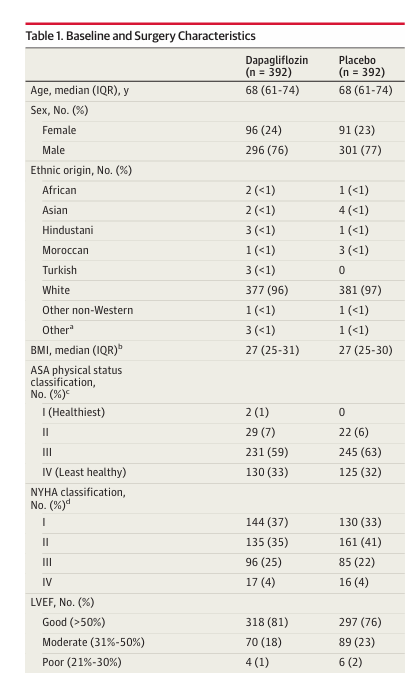
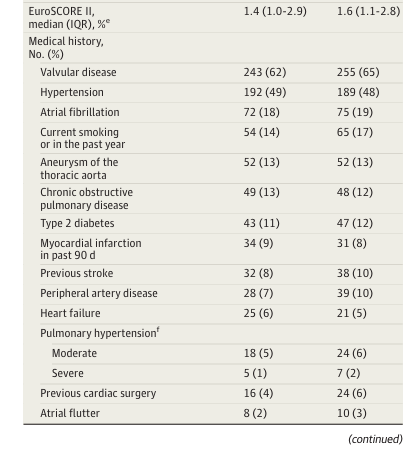
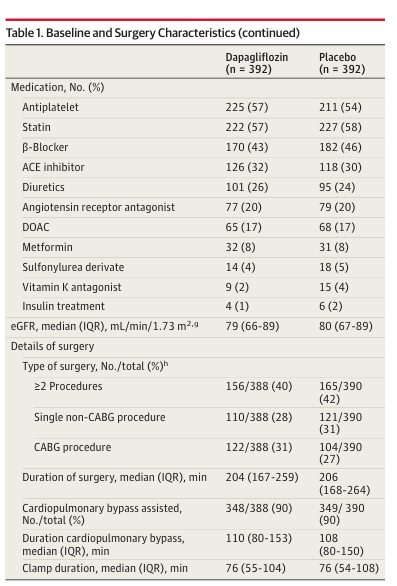
Table 1: Baseline and surgery characteristics from Oosterom-Eijmael MJP et al, JAMA 2026.
Primary Outcome
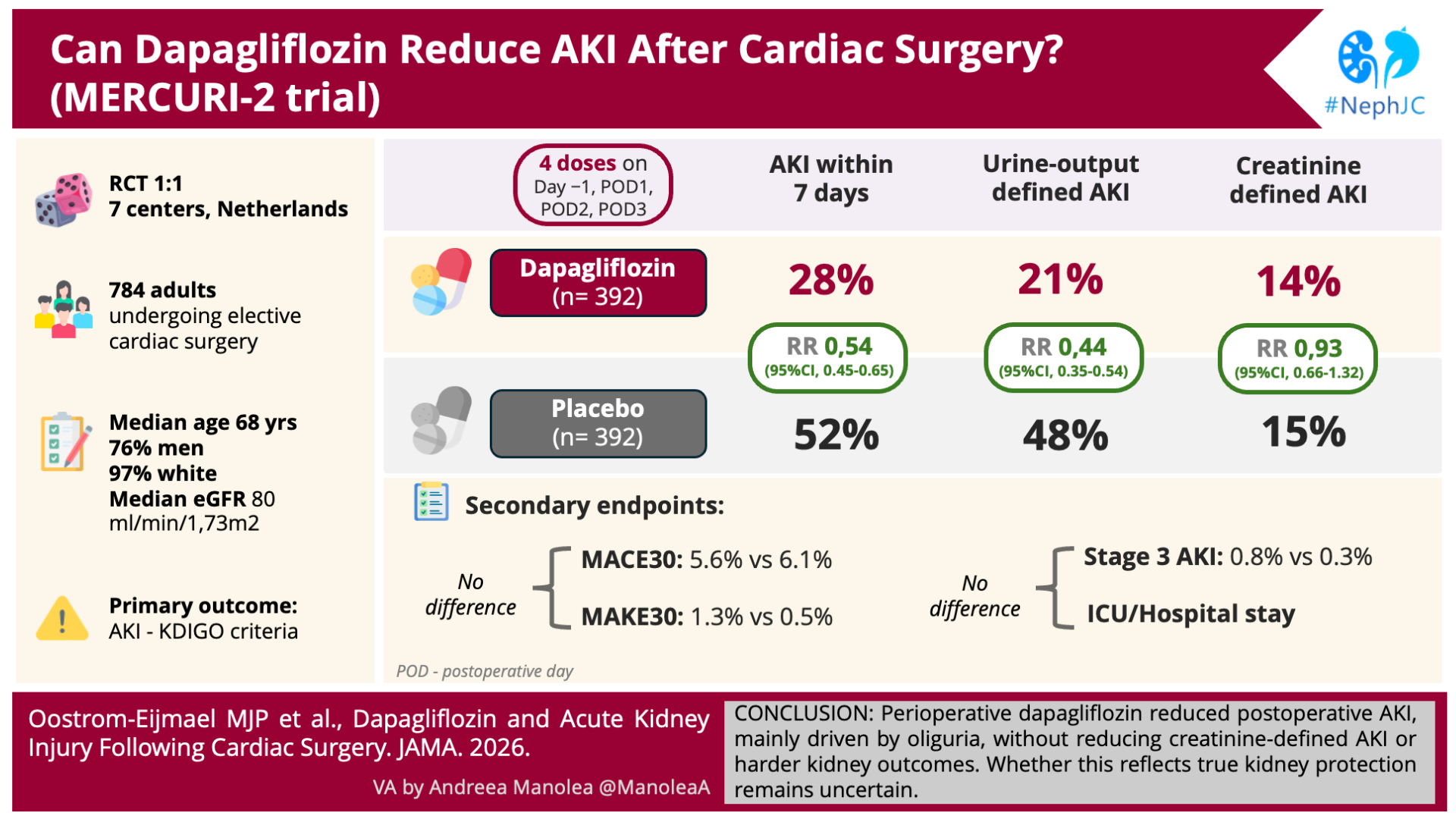
AKI occurred in 111 (28%) participants in the dapagliflozin group and in 205 (52%) participants in the placebo group (risk difference, −23.98% [−30.64% to −17.32%]; relative risk [RR], 0.54 [95% CI, 0.45-0.65]; P < 0.001).
Figure 2: Kaplan-Meier plot of time to AKI in the primary analysis from Oosterom-Eijmael MJP et al, JAMA 2026.
Most primary-outcome events happened in the first 24-48 hours after surgery. That’s quick - closer to what you’d expect from transient postoperative oliguria (a normal, reversible dip in urine output from anesthesia, fluid shifts, or vasopressors) than from real structural kidney injury (see at-risk numbers under the curve), see discussion below.
Secondary Outcomes
Three (0.8%) in the dapagliflozin group and one (0.3%) in the placebo group had stage 3 AKI, however, this was not statistically significant (RR 3; 95% CI 0.31-28.71). Postoperative maximum change in eGFR compared with baseline was −7.4mL/min/1.73 m² in the dapagliflozin group and −1.75 mL/min/1.73 m² in the placebo group, likely reflecting the hemodynamic dip often seen with SGLT2i initiation. There were no between-group differences in MACE30 (5.6% vs 6.1%), MAKE30 (1.3% vs 0.5%), duration of hospital stay, or days alive and at home within 30 days after surgery (DAH30).
Also unchanged was ECG-confirmed new-onset atrial fibrillation (32% vs 31%). Note that this is a separate variable from the “atrial fibrillation” adverse event in Table 3, which captures any AF, not just new-onset cases confirmed by ECG. Patient-reported quality of life (EQ-5D-3L) and functional status (WHO-DAS) were also unchanged.
Table 2: primary and secondary outcomes from Oosterom-Eijmael MJP et al, JAMA 2026.
Exploratory Outcomes
In exploratory analyses, using a per-protocol method, the incidence of AKI was 27% in the dapagliflozin group and 51% in the placebo group, yielding a similar RR as the ITT analysis.
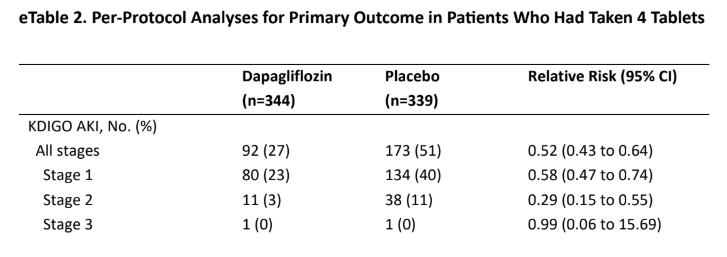
eTable 2: per-protocol analyses in those who took the four doses, from Oosterom-Eijmael MJP et al, JAMA 2026.
Post Hoc Outcomes
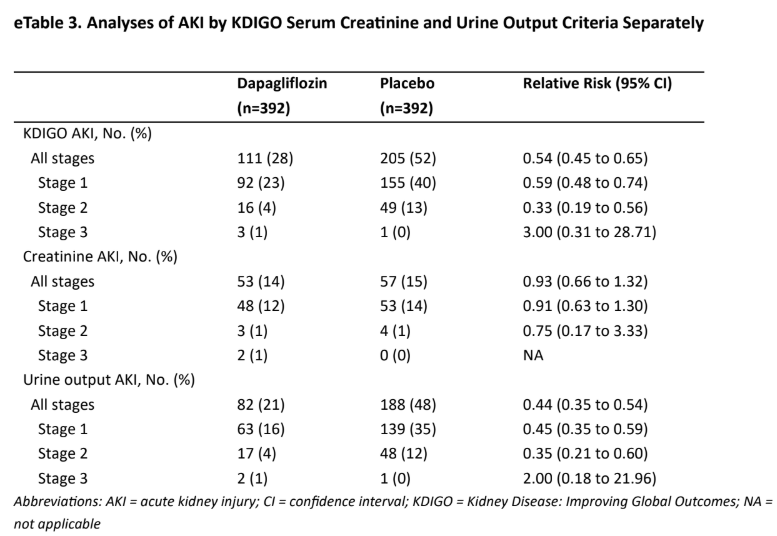
eTable 3: analyses of AKI by KDIGO Creatinine and Urine output criteria from Oosterom-Eijmael MJP et al, JAMA 2026.
When AKI was defined exclusively by creatinine criteria, AKI occurred in 14% of the dapagliflozin group and 15% of the placebo group (RR, 0.93 CI, 0.66-1.32). However, when defined exclusively by urine output criteria, AKI incidence was 21% in the dapagliflozin group and 48% in the placebo group (RR, 0.44 0.35-0.54), indicating that the entire benefit lies in the AKI by urine output definition.
Adverse Events
Recommended practice is to hold Flozins a few days before surgery to reduce the risk of ketoacidosis. However, only one episode of ketoacidosis was reported in the dapagliflozin group. Similarly, mycotic infections only occurred in one dapagliflozin treated patient. The most common post hoc adverse events were atrial fibrillation (45% vs 45%) and reoperation (11% vs 10%), which were nearly identical between groups.
Table 3. Postoperative adverse events, from Oosterom-Eijmael MJP et al, JAMA 2026.
Discussion
AKI after major surgeries, especially cardiac surgery, remains a significant issue contributing to high costs, prolonged hospital stays, and increased morbidity. Diuretics, CCBs, bicarbonate, and statins have all failed to create a significant difference in the incidence of AKI (Zanardo G et al, J Cardiothorac Vasc Anesth 1993; Tie HT et al, Crit Care 2014; Zhao BC, J Cardiothorac Vasc Anesth 2017; Bove T et al, PLoS One 2018; Takeichi T et al, J Extra Corpor Technol 2025). Here, we have flozins appearing to finally make a breakthrough where so many others have failed…or do we?
Mercury in Roman mythology was the messenger of news, but he was also considered a trickster god who used cunning and sleight of hand to confuse patrons. Upon closer examination, this trial seems more trick than treat. Unfortunately, the stunning headline of reduced AKI incidence does not hold up to closer inspection whatsoever.
The creatinine-based signal is null, with the CI crossing 1 across all stages. The entire treatment effect lives in the urine-output criteria. The authors say this outright in the discussion: “the high placebo incidence is likely due to the urine-output criteria.”
That's the whole ballgame, right there! Dapagliflozin is a glucosuric osmotic diuretic. An agent that increases urine output will mechanistically make patients less likely to trip a low-urine-output threshold, independent of anything else happening in the nephron. The authors anticipated this and tried to defuse it by citing steady-state, fixed-sodium-intake, euvolemic, mildly hyperglycemic outpatient PK/PD studies (Scholtes RA et al, Diabetes Care 2021; Heise T et al, Clin Ther 2016) showing Flozins aren't meaningful diuretics beyond the first dose.
But that literature isn’t appropriate here and highlights why indirectly comparing trial results is fraught with issues. Post-cardiac-surgery patients are not necessarily euvolemic, and usually hyperglycemic from surgical stress (catecholamines, cortisol), which means more filtered glucose, more glucosuria, more osmotic diuresis during the short 7 day window used to adjudicate the outcome.
This is a testable hypothesis, and the authors had the data to test it. Perioperative glucose measurements and hemodynamics were prespecified secondary/exploratory outcomes but are explicitly flagged as "not analyzed at the time of this report." (BOOM goes the kryptonite) That's a significant thing to hold back given it bears directly on whether this is renoprotection or an osmotic-diuresis artifact. The same trick could be pulled off with hydrochlorothiazide dosing.
The -7.4 ml/min/1.73 m² eGFR decline with dapagliflozin in MERCURI-2 in retrograde, in more ways than one - the filtration rate goes backward, and so does the “usual dip” explanation invoked to excuse it. CREDENCE’s (Perkovic V et al, NEJM 2019) eGFR dip averaged 3-4 ml/min/1.73 m² at 3 weeks (baseline 56); EMPA-REG’s (Zinman B et al, NEJM) was 2.7 ml/min/1.73 m² at 4 weeks (baseline 74)- Both drops were smaller and in stable outpatients over weeks. A “more normal” kidney startpoint doesn’t explain the size either: DECLARE-TIMI58 (Wiviott SD et al, NEJM 2018), the closest eGFR match (median 85), showed a smaller dip than EMPA-REG, not larger. The dip tracks baseline hyperfiltration, not baseline eGFR - a post hoc DINAMO analysis found a significant dip only in hyperfiltering patients (-11.7 ml/min/1.73 m²), not in normofiltering ones (Bjornstad P et al, CJASN 2025). MERCURI-e doesn’t report hyperfiltration status. The acute surgical/CPB context remains the likelier explanation.
In POST-CABGDM (Pitta FG et al, Diabetes Care 2025), using a creatinine-only AKI definition, the administration of empagliflozin in diabetic on-pump CABG patients - a population MERCURI-e excluded - showed a significant reduction (22.5% vs 29.1%, RR 0.57; CI 0.34-0.96), the inverse of MERCURI-2’s null creatinine finding. But it was a small, single-center, and open-label trial; an unblinded design is a real vulnerability for an outcome as sensitive to perioperative fluid and vasopressor management as AKI. Furthermore, the drug was stopped 72 hours before surgery, so its link to the acute injury window is indirect at best.
A 2026 meta-analysis of 13 chronic dosing RCTs (84,581 patients; Chiang YC et al, Kidney Med 2026) found a 20% AKI reduction using largely creatinine/adjudicated definitions that exclude transient fluctuations - a different philosophy than MERCURI’s urine-output inclusive composite. Together, they suggest a real, more modest creatinine-based signal may exist that MERCURI-2 itself didn’t reproduce.
MERCURI’s associated editorial (Winkelmayer & Chertow, JAMA 2026) counters: in a 105-patient Amsterdam subset, patients on dapagliflozin got less IV fluid and norepinephrine, suggesting true kidney function rather than forced diuresis (not verifiable from the JAMA manuscript). It also cites lower KIM-1/TIMP-2xIGFBP7 from the earlier open-label pilot, a smaller, unblinded, non-MERCURI-2 cohort.
Limitations
OK take a deep breath…
The authors themselves describe up to 11 limitations in their study, some of them potentially questioning the entirety of their results. Let us start by stating that evaluating results just 7 days after starting a drug can potentially prove your intervention to be null across most meaningful endpoints. Using criteria with questionable clinical weight, such as transient oliguria without serum creatinine changes, could be disregarded as a mere hemodynamic change rather than a true kidney injury.
There was no mention of any other AKI prevention protocols implemented. Without data on pre-op discontinued medications (specifically RASi), fluid therapy, hemodynamic shifts, or even how old baseline creatinine values actually were, it's really hard to take those AKI numbers at face value. On top of that, there were no urine albumin measurements or differential diagnoses for the AKI cases they found. The use of kidney damage biomarkers and/or MAKE30 in the primary outcome may have given us a better idea about the role of Flozins in preventing AKI. Similarly, the study does not state the need for post-op vasoactive drugs, fluid therapy, or initiation of additional drugs besides dapagliflozin.
The amount of secondary outcomes is difficult to square, and at the same time, there were endpoints that were registered, but ultimately not analyzed, including important end points like health care and productivity costs, hemodynamic vital signs and cardiac function.Why include them as endpoints if you’re not going to use the data in your published report? Given the results for the kidney outcomes, we could perhaps assume they just didn’t include those other endpoints because those results were also not statistically significant.
This study population was extremely homogeneous, with 97% white individuals, >75% males. While this may be explained away by geographical location of the study and higher prevalence / earlier age onset of cardiac disease in men vs women (though some studies suggest men are more aggressively treated for their cardiac disease than women), this heterogeneity does limit generalization despite the murky results. Furthermore, the medication provided was an SGLT2i drug from AstraZeneca, which is mentioned as one of the grant supporters for one of the main authors. Sponsorship bias alert.
The authors go on to frame limitations as potential benefits? “Specific treatment protocols for AKI prevention were not implemented. The absence of study-specific protocols enhances the generalizability of the findings to routine clinical practice.” That second sentence should really give us food for thought. In fact, a better designed trial could have had multiple arms: one could imagine a trial with AKI prevention bundle +/- dapagliflozin versus placebo could perhaps produce more robust findings and elucidate if flozins are providing anything more than diuresis.
To add fuel to the fire, the paper is littered with multiple spelling and grammatical errors.
Conclusion
In adults undergoing elective cardiac surgery, perioperative dapagliflozin did lower the incidence of postoperative AKI strictly according to the KDIGO AKI 2012 criteria at Day 7. However, the benefits were driven by urine output criteria, whereas serum creatinine remained completely unaltered. Although the study shows a large effect size, the inappropriate choice of the primary outcome measure marred the interpretation of this ambitious study.
All in all, we have seen our superhero SGLT2i sullied by this poorly designed study. Fear not citizens of Nephropolis, SuperFlozinators will live to fight another day (in a much more logical and worthwhile study like The Renal Lifecycle Trial due to be completed in 2027). Until then, don’t hesitate…flozinate!
Summary by
Raquel Barba Teba Nephrology specialist, Spain
Reviewed by
Akshaya Jayachandran, Brian Rifkin, Cristina Popa,
Jade Teakell, Pallavi Prasad
Header Image created by AI, based on prompts by