#NephJC Ten POsts Chat
Tuesday, August 4th 2026, 9 pm Eastern
N Engl J Med. 2026 Jun 12. doi: 10.1056/NEJMoa2600526. Online ahead of print.
Sodium Bicarbonate for Critically Ill Adults with Metabolic Acidosis and Shock
SODa-BIC Investigators and the Australian and New Zealand Intensive Care Society Clinical Trials Group; Ary Serpa Neto, Mairead McNamara, Kyle White, D Jamie Cooper, Tomoko Fujii, Alisa M Higgins, Carol L Hodgson, Leanlove Navarra, Alistair Nichol, Sandra Peake, Alvaro Réa-Neto, Paul Secombe, Fiona Osborne, Hugh Burrill, Emily See, Meredith Young, Fernando G Zampieri, Mark Plummer, Connor Christie, Leo Nunnink, Josephine Mackay, Shay McGuinness, Joradee Marmol, Ravindranath Tiruvoipati, Michael Bailey, Paul J Young, Rinaldo Bellomo, Andrew Udy
PMID: 42283370


Introduction
Metabolic acidosis, a common manifestation in critically ill patients with shock, is independently associated with increased mortality, poor myocardial contractility, and impaired catecholamine response. Although identifying and correcting the underlying cause is the primary goal, there is still debate about whether correcting metabolic acidosis leads to improved clinical outcomes.
Intravenous sodium bicarbonate has been widely used for the correction of acidosis. Early trials (Cooper et al, Ann Int Med 1990; Mathieu et al, Crit Care Med 1991) corrected the acidosis without moving cardiac output to survival. Consequently, international guidelines recommend against sodium bicarbonate for hypoperfusion-induced lactic acidemia with pH ≥ 7.15, while conceding the evidence is weak (Surviving Sepsis Guidelines, Rhodes et al, Crit Care Med, 2016).
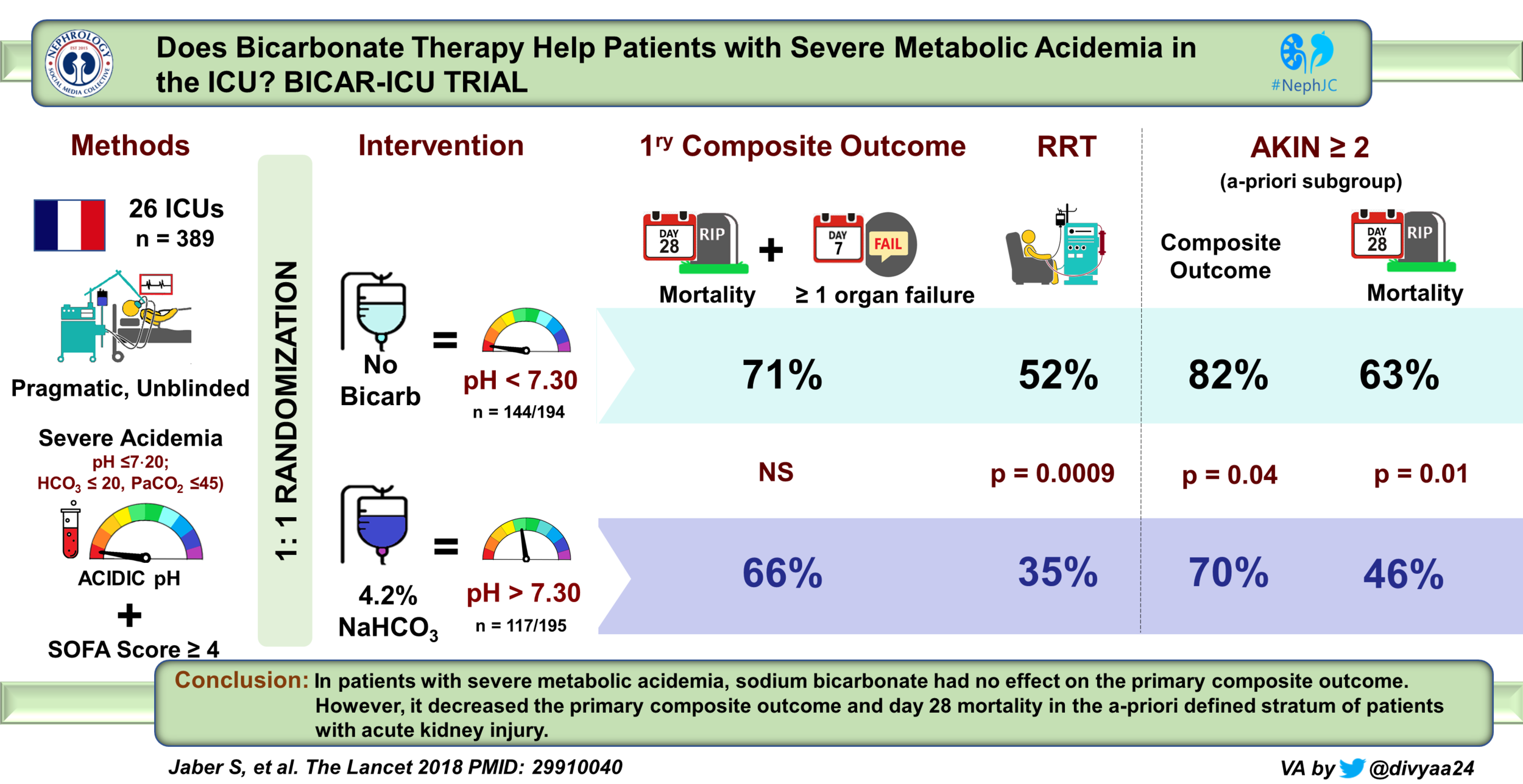
BICAR-ICU trial (Jaber et al, Lancet, 2018| NephJC summary)- a multicentric open-label randomized controlled trial- reopened the question: no day-28 mortality benefit overall, but lower mortality and RRT need in the AKI subgroup. To note the open-label design: renal replacement therapy (RRT) initiation is a clinician's judgment call, and an unblinded clinician who knows the patient is on bicarbonate has every incentive to defer dialysis a little longer. A subgroup RRT signal generated this way can be considered at least as consistent with detection bias as with a true renal effect- the trial cannot completely distinguish the two. A subsequent meta-analysis nonetheless reinforced a mortality benefit in AKI and shock (Ghauri et al, Cureus 2019), prompting the 2021 Surviving Sepsis Guidelines to endorse bicarbonate in septic shock with AKI (Evans et al, Crit Care Med, 2021)- guidance built on the same unblinded foundation- and setting up BICAR-ICU2. BICAR-ICU2 (Jung et al, JAMA 2025| NephJC Short) restricted enrollment to severe acidosis plus severe AKI, remained open-label, and still found no 90-day mortality benefit; its RRT reduction is open to the same criticism. A target-trial emulation in 1764 patients reported an association between bicarbonate and reduced mortality- observational, and therefore unable to settle what 2 unblinded RCTs already could not (Blank et al. Intensive Care Med, 2025). An individual-patient-data meta-analysis of BICAR-ICU trials concluded bicarbonate functions, at best, as an RRT-sparing strategy, with a mortality signal confined to pH ≤7.10—a conclusion built entirely on open-label data and inheriting all of its confounding (Fosset et al, Crit Care, 2026).
Taken together, this evidence points to a narrow niche- severe acidosis with concurrent AKI, RRT-sparing rather than survival-improving—and leaves patient selection, timing, target pH, and etiology dependence (lactic, septic, renal) unresolved. A more recent meta-analysis found no overall mortality benefit, but a 31% reduction in dialysis need in patients with acidosis and AKI (Chen et al, Crit Care Med, 2026).
Against this backdrop, SODa-BIC’s rationale rests on three unaddressed gaps. First, every positive trial to date was open-label, and any renal signal from an open-label trials is inseparable from performance bias in the RRT-initiation decision. Second, prior trials intervened only after severe acidemia was already established, leaving early correction untested. Third, only BICAR-ICU2 used a kidney-specific endpoint; the rest measured mortality or global organ dysfunction, diluting any renal-specific signal early correction might produce.
After assessing feasibility in a smaller cohort (Serpa Neto et al, Crit Care Med, 2023), the SODA-BIC trial was designed as a double-blind, placebo-controlled trial to evaluate the effect of sodium bicarbonate treatment on MAKE30 (Major Adverse Kidney Events within 30 days), a composite kidney-specific outcome in critically ill patients with shock and moderate metabolic acidosis (pH <7.30) in. The central question SODA-BIC intended to answer was whether early correction of metabolic acidosis improves kidney-specific patient outcomes.
The Study
Methods
Population
All patients (>18 years) admitted to the ICU with metabolic acidosis and receiving vasopressors were screened for eligibility. Metabolic acidosis was defined as a pH < 7.30, a base excess ≤ -4 mEq/L, and a PaCO₂ ≤ 45 mmHg (non-intubated) or ≤ 50 mmHg (intubated) within the 2 hours prior to randomization. These 3 criteria together ensure the acidosis is truly metabolic, excluding primary respiratory acidosis, and is clinically significant (pH). The higher PaCO₂ threshold for intubated patients accounts for permissive hypercapnia from lung-protective ventilation. All 3 criteria (pH, PaCO₂, and base excess) needed to be met within the 2 hours preceding randomization. Patients with shock and metabolic acidosis for >48 hours, suspected secondary cause for metabolic acidosis (GI, urinary losses or DKA), eGFR <30, dyselectrolytemia (dysnatremia, serum K <2.5 mEq/L, iCa <0.8 mmol/L), or currently receiving RRT/ planned to start within 3 hours were excluded. Patients deemed at inevitable high risk of cerebral edema and clinicians’ decision for enrollment (pragmatic approach) were also excluded.
Key inclusion and exclusion criteria, from Serpa Neto et al, NEJM 2026
Study design
This pragmatic, adaptive, placebo-controlled, double-blind, phase III randomized clinical trial (NCT05697770) was conducted in 55 centers across seven countries between April 2023 to December 2025. Randomization was performed by variable block method and stratified for centres, pH (<7.25 or ≥7.25), and creatinine level (<150 or ≥150 𝞵mol/L). At each site, the investigator who randomized the patient and prepared the study drug was distinct from the (blinded) investigator collecting outcome data, to preserve the blinding.
The adaptive design had 2 components:
1. A blinded sample-size re-estimation after the first 100 patients had outcome data, performed by an independent statistician unaware of treatment allocation, using the observed pooled event rate with the originally assumed relative effect held constant- bounded such that the sample size would be capped at 700 if recalculation exceeded this, and would not fall below the original 500 even if the observed event rate were higher than assumed
2. A single formal Data and Safety Monitoring Board (DSMB) interim safety review at 125 patients (25% of target, with 90-day follow-up complete), conducted June 2025, after which the DSMB recommended continuation without protocol changes. Informed consent (or waiver, where locally permitted) was obtained per jurisdiction; if a patient died before consent, data were included where local regulation and ethics approval allowed.
Intervention
Trial participants were randomized to sodium bicarbonate or placebo groups and received infusion as per the algorithm given in Fig 1. The intervention group received either sodium bicarbonate infusion (300 ml sodium bicarbonate (8.4%) added to 500 ml 5% dextrose after removing 300 ml dextrose; final concentration 600 mEq/L) or placebo infusion (5% dextrose). The two solutions were macroscopically indistinguishable, as validated in a prior pilot trial (Serpa Neto et al, Crit Care Med, 2023). The study drug was permanently withheld if a contraindication developed (hypernatremia, hypocalcemia, refractory severe hypokalemia, clinically significant fluid overload, or per treating clinician judgment). Open-label bicarbonate after the infusion window was discouraged but permitted at clinician discretion, guided by non-mandatory suggested triggers (pH < 7.10 with PaCO₂ < 40; HCO₃⁻ < 8 mmol/L, BE < -15; or K > 7 with a pH <7.10)
Fig 2. Study intervention and titration in both groups, from Serpa Neto et al, Crit Care and Res 2025
Outcomes
Baseline serum creatinine was determined hierarchically using the following order: the most recent outpatient value obtained 7 days to 3 months before ICU admission; an in-hospital value measured within 7 days before admission; or, if no measured value was available, an estimated creatinine calculated using the formula: 0.74 − 0.20 (if female) + 0.08 (if Black) + 0.003 × age.
The primary outcome was evaluated across eight prespecified subgroups: baseline pH (<7.25 vs ≥7.25), AKI stage (KDIGO stage 2–3 vs none/stage 1), PaCO₂ (≤45 vs 46–50 mmHg), acidosis type (high anion gap >12 vs non-anion gap ≤12 mmol/L), illness severity (APACHE II score above vs at or below the median), pre-randomization bicarbonate use, presence of septic shock, and admission type (medical vs surgical).
Sample size estimation
Based on the data from the BICAR-ICU trial (Fujii T et al, Crit Care 2021 and Mochizuki et al, Crit Care and Resusc 2023), assuming 40% incidence of MAKE30 in the control group with 90% power, 5% alpha-error and attrition considered, 500 patients were required to detect an absolute difference of 14%. Sample size was re-estimated using the event rate observed after completing the study of 100 patients and capped between 500-700 patients.
Statistical analysis
A modified intention-to-treat analysis was performed with a two-sided superiority hypothesis (α=0.05). A mixed-effects generalised linear regression with a binomial distribution and an identity link was used to estimate the absolute risk difference, with clustering and stratification variables as random effects. Kaplan-Meier curves were used to display survival at days 30 and 90, with adjusted hazard ratios and 95% CIs estimated using shared-frailty Cox proportional hazards models (site as the frailty term). Heterogeneity of treatment effects across the 8 prespecified subgroups was tested via a treatment-by-subgroup interaction term. Sensitivity analysis was also performed, accounting for age, sex, pre-randomization open-label bicarbonate use, APACHE II and SOFA score. No correction for multiplicity was applied to secondary or exploratory outcomes; these are reported as point estimates with 95% CIs that should not be used to infer definitive between-group differences.
Funding
The trial was funded by the National Health and Medical Research Council of Australia and coordinated by the Australian and New Zealand Intensive Care Research Centre at Monash University. The funding body had no role in design, trial conduct, analysis, or reporting of the data.
Results
Baseline demographics
In 33 months (April 2023-Dec 2025), 500 of 3060 patients were enrolled, and 498 were included in the analysis (Fig 1). Patients were recruited from 7 countries, predominantly from Australia and New Zealand. Enrolled patients were elderly, with a median age of 66 years. The majority were admitted to the ICU from the operating theatre and the emergency department, accounting for 76% of enrolled patients (Table S3). The median APACHE II and SOFA scores were 21 and 7, respectively, suggesting an association with higher mortality risk.
Fig 1. Study flow, from Serpa Neto et al, NEJM 2026.
Approximately 50% patients were admitted with a medical diagnosis, and septic shock was the most common cause for metabolic acidosis (48%). Prevalence of severe AKI was slightly higher in the sodium bicarbonate group (46.9% vs 40%) than in the placebo group (Table S3). The median pH at enrollment was 7.26 with a median base excess of -9 mmol/L; approximately 40% had pH <7.25.
Notably, trial participants were substantially sicker than the general ICU population at the same centres over the same period (APACHE III 77.2 vs 55.4, hospital mortality 23.1% vs 10.4%, Table S2).
Table 1. Baseline characteristics, from Serpa Neto et al, NEJM 2026.
Intervention and outcomes
498 patients received the intervention, of whom 244 received sodium bicarbonate infusion (median dose 300 mmol or mEq). Infusion-rate adjustment per protocol was required in half of the patients in the bicarbonate group (49.8%) versus only 23.2% of the placebo group—expected since the algorithm responds to biochemical correction, which happened more often and faster with the active drug. Open-label sodium bicarbonate was given more often in the placebo arm (15.2% vs 7% in Fig S8), consistent with a lower need for rescue therapy once the study drug had already corrected the pH. Protocol deviations (Table S5) were also more frequent in the bicarbonate arm, driven predominantly by infusion rate non-adjustment (13.5 vs 2.8% in the placebo group)- expected, since the titration algorithm fires more often with faster correction, not a conduct failure. Randomization of ineligible patients was balanced between arms (5.4% overall), and shouldn’t be counted as part of this pattern.
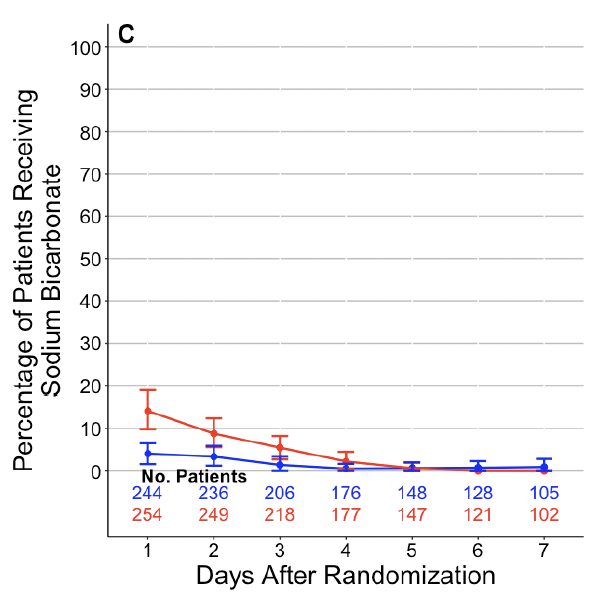
Fig S8. Use of bicarbonate after randomization, from Serpa Neto et al, NEJM 2026.
Protocol deviations (Table S5) were more common in the bicarbonate group, driven largely by “infusion rate not adjusted per protocol” (13.5% vs 2.8%); randomization of ineligible patients, by contrast, was similar between arms (4.9% vs 5.9%; combined 5.4% overall) and was not a bicarbonate-arm-specific problem.
Primary endpoint
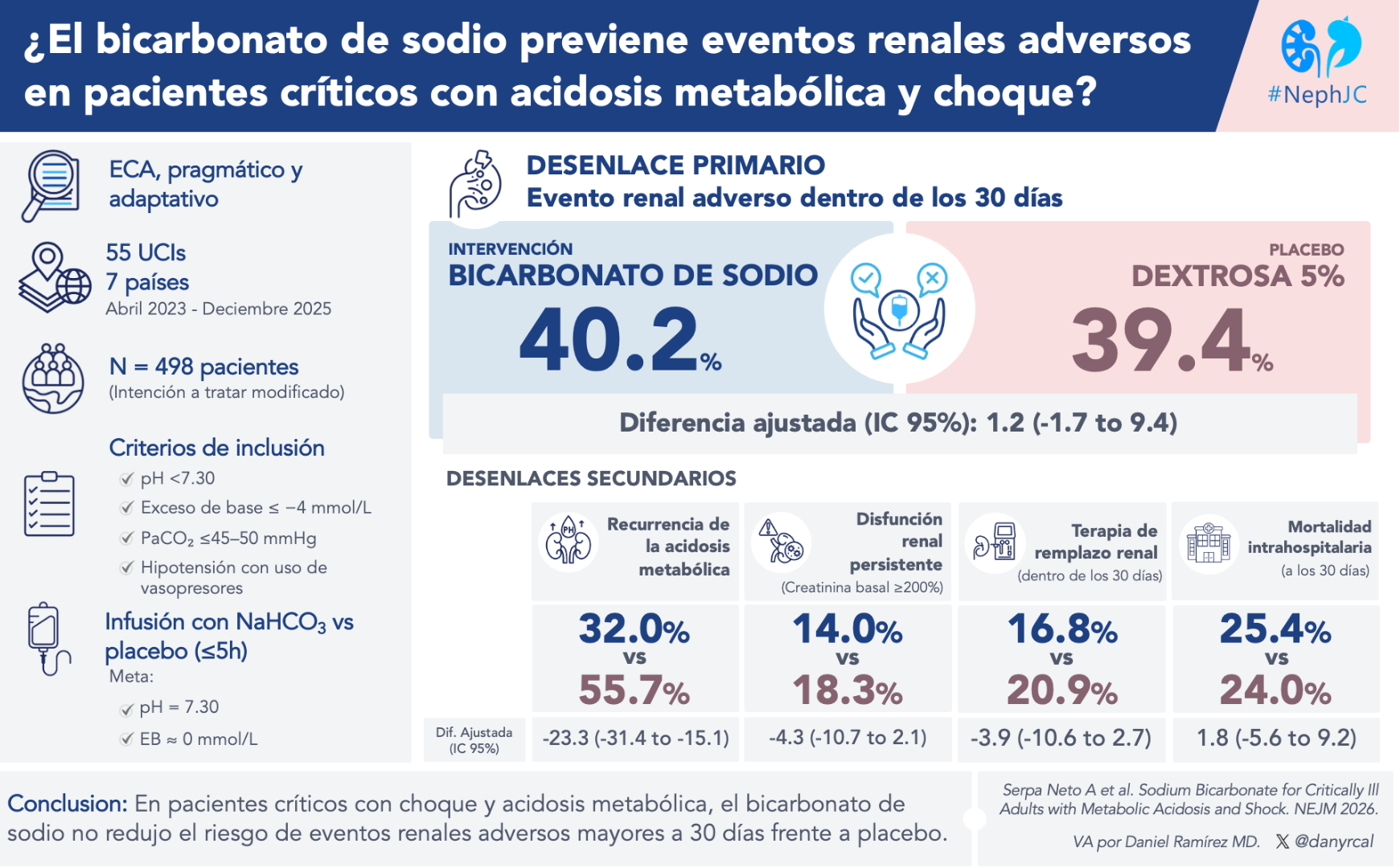
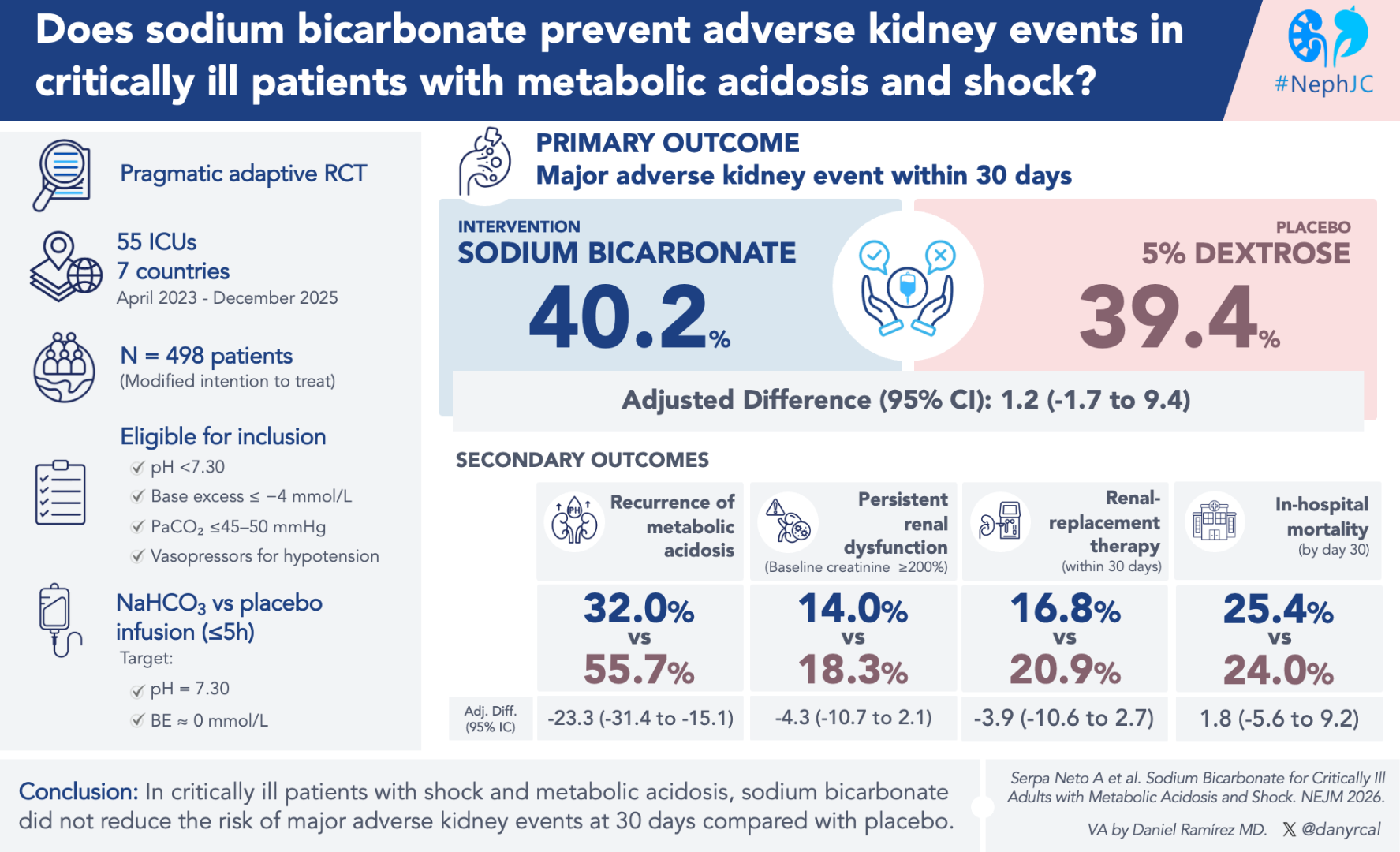
At 30 days there was no significant difference in the incidence of MAKE30 between the two groups (40.2% vs 39.4%; P=0.78).
Table 3. Primary and secondary outcomes, from Serpa Neto et al, NEJM 2026.
There was no significant difference in persistence of kidney dysfunction in the prespecified subgroup analysis (Fig S7).
Fig S7. Subgroup analysis of persistent renal dysfunction within 30 days, from Serpa Neto et al, NEJM 2026.
Sensitivity analyses were concordant: further adjustment for age, sex, pre-randomization bicarbonate use, APACHE II and SOFA gave an adjusted difference of 0.7 pp (-7.3 to 8.6), and an alternative eGFR-based definition of persistent renal dysfunction gave 1.3 pp (-7.2 to 9.8) (Table S9). A confidence distribution analysis of the primary result (Fig S4) estimated only 38.9% confidence that bicarbonate reduces MAKE 30 to any degree- i.e., the point estimate leans, non-significantly, toward no benefit or harm rather than benefit.
Fig S4. Confidence distribution for the primary outcome, from Serpa Neto et al, NEJM 2026.
Secondary and additional endpoints
One fourth of the enrolled patients died within 30 days in both groups (25.4% bicarbonate vs 24% placebo; HR 1.09, 0.76-1.56- Fig 2A), same as death by day 90 (fig S9). RRT use within 30 days was numerically lower with bicarbonate, but not significantly so (16.8% vs 20.9%- Fig 2B), as was persistent renal dysfunction (14% vs 18.3%- subgroup analysis Fig S7). RRT dependence and ICU death by day 30 were also similar (Table 3).
Fig 2. (A) Probability of in-hospital survival at day 30 and (B) of renal-replacement therapy within 30 days, from Serpa Neto et al, NEJM 2026
AKI incidence at 7 days was similar between groups (about 64%), but recurrence of metabolic acidosis was lower with bicarbonate (32 vs 55.7%). Though reaching the pH target was earlier in the bicarbonate group, patients in both groups had similar pH after day 7 of randomization (Fig S2).
Fig S2. pH, bicarbonate and base excess in the first seven days post-randomization, from Serpa Neto et al, NEJM 2026
The number of vasopressor-free days, renal-replacement therapy–free days, and ICU-free days on day 30, and the number of hospital-free days on day 90, were also similar between the two trial groups (Table 3, distributions in fig S10).
Adverse effects were uncommon: 1.6% with bicarbonate vs none with placebo; driven by hypokalemia needing correction, with one patient also developing hypernatremia. No serious adverse effects occurred in either group.
Table S10. Adverse effects, from Serpa Neto et al, NEJM 2026
Discussion
The SODa-BIC trial was a pragmatic trial that randomized 500 patients from 55 ICUs to receive sodium bicarbonate or dextrose infusions. They included critically ill patients dependent on vasopressors with a pH < 7.30, BE ≤ -4 mEq/L, and PaCO2 ≤ 45 mmHg (≤ 50 mmHg if intubated), representing a very common phenotype seen in the ICU. In this trial, sodium bicarbonate (an infusion of 8.4% sodium bicarbonate solution, 1000 mEq/L) did not reduce major adverse kidney events within 30 days (MAKE30) of randomization compared with an infusion of 5% dextrose.
MAKE30 is a well-validated, patient-centered composite: it captures both injury severity and survival. Here, the composite was driven almost entirely by death of any cause (25.4% vs 24%), while every renal component moved in a numerically favorable direction without reaching significance: renal replacement therapy (16.8% versus 20.9% in placebo), persistent renal dysfunction (14% versus 18.3%), and dialysis dependence at day 30 (5.7% versus 9.1%). Three consistent point estimates favouring bicarbonate and none of them being significant is evidence of an underpowered trial, a genuinely absent effect, or both, and this trial cannot distinguish between these issues.
A comparator is the PRESERVE trial - IV bicarbonate versus saline for the prevention of contrast-associated AKI, using a composite of death, dialysis, or persistent kidney impairment, and was stopped early for futility (Weisbord et al, NEJM, 2018). Two bicarbonate trials, two patient-centered composites, and two null results. That’s not a coincidence worth explaining away with endpoint choice. Perhaps the question is not whether MAKE30 was the right endpoint—it almost certainly was. Rather, isn’t it naive to think that correcting metabolic acidosis would somehow reverse such a complex multisystemic pathophysiology?
Interestingly, despite protocolized treatment, clinicians retained the ability to administer open-label sodium bicarbonate whenever deemed clinically necessary. Although crossover was relatively limited, 14.3% of patients in the bicarbonate arm and 9.1% in the placebo arm had already received bicarbonate before randomization, while additional rescue bicarbonate administration occurred after randomization in both groups. This pragmatic design reflects real-world practice, but may also have attenuated any treatment separation. For what it is worth, the prespecified subgroup analyses were similarly unremarkable, with no evidence of heterogeneity across the evaluated subgroups. Neither the presence of septic shock, illness severity, baseline bicarbonate administration, nor admission type appeared to modify the treatment effect.
BICAR-ICU2’s finding- lower RRT with bicarbonate- deserves more scrutiny than it usually gets (Jung et al, JAMA 2025| NephJC short). The primary endpoint, 90-day mortality, was neutral; RRT initiation, unlike death, is not a hard endpoint; it is a clinician’s judgment call, made in real time, by an unblinded physician. Faced with worsening acidosis in a patient already on bicarbonate, the path of least resistance is more bicarbonate—cheaper, non-invasive, and reassuringly proactive-feeling—rather than escalating to dialysis. This is evidence that open-label trials let treatment knowledge steer secondary endpoints. SODa-BIC, being double-blind, removes exactly this confounder, and the RRT signal shrank accordingly: 16.8% vs 20.9%, overall not significant. In the pH <7.25 subgroup, an 11-point difference persisted (17.2% vs 28.3%, 95% CI -22.3 to 0.4)—but with blinding intact, this is the honest version of the question BICAR-ICU2 never answered.
Old treatment, new trial
SODa-BIC differs from its predecessors in phenotype: vasopressor-dependent metabolic acidosis rather than severe acidemia and AKI. While BICAR-ICU suggested benefit in the subgroup with severe AKI and BICARICU-2 confirmed a reduction in kidney replacement therapy without improving death (dissociation more plausibly explained by unblinded clinicians than by a kidney-specific drug effect), SODa-BIC, blinded, found neither. Perhaps most consistent was the finding of no change in mortality.
Strengths
SODA-BIC used MAKE30, a patient-centered composite outcome, while accounting for competing risks and variation in baseline kidney function. Second, the trial incorporated a prespecified blinded sample-size re-estimation, improving confidence that the final sample size was adequate for the planned effect. Most importantly, the trial was also pragmatic and multicenter, increasing its relevance to real-world ICU practice across different health-care systems
Limitations
Several limitations are also important. Open-label bicarbonate was permitted when clinically indicated, and other sodium- or buffer-containing therapies were not fully controlled, potentially reducing treatment separation. Although the intervention corrected acidemia rapidly, it was brief, raising uncertainty about whether it was sustained long enough to influence a 30-day outcome. In addition, although blinding was carefully maintained, changes in pH and bicarbonate may have allowed clinicians to infer treatment allocation in some cases. The study did not collect physiological data at the time of initiation of renal replacement therapy, limiting interpretation of whether dialysis decisions differed between groups. Finally, the trial was powered to detect a moderate-to-large treatment effect. Therefore, while it convincingly excludes a major benefit, smaller but potentially clinically relevant effects, and here we are talking about kidney-specific outcomes, cannot be ruled out.
So, where does the SODA-BIC trial leave us? Sodium bicarbonate corrects the numbers, yes, but it still fails to correct patient-oriented outcomes and prevent death. Routine administration to prevent MAKE30 is difficult to justify. However, let’s imagine a real-world scenario. In a deteriorating patient with metabolic acidosis, vasopressor dependency and no clear contraindication, many clinicians may still use sodium bicarbonate as a “wait-it-out” measure - not because it improves survival, but because transient correction of acidemia may provide physiological support while the underlying cause is addressed (and it makes us clinicians feel better, like we’ve done something). Considering these aspects, maybe the takeaway message isn't that “bicarbonate isn’t useful”, but rather “don’t expect bicarbonate to change the prognosis”.
Conclusion
In the SODa-BIC trial, sodium bicarbonate infusion in critically ill patients in the ICU with metabolic acidosis did not improve mortality or MAKE30 outcome.
Summary by
Srinivasavaradan Govindarajan
Assistant Professor (Ped Neph)
VMMC and Safdarjung Hospital, India
Anca Elena Stefan
Nephrology specialist
Romania
Reviewed by
Brian Rifkin, Cristina Popa, Sai Vani, Akshaya Jayachandran
Header image created by AI and prompts from Brian Rifkin