
J Am Soc Neph. Published ahead od print. May 20, 2026. | DOI: 10.1681/ASN.0000001147
Nondialyzable versus Dialyzable Beta-Blockers in Hemodialysis: A Target Trial Emulation Study
Ali Etemadi, Sai Liu, Wolfgang C Winkelmayer, Maria E Montez-Rath, Tara I Chang
PMID: 42160184
Why was the study done?
Beta blocker use, although well established in cardiovascular disease, has been embroiled in controversy when it comes to their protective effects in patients in CKD (Han Hyung Seung et al, NDT 2026; Yeh Tzu-Hsuan et al, PLOS One 2022). Cardioselectivity and dialyzability are two major factors influencing physician choice in patients on dialysis. Non-cardioselective beta blockers, like bisoprolol, have proven mortality benefit in heart failure (Hans-Dirk Düngen et al, Euro J Heart Fail, 2011) with some evidence describing their superiority in CKD (Shireman TI et al, BMC CVD 2016; Yu Albert et al, JASN supplement 2022). However, they may predispose to hyperkalemia, especially in patients on mineralocorticoid receptor blockers (Wu PH et al, NDT 2020). Alternatively, non-dialyzable beta blockers may provide consistent cardioprotective benefit, they may also predispose to bradycardia and intradialytic hypotension (Yeh Tzu-Hsuan et al, PLOS One 2022).
Unfortunately, to date, observational data comparing dialyzable vs non dialyzable beta blockers use in dialysis populations has given mixed signals of cardiovascular benefits
(Weir et al JASN 2014; Assimon et al, AJKD 2019; Wu et al, NDT 2020). Importantly, apart from dialyzability, beta blockers have other pharmacokinetic and pharmacodynamic properties such as cardioselectivity, vasodilatory capacity, lipophilia which may affect outcomes. Cardioselective betablockers have been demonstrated to be more beneficial in dialysis patients compared to non-selective beta blockers (Shireman at al, BMC CV Dis 2016; Meta-analysis-Tao et al, PloS 2022).
Due to the inconsistent data regarding the benefit of one class over another, prescription practices vary widely and are often influenced by availability, insurance coverage, familiarity, and peer usage. Considering the clinical equipoise, the high variability in practices, and the difficulty in conducting RCTs in hemodialysis population, this target trial emulation study was done to demystify this controversial area.
How was the study done and what did it report?
Methods
This was a target trial emulation study (Hernán M et al, JAMA 2022) using retrospective data from USRDS, Medicare and Davita to predict the outcomes of a randomized controlled trial of dialyzable versus non dialyzable beta blockers in CKD patients initiating hemodialysis. Retrospective data from USRDS was obtained for patients with Medicare A, B, and D from 2008-2021. Elderly patients ≥ 67 years initiating hemodialysis while on beta blockers, with at least claim for hypertension in the past, were included in the study from 41 US states .
Inclusion and exclusion criteria are detailed below:
Adapted from Supplemental table 1 from Etemadi et al, JASN 2026
Nomenclature /definitions:
Dialyzable beta blockers: metoprolol, atenolol, bisoprolol, acebutalol
Non dialyzable beta blockers: carvedilol, propranolol, betaxalol
Classification of patients by type of beta blockers was based on whether they had only one active prescription supply for either a dialyzable or a nondialyzable beta blocker on index date or within a 30-day grace period prior to index date.
Outcomes:
All-cause mortality and major adverse cardiac events (MACE-defined as stroke, myocardial infarction, or all-cause mortality) were studied as per intention to treat analyses. Negative control outcomes (unrelated outcomes like conjunctivitis, contact dermatitis, onychomycosis, contact dermatitis) were analyzed both in the instrumental variable approach and the Cox model. Data were obtained from ICD codes used in Medicare.
Statistical procedures:
Quasi-randomized treatment groups were made based on an instrumental variable (IV) approach using regional prescribing preferences. Regions with a preferential prescription were included.
RESULTS:
A total of 161,798 patient records were screened for eligibility, of which 80,353 patients were eligible for inclusion in the emulation study (Figure 1 below). Since only patients residing in areas with a preferential prescription (ATR>0.8) were included in the instrumental variable (IV) approach, the final sample size was 40,313 (n= 19,833 in the non-dialyzable beta blocker group, n=20,480 in the dialyzable beta-blocker group).
Figure 1 . Consort diagram from Etemadi A et al, JASN 2026
Baseline characteristics (Table 1 below) were balanced between the two groups -patients residing in areas with preferential dialyzable vs preferential non-dialyzable beta blocker use (SMD <0.1 for all characteristics). Although p value should not be calculated for comparing baseline characteristics in randomized trials, a SMD in target trial emulation helps to determine if the quasi-randomization has genuinely been able to create balanced groups. When actual group of patients receiving dialyzable versus non-dialyzable beta blockers was compared (supplemental table 3), the group of patients receiving non-dialyzable beta blockers were found to have a higher prevalence of congestive heart failure, ischemic heart disease, chronic pulmonary disease, complicated hypertension and diabetes, higher mean Elixhauser mortality score, more frequent cardiology visits, and higher baseline diuretic use (probably reflecting sicker baseline status with higher comorbidity burden).
Table 1- adapted from Etemadi A et al, JASN 2026
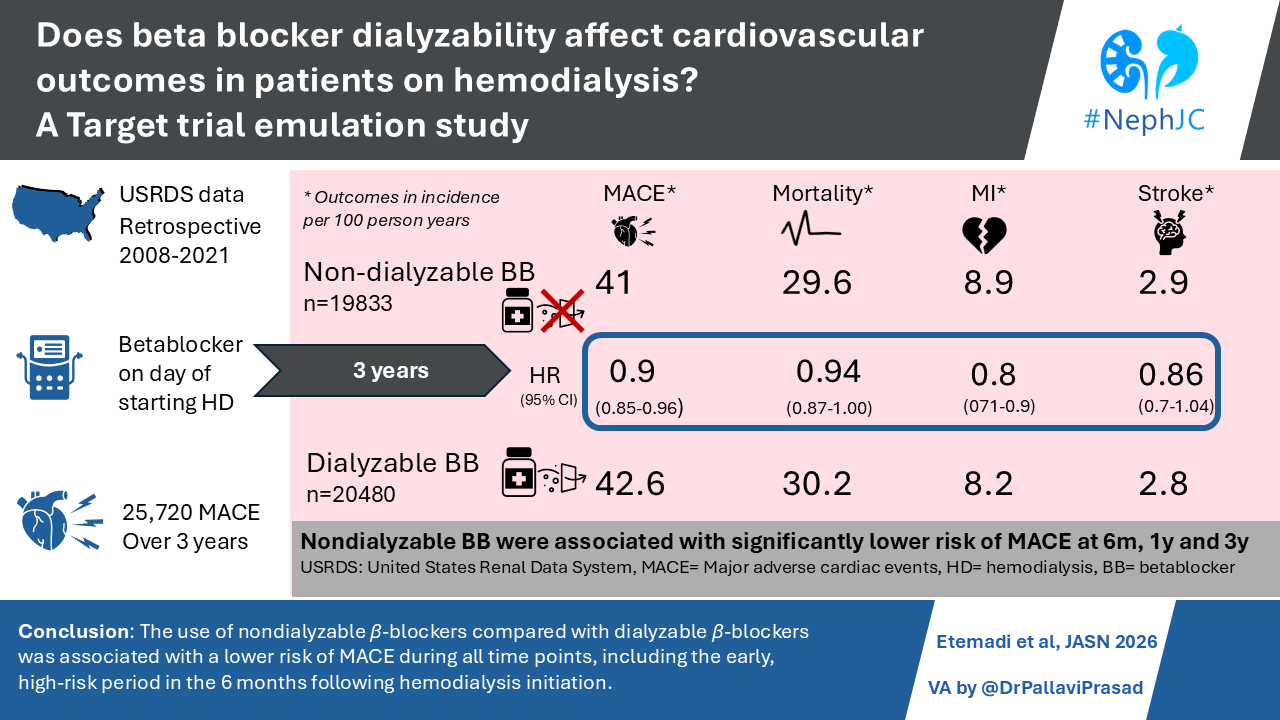
MACE and its individual component outcomes were significantly lower in the arm with preferential non-dialyzable beta blocker use compared to dialyzable beta blocker use.
(Figure 3 below). There was no significant association of any of the negative outcomes (conjunctivitis, cerumen accumulation, onychomycosis) with beta blocker dialyzability.
Figure 3- from Etemadi A et al, JASN 2026. Hazard ratios for the use of nondialyzable vs dialyzable beta-blockers in three follow-up endpoints calculated using the g-estimation instrumental variable analysis. MACE: Major Adverse Cardiovascular Events; MI: Myocardial Infarction; BB: Beta blocker
In the fully adherent cohort , the outcomes showed similar trends, shown in Figure 3, except for the outcome of stroke which was not significantly associated with beta blocker dialyzability at 6 months, 1 year or 3 years.
Overall there were 25,720 MACE over the 3-year follow-up period, with 10,933 occurring in the first 6 months. The table below shows the incidence of MACE and individual outcomes at 6 months, 1 year and 3 years. The incidence of each outcome and of the composite outcome was highest during the first 6 months after hemodialysis initiation.
Table 2- from Etemadi A et al, JASN 2026.
Using a primary Cox model, hazard ratios for MACE, acute MI and stroke at 6 months, 1 year and 3 years showed a significant advantage of using non-dialyzable beta blockers in HD. However, negative outcomes (conjunctivitis, cerumen accumulation, contact dermatitis , onychomycosis) were found to be associated with beta blocker dialyzability at different time points after HD initiation. (A smart way to demonstrate the advantage of using target trial emulation over the Cox model!)
DISCUSSION:
Beta blockers are a frequent antihypertensive choice in patients on hemodialysis, especially in those with cardiac disease. The data regarding the use of dialyzable versus non-dialyzable beta blockers in the dialysis population has been fraught with controversy.
This study analysed data from >40,000 patients who were initiated on dialysis to compare outcomes in regions where there was prescription preference for dialyzable vs non-dialyzable beta blockers. The results demonstrated a significant benefit of non-dialyzable beta blockers in preventing MACE and its individual components.This target trial emulation study tried to bring an end to the controversy, but can anything but an RCT be the final answer ?
Unfortunately, large scale RCTs on beta blocker use in hemodialysis have failed to reach completion due to various reasons (see table below).The first RCT of beta blockers in dialysis patients was published as early as 2001 (Cice G et al, JACC 2001) - it demonstrated that carvedilol decreased all cause mortality in dialysis patients with dilated cardiomyopathy. Subsequent to this small study (n=117), there was one RCT of atenolol vs lisinopril in HD patients (Agarwal et al, NDT 2014; HDPAL study) which was terminated early due to more serious adverse events including CV events, all cause mortality , hyperkalemia and hypertensive crisis in the lisinopril arm. A feasibility trial of beta blocker vs placebo use in dialysis patients
(Roberts et al, AJKD 2016; BLOCADE) was unable to recruit patients due to high baseline use of beta blockers, apprehension of nephrologists to switch patients to a non-beta blocker, inability to get informed consent and a high drop out rate (with intradialytic hypotension and bradycardia).
Made using Claude AI by -references from Cice et al, JACC 2001 & JACC 2003; Agarwal et al NDT 2014 and Roberts et al, AJKD 2016
The study by Etemadi et al (JASN 2026) had the strengths of using an instrumental variable approach and a target trial emulation design with a large sample size. It was a very well designed statistical approach with clear demonstration of techniques used to check independence, relevance and exclusion restrictions. They also demonstrated comparison with a Cox model to highlight the difference in results and flaws of using a Cox regression analysis in situations where RCTs are ideal (and trial emulations a distant second choice). Analysis was done both on ITT and the adherent population to bring out the differences.
Limitations include the inherent limitations of a retrospective cohort and the use of medicare data rather than actual outcomes. The generalizability may be limited to older patients (age >67 years) and those with medicare coverage (adherence could also be influenced by that). Incidence of bradyarrhythmias and intradialytic hypotension episodes were not available to draw any mechanistic conclusions. Lastly PD patients were not included , similar to all previous studies quoted above of beta blockers in dialysis patients.
Conclusion:
In this target emulation trial, MACE and its individual component outcomes were significantly lower in the arm with preferential non-dialyzable beta blocker use compared to dialyzable beta blocker use.
This study also highlights the need for adequately powered RCTs in HD patients to study the effect of beta blockers accounting for dialyzability, cardioselectivity and other physicochemical factors unique to different drugs in this class.
Blog by Pallavi Prasad
Associate Professor Nephrology, VMMC and Safdarjung Hospital
New Delhi, India
Reviewed by