
Am J Hematol. 2026 Oct 12. doi: 10.1002/ajh.70516. Online ahead of print.
Plasma Exchange and Daratumumab for Myeloma Cast Nephropathy
Christina I Shincovich, Api Chewcharat, Motohiko Adomi, Emma E McGee, Raphael Kim, Marta Pirovano, Jason Prosek, Srinivas S Devarakonda, Joshua Leisring, Eshetu Obole, Jasmin Tharakan, Arti Vaishnav, Nattawat Klomjit, Pornlada Likasitwatanakul, Chester Andrzejewski, Sajjad Hassan, Annie Elizabeth Abraham, Lynne O'Hearn, Oscar Garcia Valencia, Jennifer S McDonald, M Salman Sheikh, Boyoung Michelle Kim, Priscilla Koirala, A Bilal Malik, Anip Bansal, Blaithin A McMahon, Benjamin Teruel, Jaya Kala, Abdallah Geara, Kristen Tillquist, Swetha Kanduri, Raphael Szalat, Ali Aijaz, Omar Mamlouk, Susan L Ziolkowski, Jillian Caldwell, Marco Bonilla, Nader Ismail, Pooja D Amarapurkar, Joseph K Franz, Rasheed A Balogun, Eibhlin Goggins, Claude Bassil, Shrinjaya Thapa, Rachid Baz, Daniel Sanghoon Shin, Jonathan E Zuckerman, Kanwarpal Kahlon, Yesha Shah, Kenar D Jhaveri, Richa Thakur, Jingjing Zhang, Priya Deshpande, Matthew H Abramson, Dureya Syed, Arun Rajasekaran, Ashwini Pujari, Jay S Raval, Linette Bosques, Florence H Porterfield, Eashwar V Somasundaram, Sophia L Wells, Mia B Rubman, Robert Seitter Pérez, Alexa C Peterkin, Carolina Saldanha Neves Horta Lima, Naoka Murakami, Maho Terashita, E Bridget Kim, Kareem Mosaheb, Paul E Hanna, Omar Nadeem, David E Leaf, Raad B Chowdhury, Sean R Stowell, Andrew J Yee, Nelson Leung, Shruti Gupta
Affiliations Expand
PMID: 42864738
DOI: 10.1002/ajh.70516
It has been more than 100 years since doctors figured out how to remove “evil humours" (i.e. cytokines, interleukins, inhibitory antibodies, inflammatory molecules, etc) via plasma exchange (PLEX) in animals (The History of Plasmapheresis in Hospitals). In the ensuing century plasmapheresis was used in a wide array of immunological diseases with varying beneficial effects. The first successful therapeutic application of plasmapheresis was in 1952, in a patient with hyperviscosity syndrome due to Waldenström's Macroglobulinemia (Tilz, et al, Med Klin 1976). Unfortunately, the number of diseases in nephrology that have shown clinical benefits (i.e. decreased mortality or relief from dialysis dependence) with well-powered RCTs is tiny. We are often forced to hypothesize benefits of a treatment that lacks proper evidence-based support. Enter target trial emulations to try to fill the gaps in rare diseases that often lack the large number of patients to support a RCT. Read up on target trial emulation studies in our previous discussions (Transplant in Elderly; Metformin in CKD; Podcast with Ed Fu)
Multiple myeloma (MM) is defined as the malignant proliferation of clonal plasma cells that secrete a monoclonal immunoglobulin (85%), excessive free light chains (sFLC, 13%) or more rarely, can be non-secretory. Kidney disease is present in up to 50% of patients at time of diagnosis and is recognized as a poor prognostic factor and associated with a higher tumor burden (Bridoux, et al. Kidney Int 2021). Myeloma cast nephropathy (myeloma kidney) or light chain cast nephropathy (LCCN) is the most common form of monoclonal immunoglobulin-mediated kidney disease. It results from the aggregation of excessive amounts of filtered free light chains, causing intratubular obstruction of the lumen of the distal nephron. As tubular obstruction increases, kidney damage progresses, leading to interstitial nephritis and irreversible fibrosis. Myeloma cast nephropathy accounts for around 70% of dialysis-dependent kidney failure in MM and is a medical emergency requiring prompt intervention. The probability of cast nephropathy increases with the serum level of FLCs (usually >1000 mg/L), and rarely occurs at a serum concentration <500 mg/L (Pillon, et al. Kidney Int, 2008). The diagnosis is typically made clinically, but kidney biopsy remains the gold standard for diagnosis.
Why is the present study needed?
The impact of PLEX, in addition to chemotherapy, on kidney outcomes in LCCN is still debated. When light chain production has been turned off - is there any addition to removing the circulating light chains with an extracorporeal method? A RCT of 21 patients with biopsy-proven myeloma kidney who received melphalan and prednisone with or without PLEX showed no statistically significant outcome differences (Johnson, et al. Arch Intern Med, 1990). However, among a dialysis-dependent subgroup, 43% in the PLEX group and none in the control group recovered kidney function. The largest RCT of chemotherapy and supportive care (58 subjects receiving plasma exchange and 39 controls) failed to demonstrate that 5 to 7 PLEX procedures over 10 days substantially reduced a composite outcome of death, or dialysis dependence at 6 months (Clark, et al. Ann Intern Med, 2005). This study was criticized because most of the enrolled patients did not have a kidney biopsy and sFLC levels were not measured. Dialysis dependence in those who survived 6 months was 13% in the PLEX group but 27% in controls; this difference was not statistically significant because of wide confidence intervals (indicating the study was underpowered). Finally, a Mayo Clinic study restricted to 18 patients with biopsy-proven LCCN, showed that when PLEX achieved a 50% reduction of sFLC, it was effective in reversing kidney failure and extending survival (Leung, et al. Kidney Int, 2008) - but this was not an RCT.
So, if PLEX does not have a clear role as a solitary therapy, what about in combination with immunosuppression? Based on a report of 14 patients with presumed myeloma cast nephropathy treated with bortezomib and PLEX, 12 had complete or partial response by 6 months (Burnette, et al. New Eng J Med, 2011). In another clinical trial, 29 patients with myeloma and AKI showed a significant decrease of FLCs in patients treated with PLEX with conventional chemotherapy compared to the bortezomib group and there was a significantly decreased FLCs and longer survival in patients treated with 3 or more plasma exchanges (Premuzic, et al. Ther Apher Dial, 2018). Thus, some still believe that intensive PLEX can improve kidney outcomes if applied immediately with concurrent chemotherapy until sFLC levels have been substantially reduced. This, however, is still not universally accepted as high cutoff-HD has been shown to remove more free light chains than PLEX and two trials of high cutoff-HD failed to show a benefit in patients with biopsy proven cast nephropathy that required dialysis (Bridoux et al JAMA 2017| NephJC summary; Hutchinson, et al. Lancet Haematol 2019). Also keep in mind that the chemotherapy has substantially improved from the 1990s to the 2020s both in terms of efficacy as well as safety, unlike the barbarian extracorporeal removal technologies - which raises sensible questions about the ongoing utility of removing light chains. Confused yet? The data is truly dizzying and far from definitive. But there exists variation in practice which makes available some observational data to analyze.
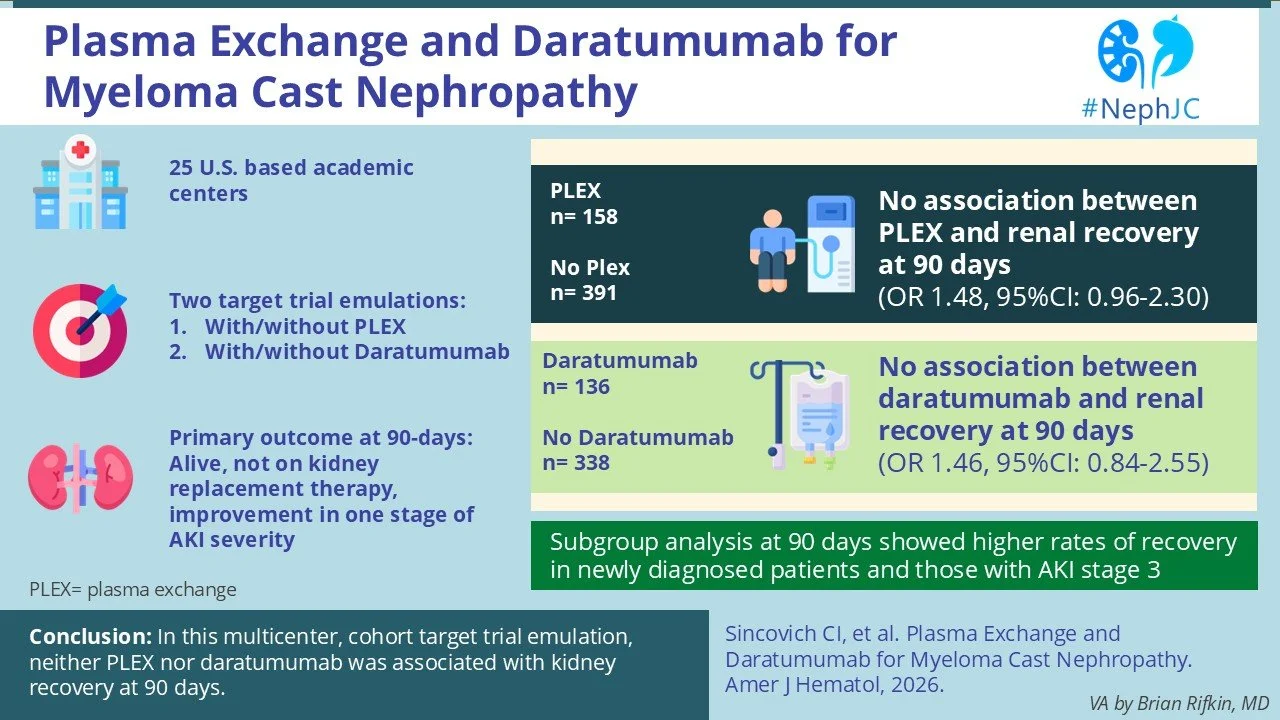
On that background of somewhat equivocal use of PLEX in LCCN, the authors wanted to examine the utility of plasma exchange and daratumumab (anti-CD 38 antibody clone directed treatment) in AKI and focus on kidney recovery in 2 target trial emulations; one with versus without PLEX and one with daratumumab-based versus a non-daratumumab-based chemotherapy regimen in the 30 days following diagnosis of LCCN at 25 major academic centers.
How was the study done?
The included patients had either newly diagnosed or relapsed multiple myeloma with both LCCN (sFLC > 500 mg/L) and AKI (≥ 1.5- fold rise in SCr from baseline or need for kidney replacement therapy (KRT)). Data was collected on demographics and comorbidities, the nature of multiple myeloma, hospitalization status at the time of LCCN diagnosis, LCCN characteristics (sFLC level, chemotherapy), baseline and follow-up laboratory values, and initial AKI severity (KDIGO staging).
Primary and Secondary Outcomes
The primary outcome was kidney recovery at 90 days following the diagnosis of LCCN, defined as survival at day 90, KRT-independence at day 90, and an improvement of at least one stage of AKI severity compared to the stage at the time of LCCN diagnosis or KRT liberation. Secondary outcomes included: (1) all- cause mortality at Day 90; (2) kidney recovery, defined as survival, KRT-independent, and a SCr < 1.5x baseline at 90 days following diagnosis of LCCN; (3) kidney recovery at 60 (±15) and 180 days (±60) following the diagnosis of LCCN; (4) liberation from KRT and alive at 60 days and 90 days following diagnosis of LCCN; (5) ≥ 50% reduction in the involved sFLC within 30 days and 180 days following LCCN diagnosis; and (6) a composite of adverse events in the 30 days following LCCN diagnosis (infection, venous thromboembolism, hospital readmission, transfusion reactions, and bleeding diatheses).
Primary outcome analysis was limited to biopsy confirmed LCCN; biopsy confirmed LCCN or available urine protein quantification; receipt of PLEX within the first 7 or 14 days following LCCN; receipt of ≥ 5 PLEX treatments; receipt of daratumumab within the first 7 or 14 days following LCCN; and those who had a baseline SCr available and thus did not require its imputation. Similar sensitivity analyses were performed for the daratumumab target trial emulation.
Results
Target Trial Emulation 1: PLEX
A total of 549 patients were included in the study, including 158 who received PLEX and 391 who did not. Of the eligible patients, 432 had a new diagnosis of multiple myeloma and 117 had relapsed multiple myeloma. The median number of sessions of PLEX was 5 (IQR, 3–6), initiated within a median of 2 days of diagnosis. PLEX- treated patients were more likely to be white, have hypertension, have more severe AKI, and exposure to nephrotoxic medications.
Fig 1. Flow diagram of patients who did and did not receive PLEX. Shincovich, et al. Am J Hematol, 2026
Of the 158 patients who received PLEX within 30 days following LCCN diagnosis, 92 had kidney recovery at 90 days, whereas among the 391 patients who did not receive PLEX, 221 achieved kidney recovery. In unadjusted analyses, receipt of PLEX within 30 days of LCCN diagnosis was not associated with kidney recovery at 90 days (OR 1.09, 95% CI: 0.74–1.62). In adjusted analyses, PLEX again was not associated with kidney recovery at 90 days (OR 1.48, 95% CI: 0.96–2.30). Results for patients treated with or without PLEX were also similar at 60 and 180 days.
There was no association between PLEX and all-cause mortality (OR 0.71, 95% CI: 0.37–1.35). Patients receiving PLEX had higher odds of achieving a ≥ 50% reduction in involved sFLC within 30 days compared with those not receiving PLEX, but not at 180 days. Rates of adverse events within 30 days did not differ between those who did and did not receive PLEX. Among 39 individuals receiving KRT at LCCN diagnosis, 5 of 12 (41.7%) PLEX patients were liberated from KRT versus 8 of 27 (29.6%) in the non-PLEX group.
Target Trial Emulation 2: Daratumumab
A total of 474 patients were included in the study, 136 who received daratumumab and 338 who did not. Daratumumab was initiated at a median of 7 days (IQR, 2–20) following LCCN diagnosis. Daratumumab- treated patients were more likely to be black, have diabetes mellitus, congestive heart failure, coronary artery disease, relapsed refractory multiple myeloma, high risk of cytogenetics, and greater exposure to nephrotoxic medications. Daratumumab-treated patients were less likely to receive PLEX compared to non-daratumumab–treated patients.
Fig 1. Flow diagram of patients who did and did not receive daratumumab. Shincovich, et al. Am J Hematol, 2026
Of the 136 patients who received daratumumab within 30 days following LCCN diagnosis, 88 achieved kidney recovery at 90 days, compared with 189 of 338 who did not receive daratumumab. In both unadjusted and adjusted analyses, receipt of daratumumab was not associated with kidney recovery at 90 days. Kidney recovery was similar between the daratumumab and non-daratumumab-treated patients at 60 days (OR 1.57, 95% CI: 0.90–2.75) and at 180 days (OR 1.39 95% CI: 0.79–2.47). Similarly, there were no differences in the proportion of patients liberated from KRT at 90 days (OR 1.49, 95% CI: 0.73–3.05). The proportion of patients achieving a ≥ 50% reduction in involved sFLC within 30 days and 180 days were similar between those who received daratumumab compared to those who did not. Among 32 individuals receiving KRT at LCCN diagnosis, 1 of 2 patients were liberated in the daratumumab group, compared with 10 of 30 in the non-daratumumab treated group.
What does this mean for my practice?
Data concerning the use of PLEX in LCCN are mixed, as are current clinical practices. Questions remain about: who (new versus relapse), what (sFLC, creatinine/eGFR cutoff and goals of treatment), when (at diagnosis prior to chemotherapy only or later) and how (many cycles of PLEX and chemo) to incorporate PLEX with other myeloma kidney treatments. Most studies have been observational, small, without a control group, or did not have confirmatory biopsies. This is the space where target trial emulation studies may be the closest we may get to RCT in rare diseases to help guide complex treatment strategies. Fortunately, the speed of disease monitoring (sFLC) and the evolution of clone-directed therapies have advanced significantly in the last few decades, but issues regarding the ideal patient for adjuvant PLEX are still not firmly established. One still could question, based upon available data, whether PLEX has any role at all. Daratumumab treats the disease (even if renal recovery is limited) what does PLEX do apart from make some numbers fall faster? The cost and logistics with doing adjunct PLEX when you have effective therapy ongoing seems quite unnecessary.
In this study, not surprisingly- but maybe disappointingly, neither PLEX nor daratumumab was associated with kidney recovery. The authors try to read into subgroups (AKI 3, markedly elevated sFLC, prompt therapy) and potential benefits that have had inconsistent benefits in prior small RCT and observational studies. Unfortunately, I can’t subscribe to beating this dead, light-chained horse any further. If there is an effect, it is likely very small.
A light-chained horse…
If we subscribe to the idea that LCCN results from the aggregation of excessive amounts of filtered sFLC causing tubular obstruction with interstitial nephritis and irreversible fibrosis, then PLEX will have a limited role because it has no effect on the distal tubule of the nephron and only effects freely floating sFLC. The authors point to sustained elevated sFLC for > 6 months as a prognostic indicator for AKI, and perhaps the kidney is capable of some clearance of entrenched sFLC, if the overall burden can be decreased. However, based upon the prevailing evidence this seems of little to no benefit. Unfortunately, many of these patients cannot be “found earlier”, particularly in smoldering disease. This study suffers from many of the problems with prior evaluations of PLEX in LCCN: small, observational (though with advanced imputational analysis), residual confounding, selection bias, variable PLEX treatment cycles and variable exposure to chemotherapy agents. Like sodium thiosulfate in Calcific Uremic Arteriopathy (Wen, et al. JAMA 2023|NephJC summary), is PLEX in LCCN a glimmer of hope associated with a devastating condition (even as the equipoise in evidence continues), or is it merely a mirage?
Figure 2. Kidney recovery at 90 days with, versus without PLEX and daratumumab. Shincovich, et al. Am J Hematol, 2026
Conclusion
In this multicenter target trial emulation, neither treatment strategy was associated with a significant improvement in recovery of myeloma kidney disease. These findings should not be interpreted as definitive evidence against the use of PLEX or daratumumab for LCCN. However, the benefits, if any, are likely small and limited to certain subgroups. The barriers to doing a larger PLEX study are numerous, and may be insurmountable.
Summary by
Brian Rifkin MD, FASN, FASDIN
Hattiesburg Clinic