JAMA. Published online October 14, 2026. doi: 10.1001/jama.2026.21322
Intraoperative Dobutamine Plus Norepinephrine to Prevent Postoperative Acute Kidney Injury in Septic Shock: A Randomized Clinical Trial
PMID: 42872914
Why was this study needed?
The kidney is the earliest and most common organ casualty of septic shock, and once AKI develops it increases mortality, length of stay and long-term CKD risk (Zarbock A et al, Nat Rev Nephrol, 2023). For the 20-30% of patients who need surgery, the intra-operative time is a particularly hostile window: ongoing infection, fresh tissue injury releasing damage-associated molecular patterns (DAMPs), anesthetic vasodilation and fluid shifts with associated organ hypoperfusion.
Our intraoperative toolkit is quite blunt. We titrate norepinephrine to a MAP of 65 (or 70) mm Hg and hope that pressure equals enhanced kidney blood flow, but it does not always happen. Norepinephrine is a vasoconstrictor, and whether it helps or hurts renal blood flow in sepsis depends on the patient, the dose and who you ask.
Dobutamine is the obvious candidate to add flow on top of pressure. Yet its evidence base is thin to the point of transparency. The Surviving Sepsis Campaign suggests (a conditional, not a strong, recommendation) adding dobutamine to norepinephrine, or using epinephrine alone it for septic shock with cardiac dysfunction and persistent hypoperfusion (Evans L et al, Intensive Care Med, 2021). The 2026 update grades the evidence as very low certainty (Prescott HC et al, Crit Care Med, 2026). The renal data are even weaker:
A tiny double-blind crossover trial (23 enrolled, 18 analysed; critically ill, not only septic) gave each patient a 5-hour infusion of dopamine, dobutamine, and placebo. Dobutamine raised creatinine clearence versus placebo (97 vs 79 mL.min); dopamine raised urine output but no clearance (Duke GJ et al, Crit Care Med, 1994).
A crossover study in 20 septic shock patients found dobutamine raised heart rate without major complications, but did not reliably improve microcirculation (Hernandez G et al, Intensive Care Med, 2013).
Observational data, including FINNAKI, linked dobutamine to more AKI progression and KRT (Poukkanen M et al, Crit Care, 2013), though confounding by indication is the obvious explanation: sicker hearts get dobutamine.
The one large RCT, CATS (n=330), compared norepinephrine plus dobutamine against epinephrine alone and found no difference in mortality or safety (Annane D et al, Lancet, 2007). However, it was not designed with kidney endpoints in mind.
The NephJC community has also been here before with perioperative AKI prevention. BigpAK-2 (NephJC Short) and MERCURI-2 (NephJC summary) both reported fewer AKI events, and both left us asking whether a lower AKI label translates to true clinical benefits. Keep that question in mind.
How was the study done?
This was a multicenter, open-label, investigator-initiated RCT at 39 tertiary hospitals in China, enrolling between June 2024 and August 2025. Adults met Sepsis-3 septic shock criteria (vasopressor for MAP ≥65 mm Hg and lactate >2 mmol/L despite fluids) and needed surgical source control expected to last over an hour. Patients could be enrolled within 24 hours of meeting criteria, either before surgery or intraoperatively.
Key exclusions: dobutamine, levosimendan, recombinant BNP or epinephrine in the prior 72 hours, and catecholamine allergy. Notably, patients with preexisting CKD (stage 1-3) or preoperative AKI were included, which helps generalizability but muddies the outcome definition (more on this below).
Randomization. 1:1, permuted blocks of 4, stratified by site, concealed in sealed opaque envelopes opened by the person preparing the drug. Outcome assessors and statisticians were blinded; clinicians and patients were not.
Intervention.
Dobutamine arm: dobutamine started at a fixed 5 μg/kg/min on top of norepinephrine titrated to MAP 65 mm Hg. Halved to 2.5 if HR >130/min or hemodynamically significant arrhythmia; stopped if the arrhythmia persisted.
Control arm: norepinephrine titrated to MAP 65 mm Hg; vasopressin or epinephrine allowed once norepinephrine exceeded 0.5 μg/kg/min.
Both arms: otherwise managed per the 2021 Surviving Sepsis Campaign guideline.
The intervention was intraoperative only. Dobutamine ran for a median of 155 minutes, and was stopped when the surgery ended.
Note what is missing: there was no requirement to document low cardiac output, low ScvO2 or echocardiographic dysfunction before starting dobutamine. This was empirical inotropy for all comers, not the guideline indication.
Figure. Flow of patients in the trial of dobutamine plus norepinephrine, from Chu et al, JAMA, 2026
Outcomes. The primary outcome was new-onset AKI, or worsening of preoperative AKI by at least one KDIGO stage, within 7 postoperative days, using both serum creatinine and urine output criteria. Eleven secondary outcomes included SOFA at days 1, 3 and 7, 28- and 90-day mortality, KRT within 7 days, ICU and hospital stay, ventilation days, and intraoperative urine output. Safety outcomes were tachycardia (HR >100/min), ventricular tachycardia, cardiac arrest, AF and PVCs.
Two details of the AKI definition deserve a mention:
Baseline creatinine. When no pre-sepsis creatinine existed, it was back-calculated with CKD-EPI assuming an eGFR of 75 mL/min/1.73 m². The paper does not report how many patients needed this imputation, or whether it was balanced. Back-calculation is known to misclassify AKI in both directions. In an adult acute-infection cohort, every back calculation assuming an eGFR of 75 uderestimated AKI incidence by more than half (Cooper DJ et al, Kidney Int Rep, 2021). In ICU patients, the same approach is overestimated (Pickering JW, Endre ZH, CJASN, 2010)
Urine output. Assessed over a fixed 6-hour window, normalized to actual body weight. Fine in principle, but urine output is exactly the parameter a cardiac-output drug can nudge in the short term.
Statistics. The sample size assumed 48% AKI in the control arm and a 25% relative reduction (to 36%), with 80% power, α 0.05 and 10% dropout, giving 584 patients. The primary analysis used modified Poisson regression with robust variance, adjusted for site. Missing data were not imputed. The authors also ran 30 post hoc analyses for robustness and prespecified subgroup analyses.
Two things to notice here. First, the 48% control event rate was optimistic; the observed rate was 34.7%. Second, the hypothesized effect (RR reduction of 25%) was smaller than the one they found (RR reduction of ~36%). A trial that overestimates its control event rate and then finds a bigger-than-planned effect should make us think of the winner's curse: effects that cross the significance threshold in moderately powered trials tend to be inflated.
Results
Of 714 screened, 584 were randomized: 290 to dobutamine plus norepinephrine, 294 to norepinephrine alone. Most (93.2%) were already in shock before surgery; 6.8% tipped into shock intraoperatively. The median age was 67.5 years, two thirds were male, and median BMI was a lean 22.2. This was overwhelmingly an abdominal surgery population: GI perforation (41.8%) and GI obstruction (29.6%) made up over 70% of indications.
Baseline characteristics looked balanced, with a few small tilts worth naming. The dobutamine arm had slightly lower preoperative creatinine (median 0.88 vs 0.97 mg/dL), slightly less preoperative AKI (26.9% vs 29.9%), and slightly more preoperative "cardiac injury" (62.2% vs 57.1%). Note that "cardiac injury" was a loose umbrella: a raised BNP, any troponin above the upper limit, or an LVEF <50%. In septic shock, troponin leak is common (about 61% in a meta-analysis; Bessiere F et al, Intensive Care Med, 2013), so this is not the same as cardiac dysfunction.
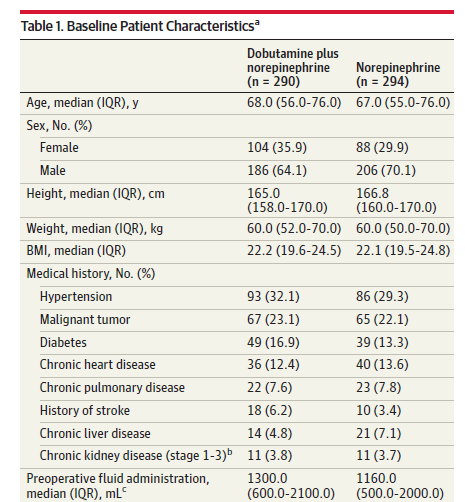
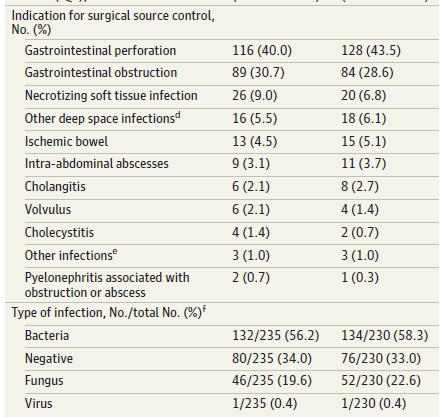
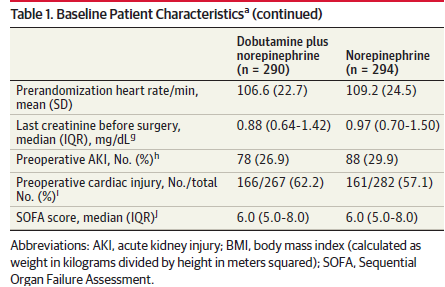
Table 1. Baseline patient characteristics,from Chu et al, JAMA, 2026
Adherence was good. Dobutamine ran through the entire operation in 85.5% and was stopped early in 14.1%. Median per-patient dobutamine rate was 5.0 μg/kg/min, so most patients stayed at the full starting dose. Both mean and maximum norepinephrine rates were lower in the dobutamine arm (P = .002 and P < .001).
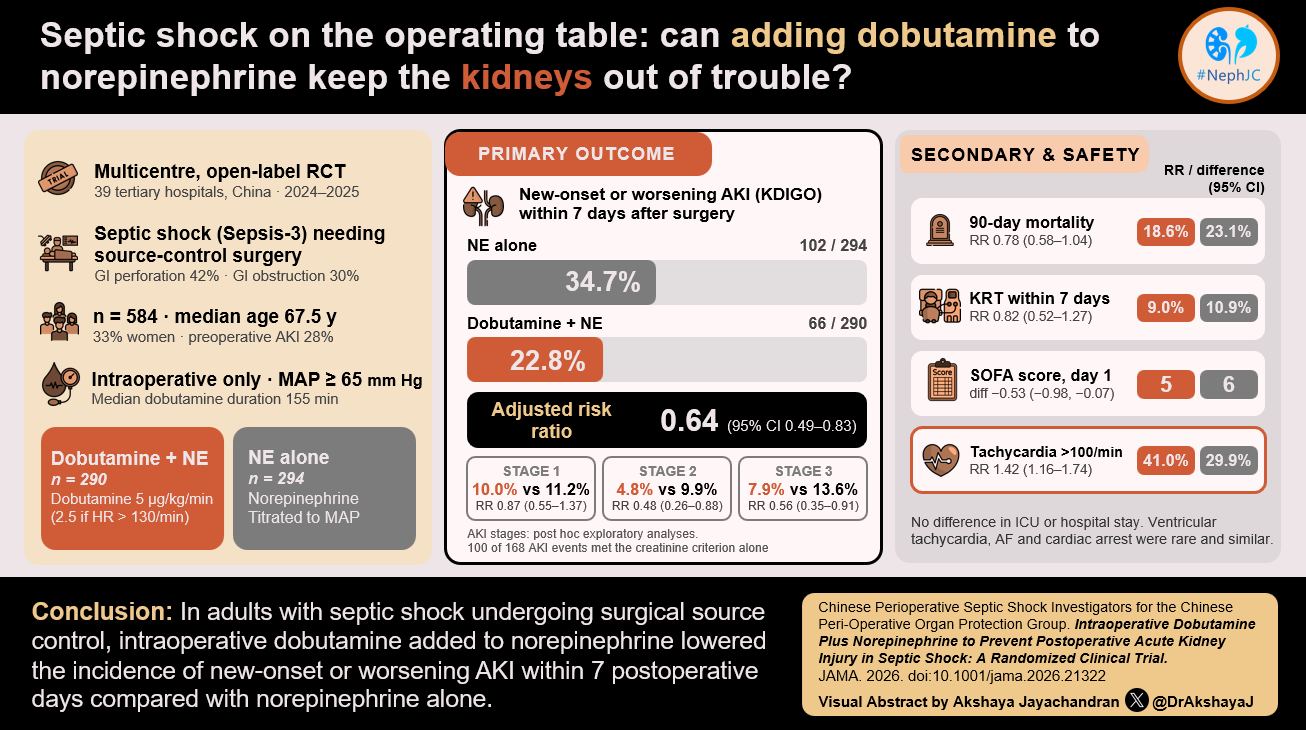
Primary outcome. New-onset or worsening AKI within 7 days occurred in 66/290 (22.8%) with dobutamine versus 102/294 (34.7%) with norepinephrine alone: adjusted RR 0.64 (95% CI 0.49-0.83), P = .001. The absolute difference was 11.9 percentage points, an NNT of about 8.
How robust is this? By our own back-of-envelope calculation, the fragility index of the primary outcome is about 13: moving 13 patients in the dobutamine arm from "no AKI" to "AKI" would push Fisher's exact P above .05. For a 584-patient trial, that is respectable.
Importantly, and unlike MERCURI-2, this was mostly a creatinine result. AKI met the creatinine criterion alone in 100 patients (17.1%), urine output alone in 22 (3.8%), and both in 46 (7.9%). Post hoc analyses of transient versus persistent AKI and creatinine trajectories were reported as consistent.
Table 2. Primary and secondary outcomes, from Chu et al, JAMA, 2026
The stage breakdown is where it gets interesting:
No difference in stage 1, and approximately halving of AKI stages 2 and 3. Biologically, that is the pattern you would hope for. Statistically, both the stage 2 and stage 3 findings are fragile (fragility index of about 2 each, by our calculation), post hoc, and unadjusted for multiplicity. Worsening of preexisting AKI was similar between groups (eTable 14), so the whole signal comes from patients who walked in without AKI.
One denominator quirk: new-onset AKI (17.9% vs 28.6%) is reported over all randomized patients, including those who already had AKI, and therefore (by definition) could not have new-onset AKI. Among patients without preoperative AKI (212 vs 206), the rates are closer to 24.5% vs 40.8%. The relative effect is similar, but the absolute risk in the AKI-naive population is considerably higher than the headline suggests.
eFigure 2. Subgroup analyses of the primary outcome, from Chu et al, JAMA, 2026
Secondary outcomes. Nine of eleven were neutral.
SOFA at day 1 was lower with dobutamine (median 5 vs 6; adjusted difference −0.53, 95% CI −0.98 to −0.07). By day 3 and day 7, there was no difference. Crucially, the non-kidney SOFA score did not differ, so the day 1 improvement is essentially the renal component restating the primary outcome.
Urine output 1 hour after starting the drug was higher (2.4 vs 1.9 mL/kg/h; difference 0.55, 95% CI 0.03-1.07). By the end of surgery, the difference had vanished (1.7 vs 1.6 mL/kg/h).
28-day mortality: 16.2% vs 20.4% (RR 0.75, 95% CI 0.55-1.04).
90-day mortality: 18.6% vs 23.1% (RR 0.78, 95% CI 0.58-1.04).
KRT within 7 days: 9.0% vs 10.9% (RR 0.82, 95% CI 0.52-1.27).
ICU stay, hospital stay and ventilation duration: no differences.
In the subset with advanced hemodynamic monitoring (size not reported in the main paper), cardiac index rose more with dobutamine (difference 0.72 L/min/m², 95% CI 0.02-1.41). Lactate, ScvO2 and capillary refill time were more favorable at 1 hour and at the end of surgery.
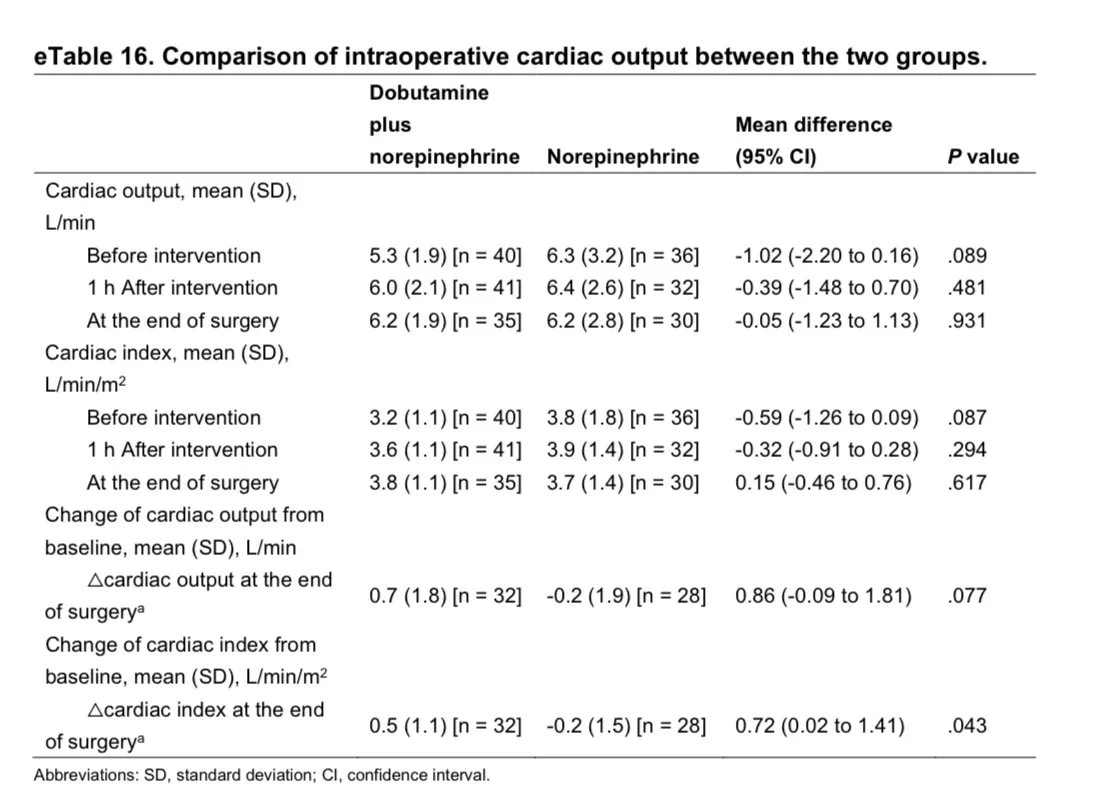
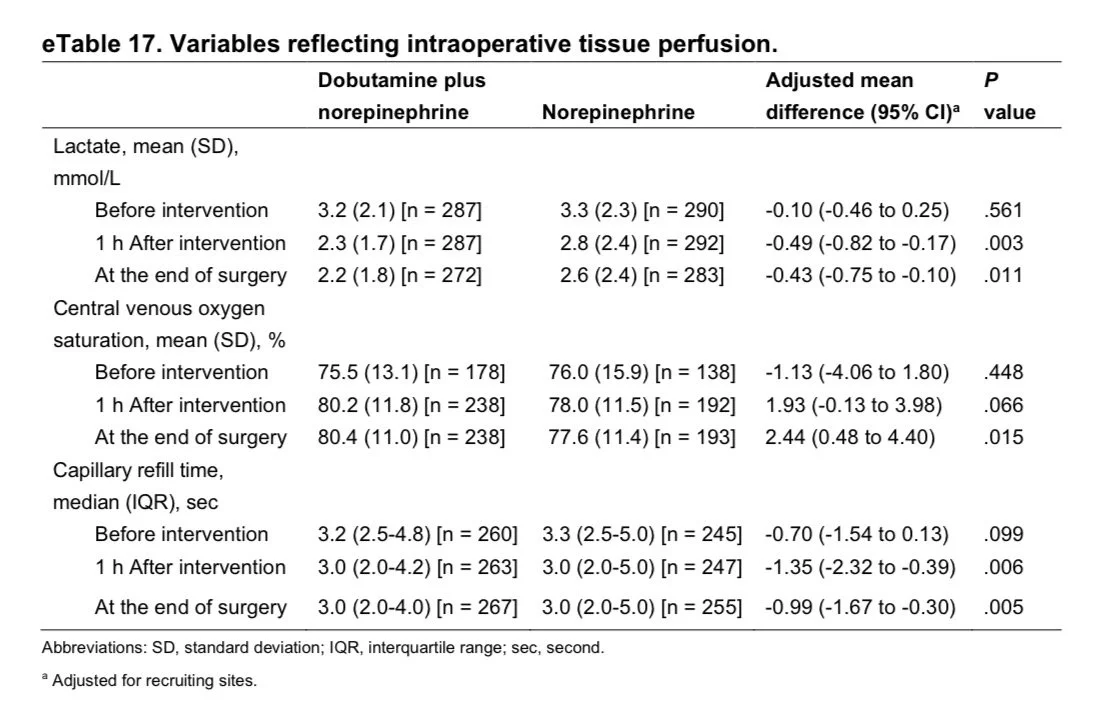
eTable 16 and 17. Markers of systemic perfusion, from Chu et al, JAMA, 2026
Safety. Tachycardia was more common with dobutamine (41.0% vs 29.9%; RR 1.42, 95% CI 1.16-1.74). Ventricular tachycardia (0.7% vs 0.7%), cardiac arrest (0.3% vs 0.3%), AF (2.8% vs 2.4%) and PVCs (2.1% vs 1.4%) were all rare and similar. End-of-surgery heart rate was comparable (97.4 vs 96.2/min).
Table 3. Safety outcomes, from Chu et al, JAMA, 2026
Discussion:
Credit where due: this is a pragmatic, government-funded trial. The main result is driven mostly by creatinine, outcome assessors were blinded, and the fragility index is reasonable. Still, the design leaves real room for bias. The trial was open-label, even though comparing dobutamine with saline in identical syringe drivers would have been easy to blind. That matters because the unblinded anesthesiologists controlled everything that drives postoperative creatinine and urine output: fluids, norepinephrine, colloids, diuretics, and transfusion. Allocation also used permuted blocks of 4 in sealed envelopes. In an open-label trial, that makes the next assignment guessable, and the envelopes open to tampering.
The bigger question is what was actually being treated. Guidelines reserve dobutamine for septic shock with cardiac dysfunction and persistent hypoperfusion. Here, every patient in the active arm got a fixed 5 μg/kg/min, with no measure of cardiac output or ScvO2 required first. Norepinephrine doses were also lower in the dobutamine arm. So part of the kidney benefit may come from using less vasoconstrictor, rather than from adding flow, and the trial cannot separate the two.
The outcome definition adds noise. Baseline creatinine was back-calculated when no prior value existed, and the paper never says how often that happened. The primary composite also mixed new AKI with worsening of AKI that was already present before surgery, and the whole signal came from patients who started without AKI. It is also hard to explain biologically how about 2.5 hours of dobutamine, whose urine-output effect was gone by the end of surgery, halved stage 2–3 AKI over the following week. That is plausible if the operation itself is the critical hit. It is also the pattern you would expect if postoperative care differed between unblinded teams.
Deaths during follow-up and missing data also deserve a mention. Patients were followed to day 7 or death, so anyone who died before creatinine rose was counted as having no AKI. Day 28 mortality was numerically higher in the control arm (20.4% vs 16.2%), which would probably bias the result toward no difference. But the paper does not report when those early deaths happened. Missing data were not imputed, and the paper does not say how many patients had incomplete creatinine or urine output data over the 7 days. Day 7 SOFA was available in only about 85% of patients. None of this overturns the main result, but it makes the size of the effect less certain.
Most importantly, nothing a patient would notice changed. Mortality, kidney replacement therapy, non-kidney SOFA scores, ICU stay and hospital stay all failed to show a difference. Stage 3 AKI fell from 13.6% to 7.9%, but KRT barely moved (10.9% vs 9.0%). Note that KRT outcome also counted patients continuing KRT started before surgery (table 2, footnote g). The stage 3 reduction therefore reflects creatinine ≥ 3 x baseline, (or ≥ 4 mg/dl), or severe oliguria, rather than new dialysis, as far as the main paper allows us to tell. The stage 2–3 findings are post hoc, fragile, and sit among 30 post hoc analyses. Generalizability is also limited: 39 tertiary centres in China, a lean population, mostly abdominal surgery, and patients on β-blockers were excluded.
Does it change anything?
Not yet. This is not a reason to give every septic patient going to the surgical theatre a dobutamine infusion. The trial shows that a short, fixed-dose infusion is reasonably safe and lowers creatinine-defined AKI. It does not show which patients benefit, and it does not show fewer deaths or less dialysis. For patients who already meet the guideline indication, such as documented low cardiac output, it offers some reassurance that intraoperative dobutamine likely does no harm to the kidney.
For nephrologists, this joins BigpAK-2 and MERCURI-2: perioperative trials where AKI incidence (based upon non-clinical definitions) moves, but nothing downstream does. The next trial should be blinded and enroll patients with a measured low-output cardiac state. It should be powered for MAKE90 (death, new dialysis or persistent kidney dysfunction at 90 days) and include a comparator that also spares norepinephrine, so the two mechanisms can be differentiated
Conclusion
In septic shock patients undergoing source-control surgery, adding dobutamine to norepinephrine during the operation reduced 7-day AKI from 34.7% to 22.8%. However, the effect was mainly on creatinine. It was not shown to reduce dialysis, survival, or kidney recovery (MAKE 90) was not measured.
Summary by
Written by
Assistant Professor of Nephrology,
Christian Medical College, Vellore, India