
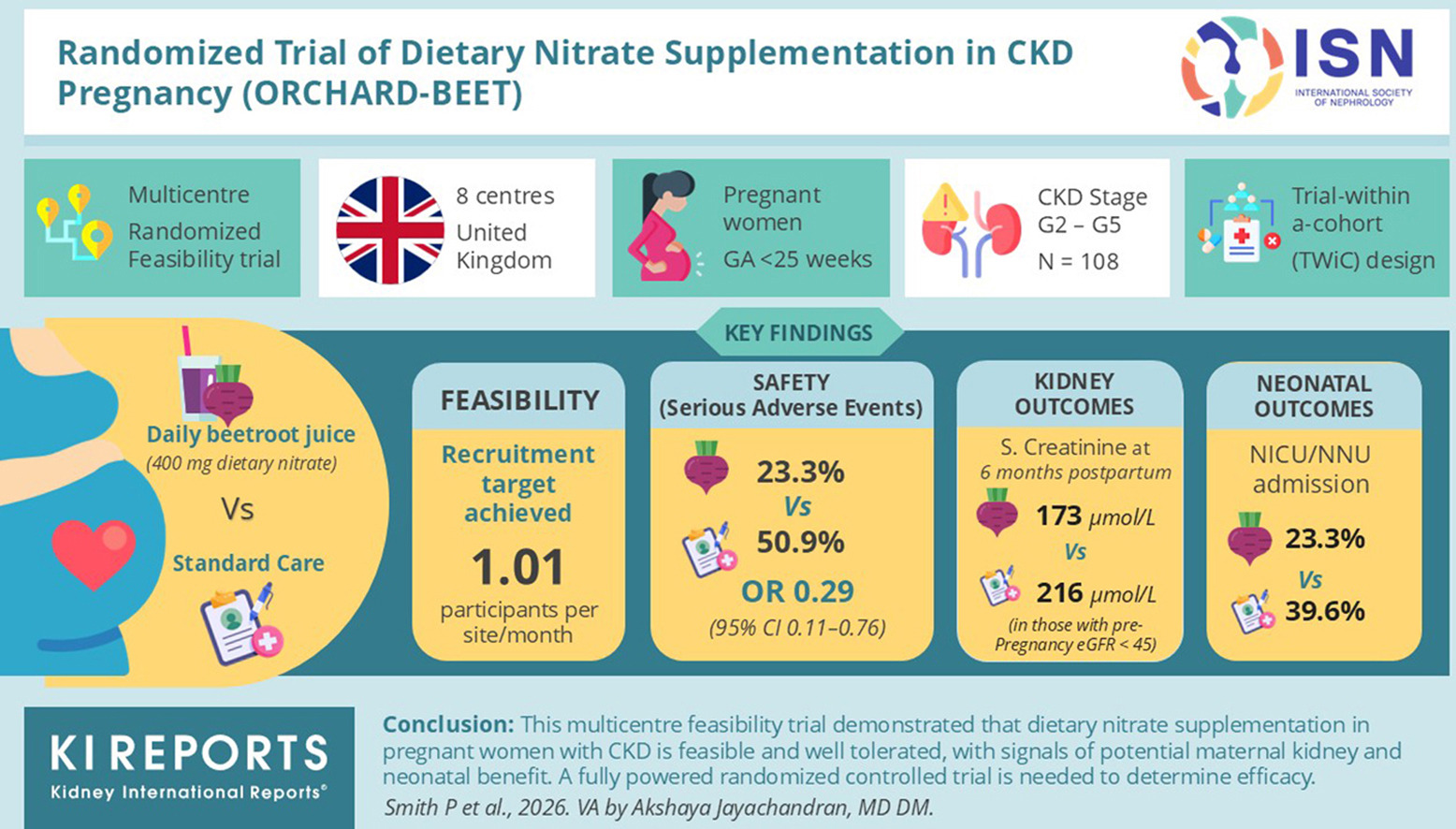
KI reports, Articles in Press 106704, July 17, 2026
Randomized Trial of Dietary Nitrate Supplementation in CKD Pregnancy (ORCHARD-BEET)
Priscilla Smith, Danielle Ashworth, Rachel Hung, Yanzhong Wang, Andrew J. Webb, Kathryn Dalrymple, Katherine Clark, Lucy C. Chappell, Kate Wiles, Kate Bramham, on behalf of the ORCHARD Consortium
DOI: 10.1016/j.ekir.2026.106704
Why was the study needed?
CKD affects 0.2% to 6% of pregnancies (Williams D & Davison J, BMJ, 2008| Piccoli GB et al, J Clin Med, 2018), rising with diabetes, obesity, hypertension, and delayed childbearing (GBD 2015 Maternal Mortality Collaborators, Lancet, 2016). In stages G3-G5 CKD, ~46% of women lose over a quarter of pre-pregnancy eGFR or need renal replacement therapy within 12 months of delivery. (Wiles K et al, NDT, 2021). Outcomes haven’t improved in two decades (Smith PA et al, Nat Rev Nephrol, 2025), and no dedicated interventional trial has run since Kincaid-Smith’s 1995 heparin/ dipyridamole study (Nephrology, 1995)- a three-decade gap ORCHARD-BEET was designed to address (Smith P et al, KI reports, 2026).
RAAS inhibitors and SGLT2 inhibitors, the strongest CKD progression-slowing agents, are contraindicated in pregnancy and lactation because of fetal risk and insufficient breastfeeding safety data (Wiles K et al, BMC Nephrol, 2019). Dialysis, meanwhile, is neither universally accessible nor scalable. KDIGO 2024 itself concedes that pregnancy-specific management evidence beyond monitoring remains unclear (KDIGO CKD Work Group, KI, 2024).
Nitric oxide physiology: normal pregnancy, CKD, and preeclampsia
Normal pregnancy
Nitric oxide (NO) drives two relevant adaptations. Renally, NO-mediated afferent/efferent arteriolar dilation lowers vascular resistance and raises renal blood flow and GFR- the physiological hyperfiltration of pregnancy. In the placenta, NO drives trophoblast remodeling of spiral arteries from narrow, high-resistance vessels into wide, low-resistance ones able to meet fetal demand.
CKD
NO bioavailability falls via impaired synthesis (Wever R et al, Arterioscler Thromb Vasc Biol, 1999) and accumulated NO synthase (NOS) inhibitors- such as asymmetric dimethylarginine (ADMA) (Schmidt RJ, Kidney Int, 2000). A kidney entering pregnancy with impaired NO synthase activity cannot mount the normal hyperfiltration response, which is a key contributor to eGFR loss.
Preeclampsia
Same deficit, different organ: reduced NO and endothelial dysfunction impair spiral artery remodeling, leaving the placenta underperfused, triggering anti-angiogenic factor release, maternal endothelial dysfunction, and fetal growth restriction- contributing to, but not strictly causing it. CKD and preeclampsia share this mechanism, explaining CKD pregnancies’ elevated preeclampsia risk.
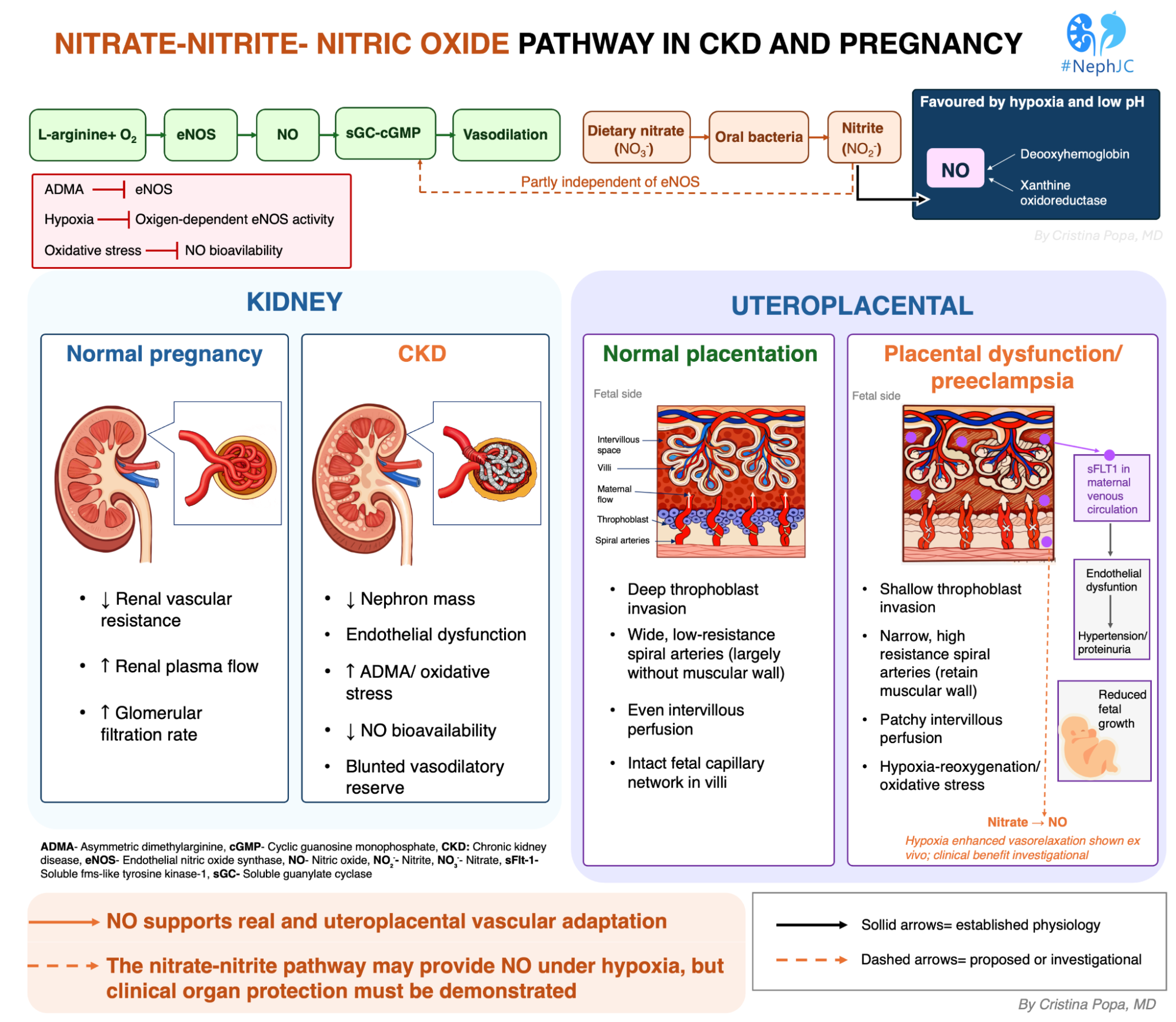
NO supports renal and uteroplacental vascular adaptation in pregnancy. CKD reduces NO bioavailability and renal reserve, while impaired placentation promotes hypoperfusion, sFlt-1 release, and preeclampsia. Hypoxia-favoured nitrite-to-NO conversion is a plausible but unproven therapeutic pathway. Solid arrows indicate established physiology; dashed arrows indicate proposed mechanisms
Dietary nitrate as an NO synthase-independent bypass
Oral/ enteric bacteria reduce nitrate to nitrite, then to NO, a route Lundberg, Weitzberg and Gladwin showed works independently of the classical L-arginine-NOS route (Lundberg JO et al, Nat Rev Drug Discov, 2008), and one preferentially active in hypoxic, acidic tissue, exactly where NOS activity is the weakest. Nitrite-mediated vasorelaxation of human placental chorionic plate arteries is enhanced under hypoxia (Tropea T et al, Nitric Oxide, 2018), and low-dose nitrite restores renal tissue oxygenation and limits the creatinine rise following ischemia-reperfusion injury in animal models (Cantow K et al, Sci Rep, 2018). This gives the intervention a mechanistic rationale specific to the compromised, hypoxic tissue found in pregnancy with CKD and preeclampsia.
Beetroot juice had already shown plausible benefit and acceptable safety in hypertensive, non-CKD pregnancy (Ormesher L et al, Nitric Oxide Biol Chem, 2018), and in non-pregnant CKD cohorts (Kemmner S et al, Nitric Oxide Biol Chem, 2017| Webb AJ et al, Hypertens Dallas Tex, 2008). The effect of beetroot juice on blood pressure itself has been reported in several, albeit all small, RCTs (Gronroos et al, Nutr Metab CV, 2024), though whether this effect is mediated through nitrates or not may be debatable (Sagar et al, KI Reports 2024).
This was a feasibility study, not an efficacy trial- designed to test whether recruitment was achievable and to gather preliminary safety/signal data for a future powered trial.
How was the trial done?
Design
Trial-within-a-cohort (“modified Zelen”) design (Figure 1): participants first consented to the ORCHARD observational cohort and then were randomized 1:1 to dietary nitrate or standard care. Only those allocated to the nitrate were approached for a second consent to actually receive it; standard care participants were enrolled automatically. This structure, originally proposed by Zelen in 1979, reduces recruitment bias, but it weakens the crossover: even modest rates bias estimates and cut power (Homer CSE, J ADV Nurs, 2002).
Figure 1. Trial within a cohort design, from Smith P et al, KI reports, 2026
Setting and population: 8 UK tertiary centers, February 2020-April 2024, with a 6-month pause for COVID-19. Eligible patients included singleton pregnancies, KDIGO-defined G2-G5 CKD, <25 weeks’ gestation, pre-pregnancy eGFR >90 ml/min/1.73 m² or pregnancy creatinine >70 μmol/l (0.79 mg/dl) without evidence of acute kidney injury.
Intervention vs comparator: Daily 70 mL “Beet-It-Sport” shot (approx. 400 mg nitrate) from consent or 12 weeks’ gestation (whichever was later) until delivery, versus standard care. The trial was open-label, without a placebo due to expense.
Follow-up and outcomes: Up to 5 visits through 6 months postpartum, assessing kidney function, proteinuria, blood pressure, and maternal/neonatal adverse events. The primary outcome was recruitment rate per site per month.
Intention-to-treat: All standard care participants were analyzed. Only nitrate-arm participants who gave the second consent were analyzed. This departs from the classical Zelen analysis (which retains everyone originally randomized); a deviation the authors acknowledge as a limitation.
Of 119 eligible women, 108 were randomized, yet only 30/54 allocated to nitrate consented versus 53/54 retained in standard care (Figure 2)- crossover made concrete, and a reminder that the analyzed nitrate arm is self-selected, not the full allocated group.
Figure 2. ORCHARD-BEET CONSORT diagram, from Smith P et al, KI reports, 2026
Results
The primary outcome- recruitment feasibility- was achieved, with a mean recruitment rate of 1.01 participants per site per month (SD 0.90)-useful for planning, likely an underestimate in higher-burden settings.
The nitrate arm had numerically less chronic hypertension and markedly fewer Black participants to standard care, both established risk factors for CKD progression; despite comparable pre-pregnancy eGFR between arms, these imbalances were not statistically adjusted for in subsequent comparisons.
Table 1. Baseline characteristics, from Smith P et al, KI reports, 2026
Kidney outcomes were directionally suggestive rather than statistically definitive, though biologically coherent. Among participants with pre-pregnancy eGFR below 45 ml/min/1.73 m², postpartum creatinine tended to be lower with dietary nitrate (176 vs 226 μmol/l at week 6, p= 0.23, 173 vs 216 at μmol/l 6 months, p=0.18), whereas in the milder CKD stratum (Figure 3c, eGFR > 45) the 2 arms’ trajectories were superimposable- consistent with the hypothesis that benefit concentrates where baseline NO deficiency is greatest.
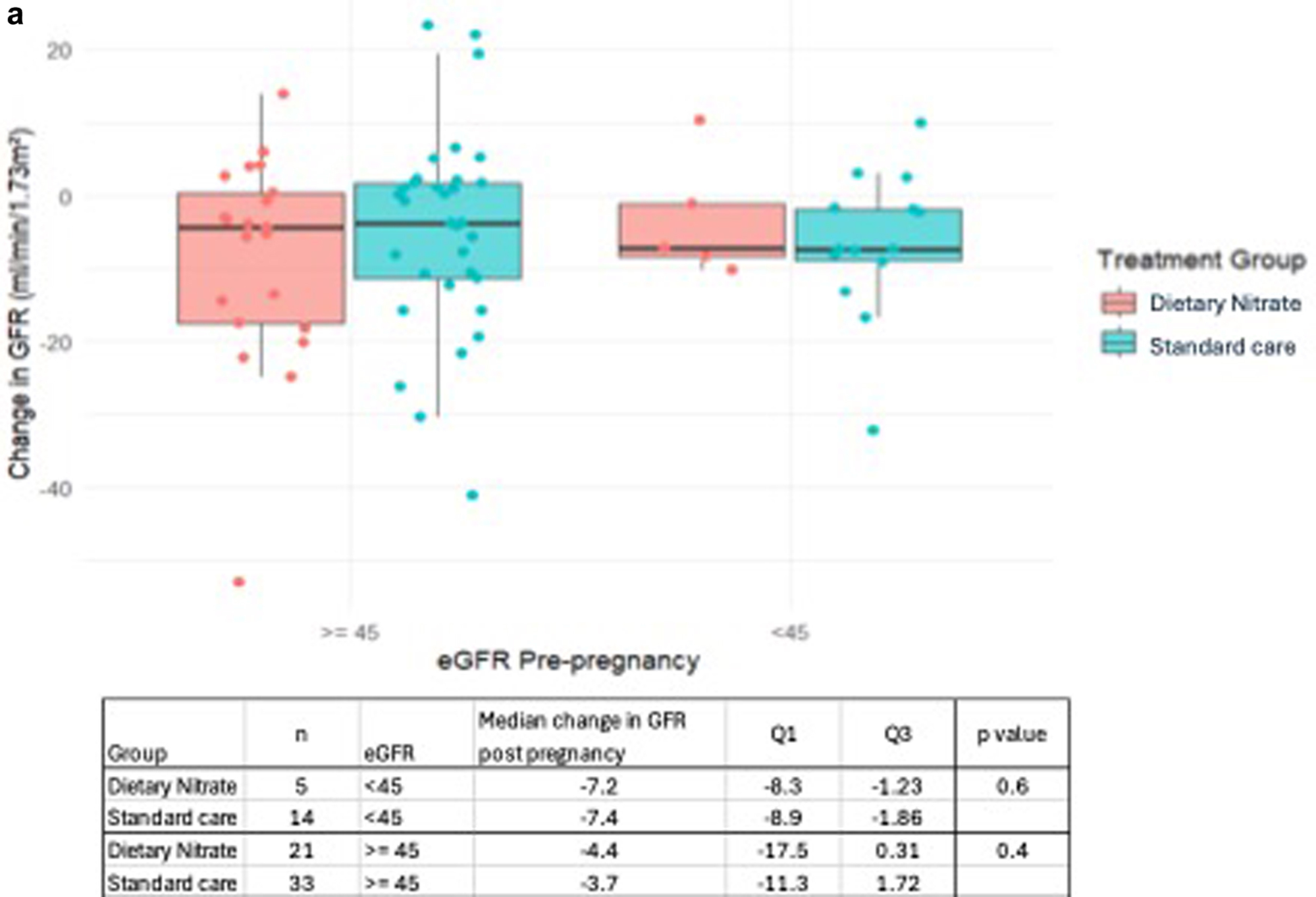
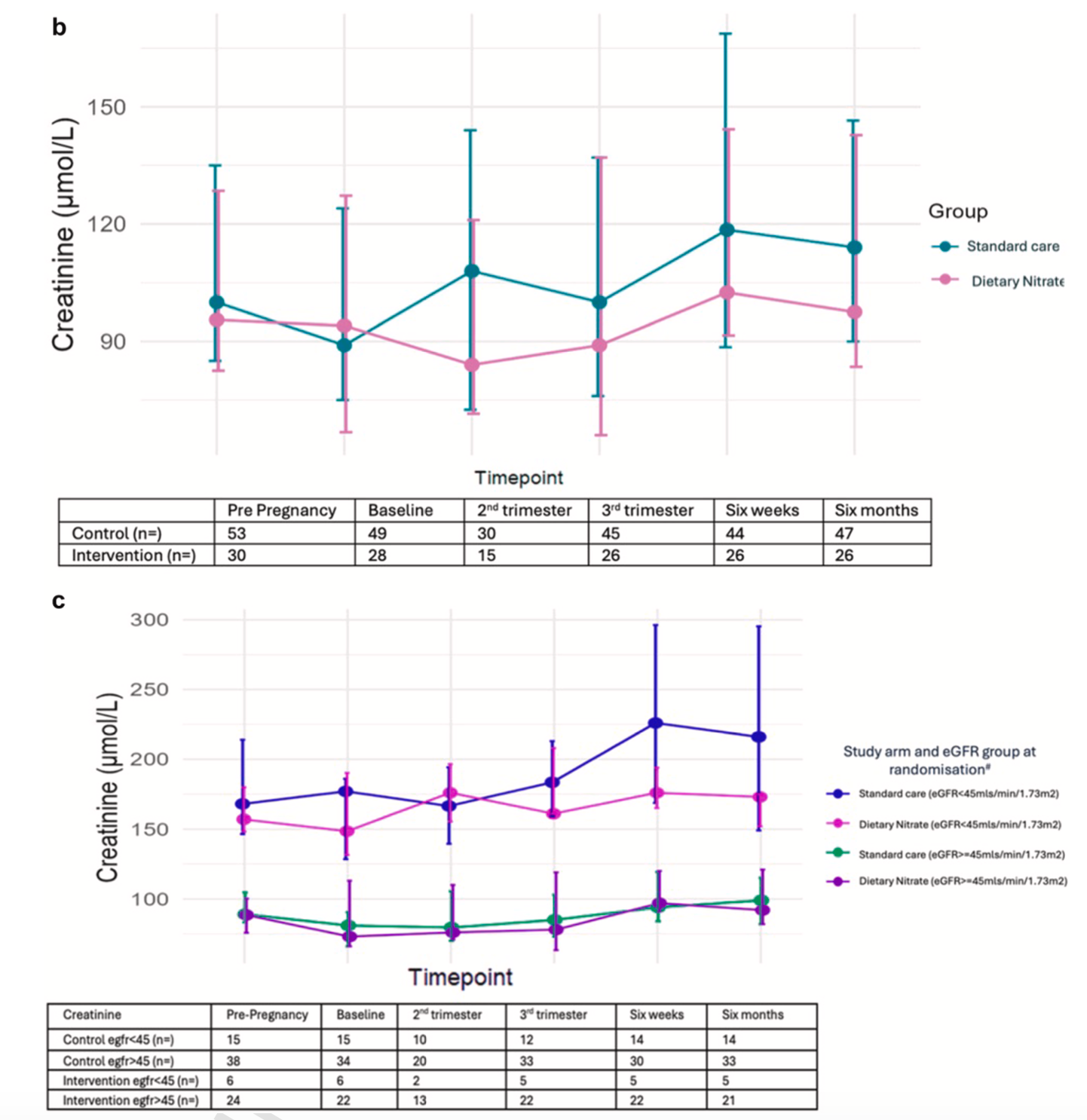
Figure 3. (a) Median eGFR changes from prepregnancy to 6 months postpartum, by randomization eGFR group and treatment. (b) Median creatinine by intervention. (c) Median creatinine by intervention and randomization eGFR group, from Smith P et al, KI reports, 2026
There were no significant differences in delivery mode, gestational age, or birthweight centile but a numerically lower NICU/neonatal unit admission rate with nitrate use (23.3% vs 39.6%, p= 0.13) and a higher median birthweight. The authors note this magnitude of NICU admission reduction is comparable to that reported for antenatal corticosteroids in the updated Cochrane review of preterm birth (Roberts D et al, Cochrane Database Syst Rev, 2026), though this remains a descriptive comparison across studies rather than a direct statistical contrast.
Blood pressure approached but missed significance (Table 3): SBP 120.3 vs 123.2 mmHg (p= 0.064) and DBP 75.4 vs 77.7 mmHg (p= 0.051). A magnitude comparable to both the CHAP trial of mild chronic hypertension treatment in pregnancy (Tita AT et al, NEJM, 2022| NephJC summary) and non-pregnant dietary nitrate meta-analyses (Ashor AW et al, J Hypertens, 2017).
Table 3. Blood pressures, from Smith P et al, KI reports, 2026
The single result reaching statistical significance appears in Table 4. Serious adverse events occurred in 23.3% of the nitrate arm vs 50.9% of standard care (OR 0.29, 95 CI 0.11-0.80), with no nitrate-attributable SAEs, no congenital abnormalities, and hyperkalemia above 6 mmol/L occurring in one participant per arm. A post hoc analysis found lower antihypertensive use with nitrate use (36.7% vs 66%, p= 0.0097). This analysis was explicitly designated post hoc by the authors and therefore is hypothesis-generating.
Table 4. Adverse events, from Smith P et al, KI reports, 2026
Only 20.8% enjoyed the intervention- taste, nausea, reflux, and beeturia (harmless urinary discoloration) were the main complaints- yet 62.5% would repeat it, and 70.8% would recommend it.
Table 5. Beetroot acceptability, from Smith P et al, KI reports, 2026
What are the implications?
The one significant finding- the SAE reduction- is also its most bias-prone result: open-label trials leave SAE ascertainment and decisions like antihypertensive initiation vulnerable to detection and performance bias without blinding. A nitrate-depleted placebo had worked before (Ormesher L et al, Nitric Oxide Biol Chem, 2018), so the comparator was feasible, just not funded here; its absence weakened every clinical outcome. Baseline imbalances compound this, as does the Zelen crossover itself: with nearly half the nitrate arm declining the second consent, the analyzed group is a self-selected, likely more engaged subgroup against a near-complete standard-care arm- exactly the bias methodological literature predicts, and one of the authors acknowledges.
Generalizability is also limited: women from lower socioeconomic groups and Black ethnicity - disproportionately affected by CKD and its pregnancy complications- were underrepresented in the intervention arm, partly from COVID-related recruitment disruption at sites serving them, limiting applicability to the population with the greatest disease burden. The mechanistic picture is incomplete too: planned salivary/ tongue sampling to characterize oral nitrate-reducing capacity was abandoned for infection-control reasons- a real gap since the pathway depends on bacterial nitrate reduction, and interindividual variation in this capacity (Willmott T et al, Hypertens Dallas Tex, 2023) plausibly explains some of the blood pressure heterogeneity (Lundberg JO et al, Nat Rev Drug Discov, 2008).
Conclusion
After thirty years without a randomized trial in CKD pregnancy and a pandemic working against it throughout, ORCHARD-BEET deserves credit for being a well-conducted, transparently reported multicenter RCT in a largely abandoned field. It met its stated goal: feasibility, not efficacy, was the primary outcome, and 1.01 participants per site per month with 76.8% completion gives solid planning data for what comes next.
It was not, and was never meant to, prove efficacy. The kidney, blood pressure, and neonatal trends are encouraging and biologically coherent, especially in more advanced CKD, but stem from a modified Zelen analysis that lost nearly half its intervention arm to a second consent in an open-label trial with no placebo.
Put simply, this is a solid proof of concept. Women with CKD will enroll in interventional pregnancy trials; the intervention raised no safety concerns, and the field now has the numbers it needs to design a properly powered trial that should follow. Closing a thirty-year gap is, on its own, quite an accomplishment.
Reviewed by