
N Engl J Med. 2026 Jul 30;395(5):465-477. doi: 10.1056/NEJMoa2600743. Epub 2026 Mar 29.
Iptacopan in IgA Nephropathy - Final 24-Month Data
Jonathan Barratt, Necmi Ere, Naoki Kashihara, Bart Maes, Dana V Rizk, Brad Rovin, Hernán Trimarchi, Hong Zhang, Weiming Wang, Ismail Kocyigit, Chuanming Hao, Vladimir Tesař, Kenan Turgutalp, Li Yang, Guangqun Xing , Valter Duro Garcia, Seung Hyeok Han, Wanhong Lu, Antonio Pisani, Julia Weinmann-Menke, Frank Eitner, Nicolas Guerard, Dmytro Butylin, Luca Monaco, Emil Scosyrev, Annabel Magirr, Ronny Renfurm, Thomas Hach, Vlado Perkovic; APPLAUSE-IgAN Study Group
Collaborators, Affiliations Expand
PMID: 41910396
Why was the study done?
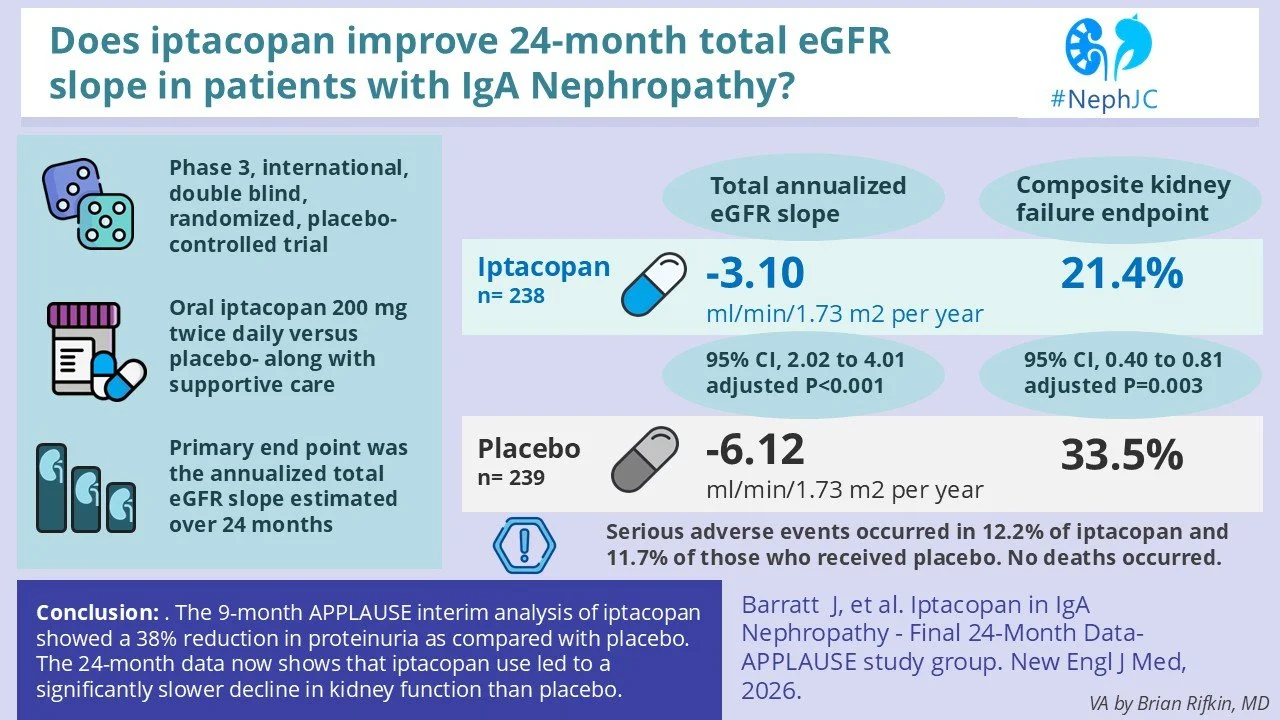
And the hits keep on coming! Ever since the elucidation of the 4-hit model in IgA nephropathy (IgAN) there has been the introduction of a plethora (a plethora? Yes, a plethora!) of new therapeutics based upon the various pathways of destruction. NephJC reviewed the KDIGO IgAN guidelines in 2025, which didn’t even incorporate iptacopan use, as the preliminary APPLAUSE results had been contemporaneously released (Perkovic et al. New Engl J Med, 2025). The excellent work by the PARASOL project, and the use of proteinuria as a reliable clinical trial endpoint for rare kidney disease, has moved medications from the lab to human studies to market at a breakneck speed. However, we are often left with questions about how effective these new treatments will be in the real world. We all hold our collective breath and await the GFR data to hopefully prove what we “already know”. Iptacopan, a complement factor B binder (alternative pathway) that inhibits C3 convertase, has shown efficacy in Paroxysmal Nocturnal Hemoglobinuria (PNH), C3 nephropathy (C3GN), and IgAN. The 9-month APPLAUSE interim analysis of this phase 3 trial of iptacopan showed a significant reduction (38%) in the 24-hour urinary protein-to-creatinine ratio as compared with placebo. We now have the 24-month data of eGFR in IgAN…and hopefully no surprises.
How was the study done?
This was a phase 3, international, double blind, randomized, placebo-controlled trial. The trial included a screening period, a run-in period of up to 90 days, and a 24-month treatment period. At the start of the treatment period, eligible patients were randomly assigned, in a 1:1 ratio, to receive oral iptacopan at a dose of 200 mg twice daily or matching placebo, along with supportive care. After the treatment period, eligible patients could receive open label iptacopan in a rollover extension study.
Eligible patients were 18 years of age or older and had biopsy-confirmed IgA nephropathy, an eGFR of at least 30 ml per minute per 1.73 m², and a 24-hour urinary protein-to-creatinine ratio of 1 or higher, despite RASi use for at least 90 days before the receipt of iptacopan or placebo.
Table 1. Baseline demographic and clinical data. Barratt J, et al. New Engl J Med, 2026
The primary end point for the final analysis was the annualized total eGFR slope estimated over a period of 24 months. Secondary end points a composite kidney-failure (defined as a sustained decline in the eGFR of ≥30% from baseline for ≥4 weeks, a sustained eGFR of <15 ml per minute per 1.73 m2 for ≥4 weeks, initiation of maintenance dialysis, receipt of a kidney transplant, or death from kidney failure), which was assessed in a time-to-event analysis. Safety end points, including adverse events, laboratory variables, and vital signs, were also assessed.
What do the results say?
The trial population was representative of the wider population of patients with IgA nephropathy. Overall, 19% of the patients were taking an SGLT2 inhibitor at baseline. During the 24-month treatment period, alternative or rescue medication was taken because of disease progression by 4.6% of the patients in the iptacopan group and by 13.4% of those in the placebo group. Discontinuation was asymmetric (18.9% iptacopan vs 36.8%), mainly driven by the prespecified ≥ 30% eGFR decline stopping rule.
Iptacopan resulted in a significantly slower eGFR decline than placebo (whew, no surprises). The between-group difference in the eGFR slope was 3.02 mL per minute per 1.73 m² per year (95% CI, 2.02 to 4.01) in favor of iptacopan. Iptacopan resulted in a smaller decrease from baseline to month 24 in the eGFR than placebo. The effect of iptacopan on the eGFR decline appeared to be consistent across prespecified subgroups defined according to age, sex, geographic region, 24-hour urinary protein-to-creatinine ratio category, eGFR category, the presence or absence of hematuria at baseline, SGLT2 inhibitor use at baseline, and the MEST-C score at biopsy. The SGLT2i at baseline subgroup showed a numerically larger benefit (diff 2.97 vs 2.71 without), hypothesis-generating for combination synergy but not powered for interaction testing.
Figure 1. Annualized eGFR slope over 24-months. Barratt J, et al. New Engl J Med, 2026
The iptacopan group had a significantly higher number of patients with a 24-hour urinary protein-to-creatinine ratio of less than 1 at month 9 (difference of 26.4 percentage points [95% CI, 18.7 to 34.0]). The risk of a composite kidney-failure end-point event was also significantly lower in the iptacopan group than in the placebo group (hazard ratio, 0.57; 95% CI, 0.40 to 0.81). FACIT-Fatigue change was not significantly different between arms- likely because baseline scores in both groups already approximated general population norms, leaving little room to detect improvement.
Table 2. Summary of outcomes. Barratt J, et al. New Engl J Med, 2026
Overall adverse event incidence was similar between groups (87% with iptacopan vs 89.1% with placebo). As was the serious AE incidence (12.2% vs 11.7%), with no deaths in either arm. However, serious infections were more common with iptacopan (6.7 vs 2.1%), predominantly pneumonia; 2 iptacopan-treated patients had confirmed S. pneumoniae infections despite prior vaccination (both resolved with antibiotics; both discontinued per protocol). No meningococcal or H. influenzae infections occurred. Serious adverse events pertaining to kidney and urinary disorders occurred in 5 patients (2.1%) receiving iptacopan and in 4 patients (1.7%) receiving placebo, and neoplasms were reported in 4 (1.7%) and 3 (1.3%), respectively.
Table 3. Adverse events. Barratt J, et al. New Engl J Med, 2026
Critical Review
So, we expected that the preliminary 9-month results of iptacopan in IgAN would show decreased proteinuria and a favorable safety profile. Now we have the eGFR data at 24-months that we also anticipated, with an improvement in eGFR slope of 3 mL per minute per 1.73 m² per year versus placebo. We can be at least a little cynical that the comparison group was placebo and additionally note that SGLT2 inhibitor use was still fairly uncommon during the study period (approximately 20%). Also, the standards for IgAN treatment are increasing, and the goal is slowing eGFR loss to background aging (0.5-1 ml per minute per 1.73 m² per year). So, we have another useful tool for IgAN, though one that still leaves a residual chronic eGFR loss of 3 mL/min/year and carries a real (if manageable) infection cost.
The bigger issue for most nephrologists was not going to be if iptacopan decreases proteinuria and slows eGFR decline, but rather where does iptacopan fit in the grand scheme of IgAN treatments. It will definitely not be a “stand-alone” medication, but will it be enough when used with maximal non-immunosuppressive medications (i.e. RASi, DERA, SGLT2i)? Now that we have definitive eGFR data (and soon to be released sibeprenlimab eGFR data that was previewed at GlomCon 2026), there will be a push for studies with data with combined therapeutics (early versus late versus simultaneous initiation), just like GDMT in diabetic nephropathy. It is a new age, and I for one am happy to see KDIGO IgAN guidelines already out of date and badly in need of revising, less than 12 months after their release. It is a wonderful time to be a nephrologist with interest in rare glomerular diseases, because innovation and hard data have been a long time coming. A round of APPLAUSE for iptacopan the study group, and its proven benefits to a wide assortment of patients with varying severity of IgAN.
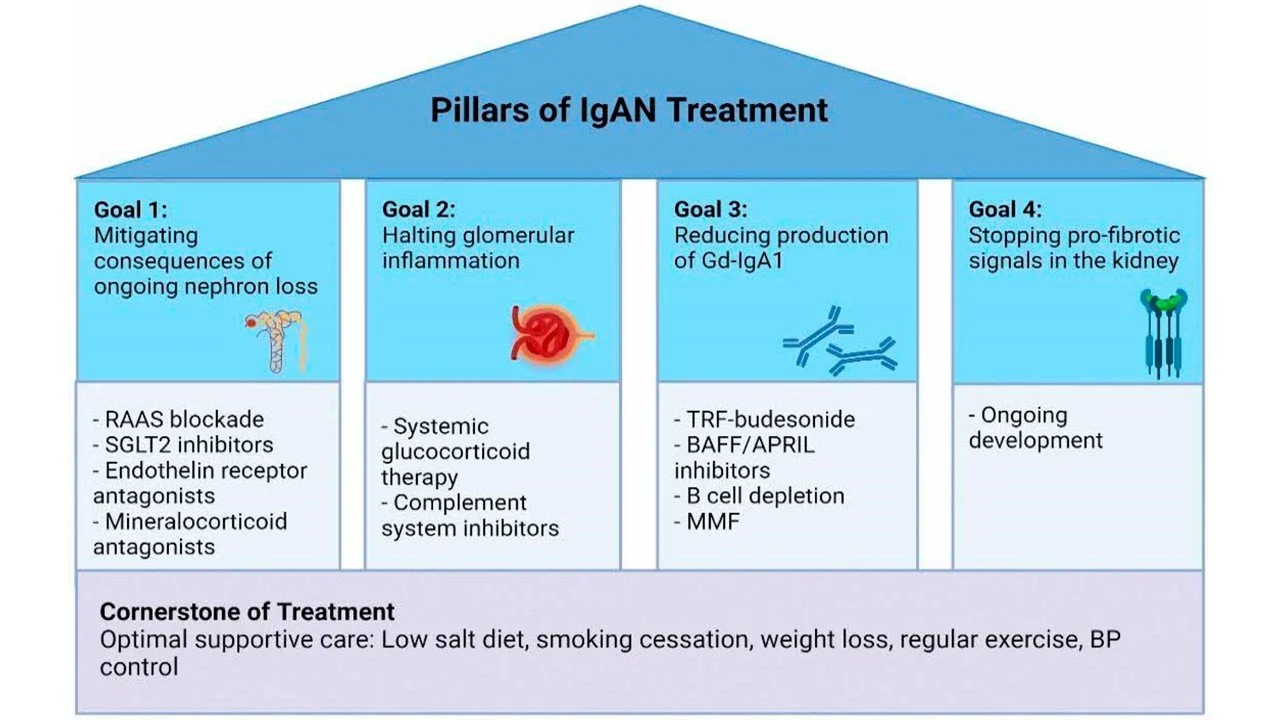
Figure 2. Pillars of IgAN treatment, from Lim RS et al, J Clin Med, 2024