
#NephJC Ten POsts Chat
Tuesday, September 29th 2026, 9 pm Eastern
Kidney International Reports, 2026
Randomized Controlled Trial of Corticosteroid Tapering in Steroid-Sensitive Podocytopathy
Arun Prabhahar, Joyita Bharati, Tamanna Sharma, Vivek Sood, Pavitra Manu Dogra, Thakur Sain, Vinod Kumar, Ritambhra Nada, Smita Subhash Divyaveer, Manish Rathi, Harbir Singh Kohli, Vivekanand Jha, and Raja Ramachandran
doi: 10.1016/j.ekir.2026.107004

Introduction
The fewer steroids, the better. This has been the catchphrase in glomerulonephritis in the past decade, with the caveat that we are not paying for it with more relapses. Adults with steroid-sensitive podocytopathy can respond to glucocorticoids, but relapse is common, and repeated courses can quickly add up to a substantial steroid burden. That matters because prolonged glucocorticoid therapy brings familiar baggage: metabolic complications, weight gain, risk of infection, bone disease, and other dose-related toxicities. The catch, of course, is that steroids work as a systemic, but non-specific, modifier of immunity and inflammation. Once remission is achieved, the practical question becomes: over what period should we taper steroids before enough is enough?
For a question we face so often in patients with nephrotic syndrome, the evidence in adults is surprisingly thin. Relapse rate in adult MCD has been reported between 61- 73% (Fenton et al, BMC Nephrology 2018; Waldman et al, CJASN 2007), with 28% frequently relapsing in the Waldman Cohort. Data from the Toronto Glomerulonephritis Registry (Troyanov et al, KI 2023) showed a 57% relapse rate among patients with FSGS and hypoalbuminemia, with a median time to relapse of 7 months.
KDIGO Guidelines recommend high-dose glucocorticoids as first-line therapy for adult MCD (1C), and suggested tapering after remission for up to about 24 weeks of total glucocorticoids exposure. For primary FSGS, glucocorticoids are recommended first line (1D), with a Practice Point suggesting a total duration of ≥6 months in responders. Infrequent MCD relapses and relapses of previously steroid-sensitive FSGS can be retreated with a shorter glucocorticoid course (tapering over 1-2 months). Much of the current practice is shaped by observational experience rather than randomized data.
Studies in children have given us some clues as to how to effectively decrease steroid exposure in nephrotic syndrome (one of the few instances where the peds literature surpasses the adult side). Randomized trials (Sinha et al, KI 2015 and Yoshikawa et al, KI 2015; Webb et al, Health Tech Assess 2019 | NephJC summary) ) found no clear advantage in extending the initial steroid treatment compared with shorter courses. Whether we can carry that lesson into adult practice has yet to be supported by RCT data.
NephJC has wrestled with the question of steroid minimisation in adults before while discussing tacrolimus as first line therapy in adult MCD (Thomas et al, CJASN 2020| NephJC summary). Despite all the hullabaloo around steroids, they remain the first line therapy for both childhood and adult MCD and FSGS considering their cost, availability and the vast literature supporting their use.
Prabhahar et al set out to address the evidence gap regarding length of steroid taper in adults with podocytopathy (MCD/FSGS). In the current study adults with biopsy-proven steroid-sensitive MCD or FSGS who had already achieved remission with prednisolone were randomized to either a 2-month or 4-month taper. The trial was not asking whether the shorter taper was better, but whether it was noninferior at preventing relapses. If the taper could be cut in half without meaningfully increasing relapses, then the steroid-sparing payoff could be substantial. The question they addressed: can we taper steroids sooner without paying for it later?
The Study
Methods
Study Design
The START (Steroid Tapering protocol in Adult Nephrotic Syndrome due to Podocytopathy) was a randomized, parallel-group, active-controlled, open-label noninferiority trial conducted at two centers in India. Enrollment took place from May 2021 to May 2023, with follow-up continuing through December 2025. Participants were centrally randomized using a computer-generated sequence, with allocation concealed. Neither participants nor treating nephrologists were blinded to treatment assignment; however, the person generating the randomization sequence was not involved in patient care or outcome assessment.
Study Population
Inclusion Criteria:
Adults >18 years
Biopsy-proven MCD or FSGS
Newly diagnosed or infrequently relapsing nephrotic syndrome
Achieved remission with oral prednisolone alone, defined as proteinuria <0.5 g/day at randomization
Exclusion Criteria:
Hepatitis B, hepatitis C or HIV infection
Corticosteroid exposure within the previous 12 months or other immunosuppressive therapy within the previous 12 months.
Persistent kidney dysfunction despite proteinuria remission
Diabetes mellitus
Active urinary sediment (>5 RBC/hpf) or ANA positivity
Suspected secondary cause of nephrotic syndrome
Steroid intolerance
Abnormal liver function tests
Intervention
Patients initially treated with oral prednisolone 1 mg/kg/day for up to 8 weeks were randomized after remission to the following arms
Short-course arm: prednisolone tapered over 2 months
Standard-course arm: prednisolone tapered over 4 months
Both tapering protocols used stepwise dose reductions based on the starting prednisolone dose, with dose changes every 7 days in the 2 month arm and every 14 days in the 4 month arm.
All participants also received an ACE inhibitor or ARB (Did they really need that?), along with calcium and vitamin D, until completion of steroid therapy.
After steroid completion, participants were followed regularly through 12 months (monthly for 2 months, then with decreasing frequency of follow up till month 12) and then every 6 months for long term follow up. Serial assessment of 24-hour urine protein, serum creatinine, and serum albumin was done in all patients.
Supplemental Table 1. Steroid taper protocol from A Prabhahar et al, KI Reports 2026
Outcomes
The primary outcome was refreshingly simple: relapse free-remission at 12 months after randomization. The study-specific definition of remission at randomization was proteinuria <0.5g/day (slightly higher than the KDIGO definition of 0.3 mg/day), and relapse was defined as recurrence of nephrotic syndrome after remission.
The secondary outcomes examined some interesting endpoints as well:
Time to first relapse
Relapse-free remission by MCD vs FSGS
Relapse-free remission in treatment-naive vs infrequently relapsing patients
Relapse-free remission at last follow-up
Cumulative prednisolone exposure
Safety and adverse events
Sample Size
The investigators assumed that 70% of patients in both groups would remain relapse-free at 12 months. Because this was a noninferiority trial, they also had to decide how much worse the shorter taper could be before it would no longer be considered an acceptable alternative. They set that margin at 25 percentage points meaning that the short taper could not be more than 25 percentage points worse than the standard taper. The authors based this on the lack of prior adult randomized data, the high relapse rates reported even with prolonged steroid courses in MCD and steroid-responsive FSGS, and the potential benefit of roughly 50% less steroid exposure. For more on non-inferiority trials, see this NephTrials summary.
With these assumptions, 106 patients were needed to provide 80% power using a one sided alpha of 0.025; allowing for a 5% attrition increased the target enrollment to 114 patients.
Statistical Analysis
The primary analysis was intention-to-treat (ITT), supported by a per-protocol (PP) analysis. Noninferiority had to be demonstrated in both. Noninferiority was met if the lower bound of the one-sided 97.5% confidence interval for the difference in relapse-free remission remained above -25 percentage points. A sensitivity analysis treated missing 12-month outcomes as relapses, and all other outcomes were considered exploratory. Relapse-free remission according to histology (MCD vs FSGS) and clinical phenotype (treatment-naive vs infrequently relapsing) was included among the secondary outcomes. Separately, the broader subgroup analysis (shown in Figure 3), including sex, age, histology, and phenotype, was described as nonprespecified and should therefore be considered exploratory.
Funding
The study was funded by the Indian Council of Medical Research, New Delhi. The manuscript does not describe a specific role for the funder in study design, data analysis, interpretation, or manuscript preparation. Vivekanand Jha reported consulting fees and honoraria from several pharmaceutical companies, with payments made to his institution; all other authors declared no competing interests.
Results
Of 118 patients with MCD or FSGS, 94 achieved complete remission within 8 weeks and were randomized to short- or standard-course taper. The target sample size of 114 could not be met in the specified time interval.
Eighty-eight patients completed follow-up, with only six lost to follow-up. All randomized patients were included in the ITT analysis, while 80 were included in the PP analysis.
Figure 1. Study flow diagram from A Prabhahar et al, KI Reports 2026
There is an error in the consort diagram above (did you spot it?), the 24 excluded patients should appear above the 94 remission patients who were then randomized.
The study population was relatively young (mean age 31.9 years; 60.6% male), with MCD and FSGS almost equally represented (51.1% vs. 48.9%). The standard treatment group had a slightly higher proportion of patients with FSGS and treatment naive participants compared to the short course group. Just over half the patients (55.3%) were treatment-naïve. Median steroid exposure before randomization was comparable. At presentation, median proteinuria was 6.0 g/day, decreasing to 0.24 g/day at randomization, with serum albumin increasing from 2.1 to 3.7 g/dL. Baseline characteristics were comparable between treatment groups.
Table 1. Baseline parameters from A Prabhahar et al, KI Reports 2026
Primary outcome
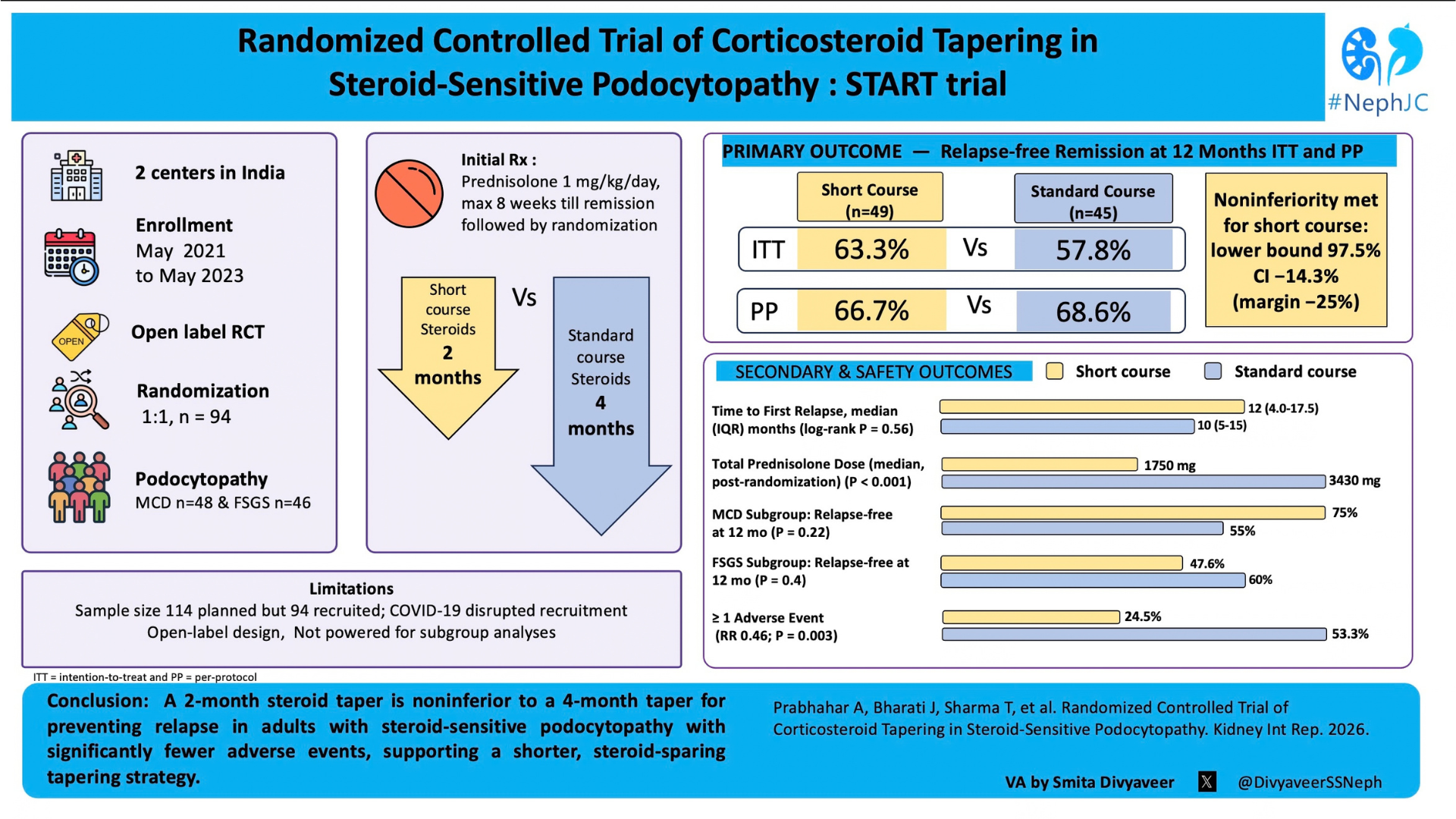
At 12 months, relapse-free remission was 63.3% with the short-course vs. 57.8% with the standard-course regimen in the ITT analysis. The risk difference was 5.5% (lower CI bound −14.3%), remaining above the prespecified −25% noninferiority margin (P=0.001). Noninferiority was also confirmed in the PP analysis (66.7% vs. 68.6%; risk difference −1.9%, lower CI bound −22.6%; P=0.014).
Figure 2. Kaplan-Meier estimates of relapse-free remission after randomization from A Prabhahar et al, KI Reports 2026
Secondary Outcomes
Regarding the type of disease, outcomes differed numerically between MCD and FSGS. In patients with MCD, relapse-free remission was more frequent with the short-course regimen (75% vs. 55%; risk difference +20.0%), whereas in FSGS, it was less frequent (47.6% vs. 60%; risk difference −12.4%). However, neither comparison reached statistical significance.
Relapse-free remission at 12 months was similar between regimens in both treatment-naïve patients (60.7% vs. 54.2%; P=0.63) and those with relapsing disease (66.7% vs. 62%; P=0.75).
At 36 months, relapse-free remission remained comparable between the short- and standard-course groups (38.8% vs. 44.4%; P=0.58), with no significant difference in time to relapse. However, the short-course regimen substantially reduced cumulative prednisolone exposure, with a median post-randomization dose of 1750 vs. 3430 mg in the ITT analysis (P<0.001). This reduction was also observed in the PP analysis (2310 vs. 4620 mg; P<0.001).
No significant differences in treatment efficacy were observed according to underlying disease (MCD 51.1%; FSGS 48.9%) or disease phenotype (treatment-naïve 55.3%; infrequently relapsing disease 44.7%).
Figure 3. Subgroup analysis of relapse risk according to baseline characteristics from A Prabhahar et al, KI Reports 2026
Safety profile
Adverse events were significantly less frequent with the short-course regimen (24.5% vs. 53.3%; RR 0.46, 95% CI 0.26–0.81; P=0.003), with similar findings in the PP analysis.
Steroid-related adverse events were consistently more frequent with standard therapy, including dysglycemia (8.9% vs. 0%), cosmetic effects (15.5% vs. 4.1%), and arthralgia/myalgia (13.3% vs. 2.0%). Serious adverse events, as defined by the study protocol, were numerically less frequent with the short course (8.2% vs. 17.8%). However, the SAE definition also included events necessitating treatment interruption or protocol deviation, which is broader than conventional SAE definitions and may have contributed to the apparent difference between groups.
Two serious infections requiring hospitalization occurred in the short-course group (1 case of severe COVID-19 infection and 1 case of renal abscess with pyelonephritis). In the standard-course group, serious adverse events included steroid-induced myopathy/arthralgia requiring protocol deviation (n=3), psychiatric disturbances (n=2),hemorrhoidal bleeding requiring blood transfusion (n=1), and avascular necrosis of the hip (n=1).
Table 2. Safety profile from A Prabhahar et al, KI Reports 2026
Discussion
The optimal duration of corticosteroid therapy in adult steroid-sensitive nephrotic syndrome remains uncertain. Current KDIGO guidance (KI 2021) recommends glucocorticoids as first-line therapy for adult MCD/primary FSGS, with tapering starting 2 weeks after complete remission, with a total exposure steroid exposure period of 6 months. These are Practice Points based on small observational studies or extrapolated from childhood NS, largely reflecting limited adult evidence and real concerns regarding relapse with shorter treatment courses.
Attempts to reduce corticosteroid exposure in adults have produced mixed results. In a prospective study of 35 adults with steroid-sensitive MCD, a 2-month steroid regimen significantly reduced cumulative corticosteroid exposure compared with conventional treatment (Ozeki T et al, Am J Nephrol 2019). However, the shorter regimen was associated with an earlier occurrence of relapse (adjusted HR 2.45, CI 1.51-3.91), although the risk of frequent relapse was not significantly different. Importantly, this study was an observational study with a historical control rather than a randomized trial.
Figure S1. Kaplan–Meier estimation of first relapse; sub-analysis from Ozeki T et al, Am J Nephrol 2019
More recently, the ADAPT randomized noninferiority trial explored a steroid-minimizing strategy in adult MCD, this time by reducing the corticosteroid dose rather than treatment duration, comparing prednisolone 0.5 mg/kg/day plus alfacalcidol with conventional prednisolone 1 mg/kg/day (Kristensen et al, Kidney Int 2026). Remission (88% vs. 91%) and relapse rates (35% vs. 32%) were similar between groups, with no significant differences in time to remission or relapse. The lower-dose strategy substantially reduced cumulative prednisolone exposure (3.7 vs. 8.0 g) and glucocorticoid toxicity. However, formal noninferiority was not established.
Figure 2. Cumulative incidence of remission and time from remission to relapse with low-dose versus conventional-dose prednisolone from T Kristensen et al, Kidney International 2026
Against this background, the present trial adds randomized evidence for adults with podocytopathies. Unlike previous studies focused predominantly on MCD, it included both MCD and steroid-sensitive FSGS, directly evaluating whether shortening the taper, after remission has already been achieved, could preserve relapse-free remission. Noninferiority at 12 months was demonstrated in both ITT and PP analyses, while cumulative prednisolone exposure was approximately halved.
The clinical trade-off therefore appears favorable: similar relapse control with substantially less corticosteroid exposure. This was further reflected in the safety findings, with adverse events occurring more than twice as often in the slow taper group. The reduction was particularly apparent for typical steroid-related metabolic, cosmetic, and musculoskeletal complications.
Protocol deviations were also more frequent in the standard-course group (6 vs. 2), with most deviations in this group related to steroid-associated adverse events, further supporting the tolerability advantage of reducing corticosteroid exposure. However, the reduction in overall adverse events should not be interpreted as evidence that the shorter taper reduces serious infections, hospitalization, or long-term complications. Notably, the two serious infections requiring hospitalization occurred in the short-course group.
The findings are also reassuring over longer follow-up. At 36 months, relapse-free remission remained similar between groups, strengthening the conclusion that shortening steroid therapy did not simply postpone relapses beyond the 12-month primary endpoint. Notably, the persistence of comparable outcomes at 36 months provides important longer-term support for the durability of the short-course strategy. Nevertheless, fewer than half of patients in either group remained relapse-free, highlighting that long-term relapse remains an important clinical challenge. This highlights that long-term relapse remains an important unresolved issue irrespective of taper duration, but that simply prolonging corticosteroid exposure may not substantially modify the underlying tendency to relapse.
Limitations
So, should we just taper steroids quickly for adult MCD/FSGS?! Well, there are important reasons for caution. The study was smaller than planned, enrolling 94 of the targeted 114 participants, which reduced the statistical power to approximately 75% and resulted in relatively wide confidence intervals. The −25% noninferiority margin was also wide, meaning that noninferiority should not be interpreted as equivalence and a clinically meaningful difference cannot be completely excluded. Although the point estimate favored the shorter taper, the lower confidence interval bound of −14.3% means that the results remain compatible with approximately 14 additional relapses per 100 patients treated with the shorter regimen. Whether this potential loss of efficacy represents an acceptable trade-off for substantially lower corticosteroid exposure may differ between patients, particularly when previous relapses have been severe or complicated by acute kidney injury, infection, or thrombosis. Additionally, the relapse free remission was much lower than the assumed 70% used to calculate sample size, further questioning the evidence this sample size could generate.
The study was open-label and conducted at only two centers, potentially limiting generalizability. The findings, therefore, cannot be directly extrapolated to older or more comorbid patients, steroid-resistant FSGS, or patients in whom induction therapy is limited by toxicity.
Importantly, the trial was not powered to detect histology-specific differences. At baseline, a higher percentage of patients in the short course group were MCD rather than FSGS. Additionally, microscopic hematuria, which is more common in FSGS compared to MCD, and a predictor of proteinuria remission (Yoshida et al, Kidney Medicine 2026), was excluded in the present study. Interpretation of the FSGS subgroup is further complicated by the heterogeneity of FSGS itself. FSGS represents a histological pattern encompassing primary, genetic, and secondary forms of podocyte injury. Although nephrotic presentation and steroid responsiveness increase the likelihood of primary FSGS, electron microscopy was not mandatory and systematic genetic testing was not reported, leaving some uncertainty regarding the classification of the FSGS population.
Although relapse-free remission numerically favored the short-course regimen in MCD and the standard-course regimen in FSGS, these subgroup findings should be considered hypothesis-generating rather than definitive. This is particularly relevant for FSGS, where evidence supporting shorter steroid courses remains much more limited and current KDIGO guidance does not support extrapolating shorter corticosteroid regimens from MCD to FSGS.
Whether steroid-sensitive MCD and FSGS should therefore be managed with the same corticosteroid tapering strategy remains an important unanswered question and warrants adequately powered, histology-specific studies.
Conclusion
START shifts the balance toward shorter steroid exposure, with a 2-month taper meeting the prespecified noninferiority criterion while substantially reducing cumulative prednisolone exposure. The inability to meet sample size, wide noninferiority margin and uncertainty around FSGS keep this from being a one size fits all taper.