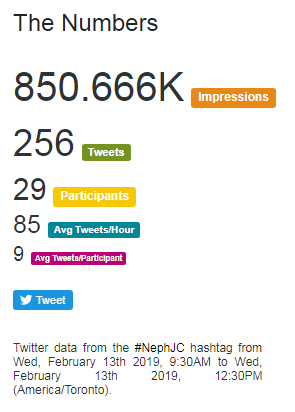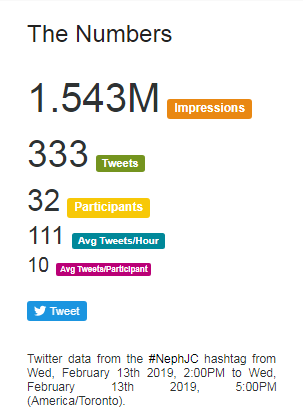
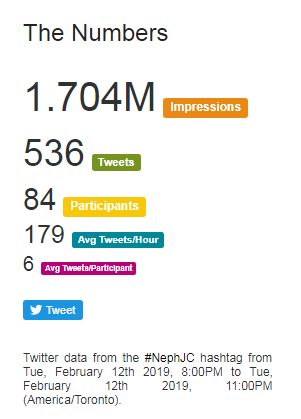
The wrap up of the exome sequencing chat. Featuring authors Emily Groopman and Krzysztof Kiryluk joining in. Lots of hope - lots of questions. A number of us came as skeptics and walked away converted, with hope in our hearts. Beyond the top line results, important discussions centred around questions of validation, scaling this up with high throughput assays, the significance of novel variants in novel genes, sharing data while safeguarding privacy and more.
Great hosting from Divya and Laura. Don’t miss the summary from Yasar and Jennie - and the commentary from Michelle.
Some selected tweets can be seen below
I think we need to move away from the "why test when the treatment isn't different" argument to the debate we have whenever discussing all other #NephJC research when we bemoan the heterogeneity of out clinical population - we can only develop treatment if we define ds accurately
— Dr MK #NephrologistOnICU (@_Dr_MK) February 13, 2019
T3 WES/WGS will become an available test for CKD workup. It'll be cheaper (already affordable) and as we sequence more and more humans our ability to call pathogenic variants will exponentially rise #nephjc
— Paul Phelan (@paulphel) February 13, 2019
Actually I went I. To this chat thinking *why bother testing* and I think my mind might have been changed. Nhs e testing is now much easier but just have to use selectively. Unlike phos binders usage #nephjc
— Clara Day (@ClaraDay13) February 13, 2019
found it. Marked centre-to-centre variation in primary disease coding, nearly certainly not driven by real variation but by clinician bias/variation in approach to ascertainment of PRD https://t.co/YW9BViRR4H #nephjc pic.twitter.com/DqyK6w88wz
— Charlie Tomson (@CharlieTomson) February 13, 2019
Would be hard to sequence everyone with AKI before a biopsy, but certainly finding a pathogenic variant provides a valuable piece of information that could lead to exclusion from some KPMP projects, but also maybe inclusion in others? #NephJC
— Krzysztof Kiryluk (@kirylukk) February 13, 2019
this commentary by @rheault_m is brilliant and changed my opinion. #nephjc https://t.co/r1WW5yz6yr
— Charlie Tomson (@CharlieTomson) February 13, 2019
It’s like any test. Know the pre-test probability, understand there is a possibility of false positives and false negatives, alter your diagnosis. Pathogenicity doesn’t have to be a black-or-white decision #NephJC
— Matt Lanktree (@MattLanktree) February 13, 2019
Such an important comment & idea. We need to bring this data out to the community to make collective discoveries, while also respecting patient privacy. @KSusztak & I have both made online databases to share genetic and expression information. More of this has to happen #nephjc
— Matt Sampson (@kidneyomicsamps) February 13, 2019
Good point. We do not have many common pathogenic mutations. If we want precision medicine APOL1 or PKD1 can serve as an example. Common and highly penetrant coding variants. For rare variants it will be much much harder unless we develop better high-throughput methods #NephJC
— Katalin Susztak (@KSusztak) February 13, 2019
@KSusztak Agree, some genes are tolerant of LOF, but there rare many LOF variants are known to be pathogenic and are diagnostic with no need for further validation. Novel variants in novel genes is a whole different game... #NephJC https://t.co/IYsfVEKt4G
— Krzysztof Kiryluk (@kirylukk) February 13, 2019