
Introduction
The prior NephJC discussion of finerenone versus spironolactone concluded that the comparative evidence base was asymmetric: explanatory trial design, not necessarily pharmacology, explained finerenone’s superior track record. Two papers published concurrently in June 2026 extended the evidence base beyond diabetic CKD and permitted a more direct test of that claim- a prespecified exploratory subgroup analysis of FIND-CKD restricted to glomerular disease (Neuen BL et al, JAMA, 2026) and INFINITY, a prespecified individual-participant-data pooled analysis of three phase 3 trials- FIDELIO-DKD, FIGARO-DKD, FIND-CKD (Neuen BL et al, Lancet, 2026).
FIND-CKD (Heerspink HJL et al, NEJM, 2026 | NephJC Summary) randomized 1584 adults with non-diabetic CKD (eGFR 25- <60 ml/min/1.73 m² with UACR 200-500 mg/g, or eGFR 25-90 with UACR 500-3500 mg/g) to finerenone 10/20 mg or placebo on maximized RAS blockade. The primary outcome, total eGFR slope to month 32, favored finerenone by 0.7 ml/min/1.73 m²/year (95% CI, 0.3-1.1; P<0.001)- magnitude comparable to the effect sizes reported for RAS inhibitors and SGLT2i in similar populations.
Resources: Brenner BM et al, NEJM, 2001, Holtkamp FA et al, Kidney Int, 2011| Heerspink HJL et al, Lancet Diabetes Endocrinol, 2021| EMPA-KIDNEY Collaborative Group, Lancet Diabetes Endocrinol, 2024| Heerspink HJL et al, NEJM, 2026
The prespecified hierarchical secondary composite (kidney failure, sustained ≥57% eGFR decline, heart failure hospitalization, or cardiovascular death) reached significance at HR 0.77 (95% CI, 0.60-0.99).
JAMA. 2026 Jun 5:e269923. doi: 10.1001/jama.2026.9923. Online ahead of print.
Finerenone in Patients With Chronic Kidney Disease Due to Glomerular Diseases: A Randomized Clinical Trial
Brendon L Neuen, Vlado Perkovic, Rajiv Agarwal, David Z I Cherney, Carolyn S P Lam, Christoph Wanner, Katherine R Tuttle, Pantelis Sarafidis, Jonathan Barratt, Anna Burgner, Xiangmei Chen, Alfredo Chew-Wong, Vladimir A Dobronravov, Jürgen Floege, Kieran McCafferty, Masaomi Nangaku, David Packham, Evangelos Papachristou, Pablo E Pergola, Marijn M Speeckaert, Arunkumar Subbiah, Sydney C W Tang, Shuifu Tang, See Cheng Yeo, Niels Jongs, J David Smeijer, Mario Berger, Meike Brinker, Rania Dayoub, Jay Elliott, Na Li, Katharina Mueller, Nicole Rethemeier, Marina Yael Finkelsztein, Hiddo J L Heerspink; FIND-CKD Investigators
PMID: 42246414
Why was the study done?
Glomerular diseases account for a substantial proportion of global CKD-attributable kidney failure and disproportionately affects younger patients. For most glomerular disease subtypes, disease-specific therapeutic options remain limited, creating an unmet need for interventions that target shared mechanisms of progression independent of underlying etiology. While the selective, nonsteroidal mineralocorticoid receptor agonist (nsMRA) finerenone is well-established in diabetic nephropathy (FIDELIO-DKD, NephJC summary| FIDELITY), clinical evidence evaluating its efficacy and safety within primary glomerular disease cohorts has historically been scarce.
The mechanistic basis for extending selective mineralocorticoid receptor (MR) blockade to podocytopathies- notably focal segmental glomerulosclerosis (FSGS)- is rooted in cell-specific receptor localization (Lazareth H et al, Kidney Int, 2025). The MR is functionally expressed on podocytes, which is the primary cellular injury site in FSGS. Pathological MR overactivation drives podocyte cytoskeletal disruption, slit diaphragm effacement, and the upregulation of pro-inflammatory and profibrotic pathways. Preclinical models demonstrate that selective MR antagonism halts this cascade, mitigating podocyte injury and slowing the progression of glomerulosclerosis (Shibata B et al, Nat Med, 2008, Tagaki N et al, Nephron Extra, 2012).
Methods
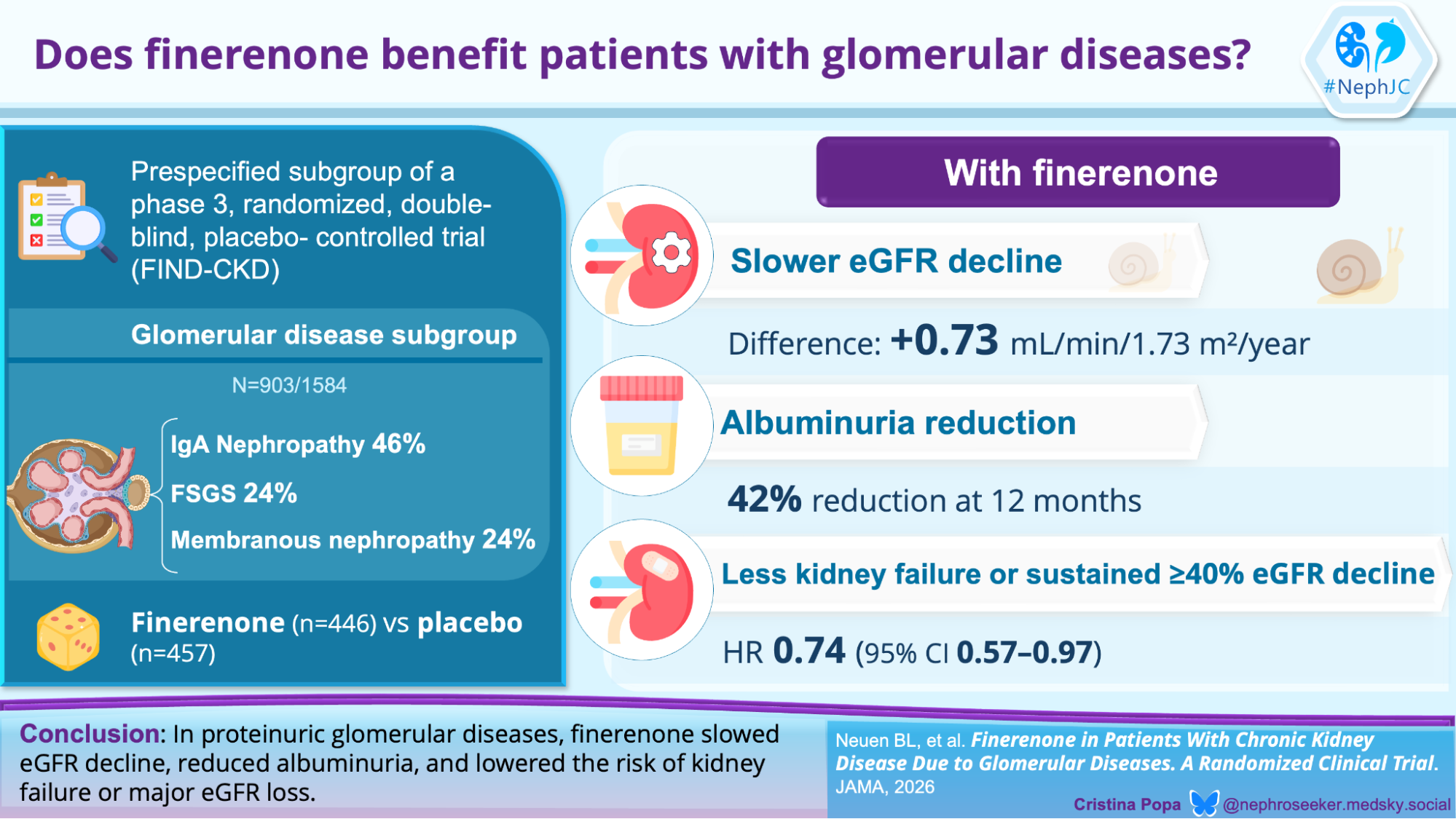
This was a prespecified exploratory subgroup analysis of FIND-CKD (Heerspink HJL et al, NEJM, 2026| NephJC summary). Of 1584 randomized participants, 57% had investigator-reported glomerular disease, 712 (78.8%) biopsy-confirmed: IgA nephropathy 46.1%, FSGS 23.8%, membranous nephropathy 10%, MPGN 2.9%, and other 17.3%.
Table1. Demographics of participants with glomerular diseases at baseline, from Neuen BL et al, JAMA, 2026
Mean baseline eGFR was 48 mL/min/1.73 m², and the median UACR was 839 mg/g. Randomization was stratified by screening UACR category and baseline SGLT2i use, but not by CKD etiology. Therefore, comparisons across glomerular disease subtypes don’t retain the protection afforded by randomization and may be affected by measured or unmeasured baseline imbalances. This limitation doesn’t compromise the internal validity of the trial but constrains causal interpretation of subtype-specific comparisons.
What do the results say?
The total GFR slope was -3.5 mL/min/1.73 m²/year with finerenone versus -4.23 with placebo; the between-group difference was 0.73 (95% CI, 0.22-1.24).
Figure 2. Change in eGFR over time allocation in participants with glomerular diseases, from Neuen BL et al, JAMA, 2026
Treatment effect was consistent across disease subtypes, with no evidence of heterogeneity (P for interaction = 0.52). The estimate was 1.34 (95% CI -0.29 to 2.38) in FSGS and 0.61 (95% CI, -0.14 to 1.36) in IgAN. Among biopsy-confirmed cases, the estimate was 0.89 (95% CI, 0.31-1.47). UACR decreased by 42% (95% CI 35-48%) at 12 months, similarly across subtypes.
Figure 3. Subgroup analysis according to glomerular disease etiology, from Neuen BL et al, JAMA, 2026
Kidney failure or ≥40% eGFR decline occurred less frequently with treatment (7.42 vs 9.60 events per 100 patient-years, HR 0.74, 95% CI 0.57-0.97).
Figure 4A. Time to event analysis of key secondary and exploratory efficacy outcomes in participants with glomerular disease, from Neuen BL et al, JAMA, 2026
Results were consistent across subtypes and in biopsy-confirmed disease (HR 0.74, 95% CI, 0.55-0.99) (Figure 5). However, this composite was selected post hoc because it generated the most events and should be interpreted as exploratory. Serious adverse events were similar between groups, including serious hyperkalemia (0.9% in both).
Critical view
Three issues limit the strength of inference. First, surrogate endpoint validation: the CKD-EPI Clinical Trials Consortium meta-analysis (Inker A et al, Nat Med, 2023) established that a total eGFR slope effect of 0.75 mL/min/1.73 m²/year in a trial of comparable size (900 participants) confers a 99% probability of benefit on clinical kidney outcomes, with a median predicted HR of 0.74- a threshold the observed 0.73 mL/min/1.73 m²/year effect sits just under—and a predicted HR that matches the observed composite-outcome HR of 0.74 exactly. This concordance is reassuring but should be read as internal consistency between a surrogate and a clinical outcome measured in the same trial, not as an external replication.
Second, the FSGS estimate was nominally significant but imprecise (N=215, 1.34 ml/min/1.73 m²/year; 95% CI 0.29-2.38). The subgroups are not powered for a definitive subtype-specific conclusion. Moreover, DUPLEX - the largest completed phase 3 FSGS trial- found no clear benefit of sparsentan over irbesartan on eGFR decline, increasing the evidentiary threshold for claiming efficacy in FSGS (Rheault MN et al, NEJM, 2023| NephJC summary).
Third, generalizability was limited by the cohort’s demographics: mean age 51 years, 57-62% male, approximately 60-65% Asian, and few Black participants. About 20% lacked biopsy confirmation, while many available biopsies were historical rather than obtained at enrollment. Interaction tests were not adjusted for multiple comparisons, increasing the risk of chance-positive findings; their limited power also means that significant interactions do not establish uniform treatment effects across subtypes.
Lancet. 2026 Jun 13;407(10546):2375-2386.doi: 10.1016/S0140-6736(26)01009-3. Epub 2026 Jun 5.
Efficacy and safety of finerenone in patients with chronic kidney disease: an individual participant data pooled analysis (INFINITY)
Brendon L Neuen, Hiddo J L Heerspink, Vlado Perkovic, David Z I Cherney, Carolyn S P Lam, Katherine R Tuttle, Christoph Wanner, Pantelis Sarafidis, Stefan D Anker, Gerasimos Filippatos, Bertram Pitt, Peter Rossing, Luis M Ruilope, Niels Jongs, J David Smeijer, Meike Brinker, Christiane Ahlers, Andrea Lage, Andrea Horvat-Bröcker, Patrick Schloemer, Thomas Eissing, Rania Dayoub, Robert Lawatscheck, Rajiv Agarwal; FIND-CKD, FIDELIO-DKD and FIGARO-DKD Investigators
PMID: 42248158
Why was the study needed?
No individual finerenone trial was powered for kidney failure alone or all-cause mortality definitively. Pooling individual-participant data increased power for these hard time-to-event outcomes and enabled assessment of effect modification by diabetes status, which FIND-CKD could not address because it excluded patients with diabetes.
How was the study done?
14,574 participants pooled across FIDELIO-CKD, FIGARO-DKD, and FIND-CKD.
Table 1. Baseline characteristics, from Neuen BL et al, Lancet, 2026
The protocol was prospectively registered to PROSPERO prior to FIND-CKD completion. Systematic search (PubMed, Embase, to March 31, 2026) identified no additional eligible trials; 301 records were screened to 3 included studies (figure S1), each assessed as low risk of bias across RoB2 domains (figure S2).
The main kidney outcome was kidney failure or sustained ≥57% eGFR decline (matching the earlier FIDELITY definition). The main cardiovascular outcome was heart failure hospitalization or cardiovascular death; undetermined deaths were excluded. Important methodological differences exist across the trials: cardiovascular and mortality events were independently adjudicated in FIDELIO-DKD and FIGARO-DKD, but in FIND-CKD these events were investigator-reported via structured case-report forms without independent adjudication. The polled hazard ratios for cardiovascular and mortality outcomes therefore combine data collected under two different ascertainment standards.
What do the results say?
The composite kidney outcome occurred at 22.3 versus 28.8 events per 1000 patient-years (HR 0.76, 95% CI 0.68-0.86). Kidney failure alone was reduced more modestly (HR 0.85, 95% CI 0.74-0.99), with the upper confidence limit close to null. The HR for dialysis or transplantation alone was 0.77 (95% CI, 0.64-0.94), while sustained ≥57% eGFR decline alone had an HR of 0.71 (95% CI, 0.61-0.81- Table S5).
Figure 1. Cumulative incidence functions for key efficacy outcomes, from Neuen BL et al, Lancet, 2026
The cardiovascular composite occurred at 19.1 vs 23.9 events per 1000 patient-year (HR 0.80, 95% CI, 0.70-0.91). The HR was 0.78 for heart failure hospitalization (p= 0.0024) and 0.82 for cardiovascular death (95% CI 0.67-0.999). All-cause mortality was also lower (HR 0.88, 95% CI 0.79-0.99).
Figure 2. Kidney, cardiovascular, and mortality outcomes in the overall INFINITY population, from Neuen BL et al, Lancet, 2026
There was no evidence of effect modification by glycated hemoglobin (P for interaction = 0.51, figure 3), CKD etiology, eGFR, UACR, or SGLT2i use (figure 4), or trial origin (all P for interaction ≥0.40; figure S6).
Figure 4. Effect of finerenone on the composite kidney outcome across prespecified subgroups, from Neuen BL et al, Lancet, 2026
Hyperkalemia occurred in 14.3% of participants receiving finerenone and 7.6% receiving placebo (Table 2). Hospitalizations for hyperkalemia were uncommon (0.9% vs 0.2%), with no fatal events. The risk of serious hyperkalemia requiring hospitalization differed by diabetes status: HHR 6.21 (95% CI, 3.18-12.12) with diabetes versus 1.48 (95% CI, 0.47-4.67) without diabetes (P for interaction = 0.034). This might reflect the greater prevalence of type 4 renal tubular acidosis in diabetic kidney disease.
The number needed to treat for the kidney-cardiovascular composite was 29.2, compared with a reported number needed to harm of -114.5 for hyperkalemia during hospitalizations (table S7), indicating an approximately fourfold benefit-to-harm ratio at the population level. Per 1000 patients treated for 3 years, finerenone was estimated to prevent 34 kidney-cardiovascular composite events, 21 kidney events, 14 heart failure hospitalizations or CV death events, and 10 deaths. Larger absolute cardiovascular and mortality benefit in participants with diabetes reflected their higher baseline risk rather than a greater relative treatment effect. NNT remains a dubious metric.
Figure 5. Estimated absolute effects of finerenone per 1000 patients treated over 3 years by diabetes status, from Neuen BL et al, Lancet, 2026
Critical view
FIND-CKD cardiovascular and mortality events were not independently adjudicated. Combining these with adjudicated events from FIDELIO-DKD and FIGARO-DKD introduces potential ascertainment bias (making some members of the study group more or less likely to be included in the study than others). No sensitivity analysis specifically excluding FIND-CKD from cardiovascular and mortality analyses was reported.
No source trial enrolled participants with screening eGFR <25 mL/min/1.73 m² or non-albuminuric CKD. The findings do not support extrapolation to advanced or non-albuminuric CKD, as in “across the entire spectrum of CKD."
Subgroup interaction tests were not adjusted for multiple comparisons. A nonsignificant interaction test may also reflect limited power and should not be interpreted as proof of uniform benefit across all subgroups.
All three trials and the pooled analysis were funded by Bayer. Several authors were Bayer employees with disclosed equity interests, and Bayer funded medical writing support. Although the data were independently reanalyzed at University Medical Center Groningen, the evidence base remains entirely manufacturer-funded.
External evidence provides partial support. FINEARTS-HF showed a heart failure benefit in HFpEF irrespective of diabetes status (Solomon SD et al, NEJM, 2024). Pooled FIDELIO/FIGARO analyses found heart failure benefits emerging within the first 6 months (Ostrominski JW et al, JACC, 2026). CONFIDENCE showed greater albuminuria reduction with combined finerenone and empagliflozin than with either drug alone, without increased acute kidney injury (Agarwal R et al, NEJM, 2025| NephJC summary). These findings support the biological and clinical rationale but don’t affect INFINITY’s outcome adjudication or eGFR-floor limitation.
Conclusion
FIND-CKD established that finerenone slows eGFR decline in non-diabetic CKD at an effect size consistent with established kidney-protective therapies; this finding is self-contained and doesn’t depend on the two subsequent analyses for validity. The JAMA subgroup analysis tests whether that effect generalizes across etiology and does not reject the null hypothesis of homogeneity- a result that is informative but constrained by the absence of etiology-based randomization, limited events in the rarer subtypes, and uncorrected multiplicity. INFINITY tests generalization across diabetes status and supplies, for the first time, adequately powered estimates for kidney failure and all-cause mortality- at the cost of pooling across trials with differing outcome ascertainment standards and a shared eGFR floor and albuminuria requirement that bound the population to which these estimates apply.
Together, these analyses suggest that finerenone’s effect reflects mineralocorticoid receptor activity rather than a specific CKD etiology or glycemic state. This interpretation is supported by consistent findings across etiologic and glycemic subgroups and by external evidence from FINEARTS-HF and CONFIDENCE. However, efficacy remains untested in non-albuminuric CKD and at eGFR <25 mL/min/1.73 m², while cardiovascular outcomes were not uniformly adjudicated. These limitations define the population and outcomes to which the findings can be applied and the priorities for future trials.
Written by
Cristina Popa
Reviewed by
Brian Rifkin