
#NephJC Chat
Tuesday, December 2nd 2025, 9 pm Eastern on Bluesky
N Engl J Med. 2025 Nov 7. doi: 10.1056/NEJMoa251303. Online ahead of print.
Fish-Oil Supplementation and Cardiovascular Events in Patients Receiving Hemodialysis
PMID: 41201837




Introduction
Fish oils, and their anti-inflammatory and anti-oxidative properties have been studied for decades in a number of kidney, neurologic and cardiovascular diseases. The original study in 1971 was built on the observation that even though Eskimos had a high consumption of fat, their pre-betalipoprotein and triglyceride levels were low - with speculation that this explained the apparent low incidence of ischemic heart disease. (Bang HO, et al. Lancet, 1971). Like most fish oil studies, this hypothesis was untrue (Fodor et al Can J Cardiol 2014). So what exactly is fish oil? It refers to lipid extracts derived mainly from cold-water marine fish such as salmon, mackerel, sardine, and tuna. Its biological relevance comes from its high content of unique long-chain omega-3 polyunsaturated fatty acids (PUFAs), particularly: Eicosapentaenoic acid (EPA) and Docosahexaenoic acid (DHA). They incorporate into cell membranes, displace arachidonic acid, modulate ion channel behavior, and generate anti-inflammatory lipid mediators. Hence, fish oils have been extensively studied for CV disease In the REDUCE-IT (Bhatt. et al, NEJM 2018) of ~ 8000 participants with hypertriglyceridemia, high-dose EPA was associated with a striking 25% reduction in CV events. The study wasn’t without controversy (the placebo in this trial was mineral oil), and the subsequent STRENGTH trial (Nicholls et al JAMA 2020) with a larger sample size (N ~ 13,000, and corn oil placebo) reported a totally null effect (HR 0.99) and higher GI side effects.
Infographic from Haq A. et al., American College of Cardiology 2021
Dialysis patients have a 20-fold higher cardiovascular mortality than the general population, along with a striking burden of arrhythmias, sudden death, ischemia during dialysis, vascular calcification, and peripheral vascular events. They also have the traditional risk factors (diabetes, hypertension, dyslipidemia) and the non-traditional risk factors (chronic inflammation, oxidative stress, endothelial dysfunction, disordered mineral metabolism, sympathetic activation, intradialytic electrolyte shifts). Why would fish oils work here when statins (4D, AURORA), dual antiplatelets, ACEi/ARB for event reduction,, and most recently spironolactone (ACHIEVE Walsh et al Lancet 2025 | NephJC Summary /ALCHEMIST| Rossignol et al Lancet 2025 |NephJC Shorts) have all been neutral and deeply disappointing in decreasing CV mortality in dialysis patients. Two data points suggest this was worthwhile and not just a fishing expedition. Several studies have shown that dialysis patients have much lower (often 50–70%) baseline EPA/DHA levels compared to the general population. (Khor et al., Nutrients 2018). In the same authors’ previous trial of fish oils to help AV graft patency, an intriguing signal of benefit was noted (HR 0.43 for CV event free survival) - though the trial was not powered for this outcome (Lok et al JAMA 2012).
The Study
Methods
Study Design
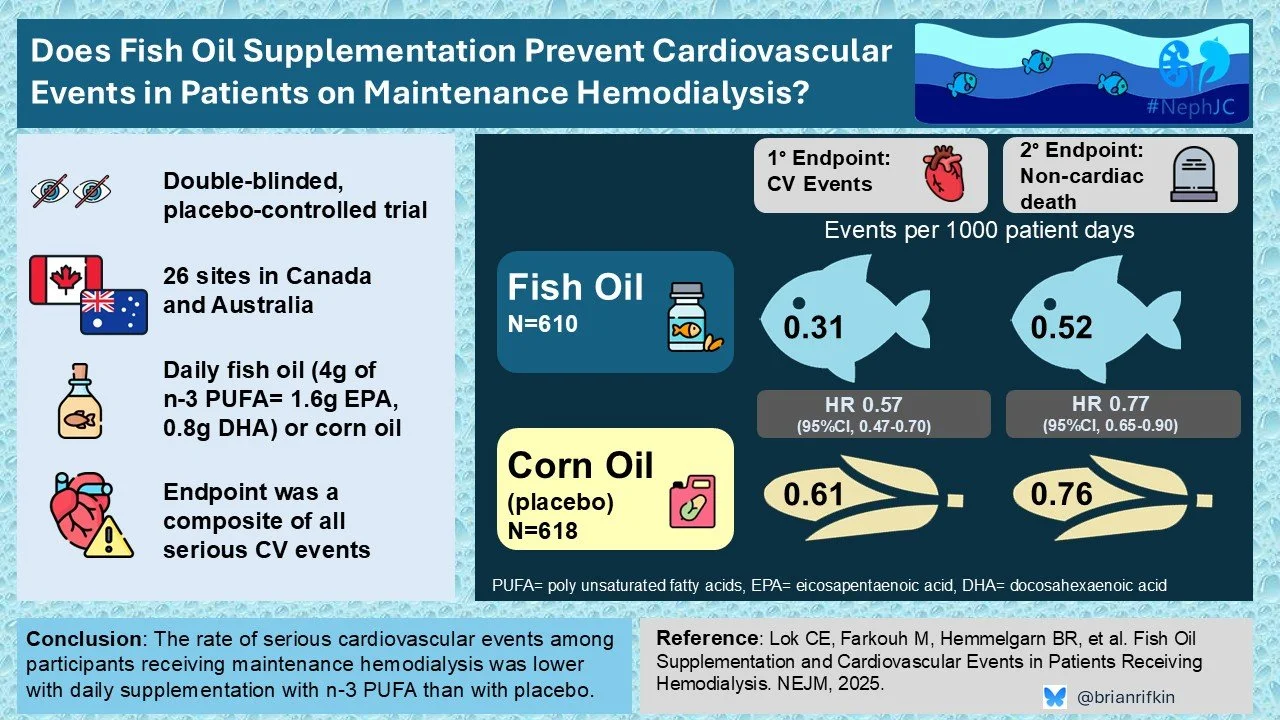
PISCES (protection against incidences of serious CV events study) was a multicenter, double-blind, randomized, placebo-controlled trial, conducted in 26 dialysis centers across Canada and Australia. This started off as an initial pilot trial, and as funding and feasibility was successful, the same cohort was invited to roll into the larger definitive trial.
Study Population
This was a pretty pragmatic design, with any hemodialysis patient (on 3-4 times HD) being eligible, unless they were already on fish oil or allergic to fish oil or soy or corn.
Interventions
The intervention was 4 g of fish oil (steam de-odorized, four citrus flavored 1g capsules with a total of 1.6g EPA and 0.8g DHA) taken daily, usually with food as once a day or in two divided doses. The control group received citrus flavored corn-oil placebo. Adherence was assessed by measuring incorporation of EPA into plasma phospholipids at 3 months in a random subset of 232 participants. The participants were randomized with a central web-based system, stratified by site and prior CV disease.
Randomization and blinding
The study used central web-based randomization. Stratification was done by site and prior CVD. Block randomisation was done using concealed permuted blocks with varying size. Participants, coordinators, pharmacists, investigators, and adjudicators were fully blinded. Blinding quality was maximized by deodorized capsules; contamination was monitored via fatty-acid incorporation measurements.
Outcomes
The primary outcome was a composite of all serious CV events including CV death (sudden and non-sudden cardiac death, fatal MI, fatal stroke) and non-fatal CV events (non-fatal MI, PAD leading to amputation, non-fatal stroke). Notably, coronary interventions, and heart failure are missing from the usual MACE list, the latter as adjudicating ‘true’ heart failure from volume overload may be difficult. Secondary outcomes were individual components of the composite, and a first CV event or all-cause death. Safety was assessed as ‘bleeding events’.
Events could recur, therefore each event was counted separately. All events were independently adjudicated and fully blinded.
Statistical Analysis
All analyses were by intention to treat, with the Prentice-William-Peterson gap-time model used for recurrent events and the standard Cox-model for mortality events. Prior CV disease was the only planned subgroup. The target sample size was 1100 participants. Based on Ontario administrative data, the expected placebo rates were: 0.27 recurrent CV events per patient-year, 0.0444 CV deaths, and 0.098 non-CV deaths. The trial assumed a 17.5% relative risk reduction (HR 0.825), a 10% annual dropout, and a 3% drop-in rate (= placebo patients taking OTC fish oil). A Poisson approximation with 2.5 years of effective follow-up suggested approx. 580 per group for 80% power, and simulation using 3.5 years of potential follow-up confirmed 82% power with 1100 participants.
Funding
This was an investigator initiated study, with funding cobbled together from the Heart and Stroke Foundation of Canada, the Lawson Health Research Institute, The Peter Munk Cardiac Care Innovation Fund, The Kidney CARE Network International, and the National Health and Medical Research Council (Australia) along with a personal donation by a dialysis patient, Mr. Alexander Epstein. The fish oil and placebo capsules were provided as an in-kind contribution from DSM (previously Ocean Nutrition Canada).
Results
The study followed 1,228 people on maintenance hemodialysis for up to three and a half years. Of the 171 participants in the pilot trial, ~ 91 consented to be enrolled into the definitive larger trial.
Figure S1: CONSORT flow diagram from Lok CE, et al, NEJM, 2025
As expected for a dialysis trial, comorbidities were common: 55% had diabetes, 85% hypertension, 30% coronary artery disease, ~ 11% prior stroke, 9% with AFib, and 19% heart failure. Notably, nearly 2/3rds had never experienced a cardiovascular event before enrollment, which makes this trial a combination of primary and secondary prevention. The cohort was diverse: 40% White participants, 15 to 16% Asian and Southeast Asian, and 12 to 14% Black individuals. Dialysis vintage was a median of 2.5 years. Just over half were on a statin, and beta-blockers were the commonest BP lowering drug, followed by CCBs and RASi. Just under a quarter were on an antiplatelet or anticoagulant. Notably the LDL-cholesterol and triglycerides were not terribly high.
Table 1. Summary of Demographic and Clinical Characteristics of the participants at baseline from Lok CE, et al, NEJM, 2025
Primary Outcome
Patients who received fish oil had a lower rate of serious cardiovascular events than those assigned to placebo. When expressed as event rates, the placebo group accumulated events at roughly 0.61, while the fish oil group accumulated 0.31 per 1000 patient-days, with the separation in the survival curves appearing very early on (HR 0.57, 95% CI 0.47 to 0.70, p < 0.001.).
Figure 1. Mean Cumulative Cardiovascular Events, from Lok CE, et al, NEJM, 2025
The benefit was clearly consistent across the one subgroup including those with and without prior cardiovascular disease (see Table 2).
Table 2. Primary and secondary endpoints, from Lok CE, et al, NEJM, 2025
Secondary Outcomes
Every individual component of the composite outcome favored fish oil (see above) - cardiac death, fatal/non-fatal MI/PAD causing amputations and fatal/non-fatal stroke all with a 50-60% RRR.
Figure 2. Participants with CV events, from Lok CE, et al, NEJM, 2025
Analysing the first CV event or death from any cause had a significant benefit as well as seen above (HR 0.73, 95% CI, 0.61-9.87).
All cause death was a tad less (HR 0.89, 95% CI 0.73 to 1.01) with the numbers implying a higher 112 non-cardiac deaths with fish oil and 82 with placebo.
Figure S2. All cause mortality, from Lok CE, et al, NEJM, 2025
Sensitivity analyses
The sensitivity analyses show that the treatment effect is statistically robust but uniformly large across all modeling strategies. Recurrent-event approaches (PWP gap-time, PWP total-time, Andersen Gill), and frailty models, produce hazard ratios clustered between 0.50 and 0.57 (Table S5a), indicating that the primary results is not driven by a single analytic specification.
Table S5a. Sensitivity analyses of time to CV events and mortality, from Lok CE, et al, NEJM, 2025
Models incorporating terminal events and count-based approaches (negative binomial, quasi-Poisson- Table S5b) yield similarly strong rate ratios around -.48-0.50. Time-to-first event analysis shows the expected attenuation (HR 0.56), confirming that recurrent-event structure amplifies the overall effect. Taken together, the analyses support internal consistency.
Table S5b. Analyses of rates of recurrent CV events and a terminal event, from Lok CE, et al, NEJM, 2025
Adherence Check
EPA levels measured in plasma phospholipids at three months (in a small random subset of patients) rose sharply in the active group and showed no meaningful change in the placebo group. This reassures us that participants tested were taking the medication and that the formulation was biologically active.
Figure S2: Plasma levels of n-3 PUFA at baseline and 3 months, from Lok CE, et al, NEJM, 2025
Safety
Bleeding events were not increased (50.8% fish oil versus 51.1% placebo). Other serious adverse events, whether infectious, vascular access related, hemodynamic, or gastrointestinal, were nearly identical between the two groups. There was no safety signal.
Table 3. Adverse events, from Lok CE, et al, NEJM, 2025
Discussion
In this large multicentre trial, assigning hemodialysis patients to taking 4 g fish oil daily resulted in a significant lowering of serious CV events, including a reduction in CV death, and consistent benefits in all individual components. The fish oil was well tolerated with few GI discontinuations, serious bleedings, or discontinuations.
Should we take this study hook, line and sinker or should we reserve judgement and await confirmatory studies? This is now the second large RCT (after CONVINCE Blankestijn et al NEJM 2023 | NephJC summary) demonstrating a benefit in HD patients. Given the lack of safe and effective interventions, an argument can easily be made to embrace this.
In terms of strengths, the trial was carefully run, adequately powered, and methodologically solid. Blinding was tight, event adjudication was centralized, follow-up was robust, and the population was representative of the real people (see table S4). The benefit was broad and consistent across all major cardiovascular domains with a very early separation. Dialysis patients live inside a highly inflamed, oxidatively stressed, electrolyte-shifting, endothelial-injuring system that distorts the pathways targeted by most traditional cardiovascular therapies. Fish oil may succeed here precisely because it hits several of the pathways that are uniquely active in dialysis patients. Omega-3 fatty acids also influence arrhythmia thresholds. If there were ever a cardiac environment that could use that stabilizing effect, it is the dialysis chair.
Earlier lipid trials in dialysis help explain why this result needs caution. The 4D and AURORA statin trials were negative. The dialysis subgroup in SHARP also did not benefit the way non-dialysis CKD patients did. Fish-oil studies outside dialysis have been inconsistent. REDUCE-IT showed benefit, but STRENGTH and other large trials were neutral. It means that a single positive trial should be read carefully, especially in a population where so many interventions have failed.
The trial didn’t include peritoneal dialysis or transplant recipients. Less than 60% of participants were on statins, although this is increasingly common in dialysis after negative statin trials. Adherence checks were limited to only a subset of patients. The study left out patients with implantable cardioverter defibrillators (however, the ICD-2 trial, published in 2019, failed to show any benefit on ICD in these populations so it is unclear who is getting this intervention or why), which means the highest risk group for malignant arrhythmias was not represented. The pragmatic design meant they had little control over diet, inflammation, or drug changes that might influence outcomes. The composite CV outcome was so broad that it is hard to pinpoint the exact mechanism behind the benefit, whether it was due to fewer arrhythmias, better vascular stability, or a reduction in inflammation - though the early separation suggests plaque rupture or arrhythmias as being events being potentially lowered. And while corn oil is a reasonable placebo, there are arguments that even neutral oils can have metabolic effects of their own.
So this is a positive trial, but it needs a balanced reading. The cardiovascular benefit is interesting, but the missing mortality signal limits how far we can take the findings. The mechanistic story is possible, but unproven. And in a field where many well-run trials have been neutral, it is important to stay cautious and analytical until more evidence arrives.
One of the most compelling aspects is how consistently each cardiovascular endpoint moved in the same direction. The benefits extended across sudden death, coronary events, cerebrovascular events, and peripheral vascular complications. Hazard ratios in the range of 0.55 to 0.60 for major cardiovascular outcomes are not the norm in this population. On one hand, seeing such strong and consistent reductions makes it harder to dismiss these findings as statistical noise or placebo-driven artifacts. On the other hand, one could also argue what kind of intervention can have these kinds of benefits across the board for all outcomes - ranging from cardiac deaths to amputations and stroke. This is the reverse of the usual experience - something that possibly doesn’t work in non-dialysis patients but works in dialysis. Should that give additional pause and a call for replication?
Conclusion
Daily supplementation with n-3 polyunsaturated fatty acids brings down the rate of serious cardiovascular events by half for adults on maintenance hemodialysis compared to those receiving a placebo over 3.5-years. The results were consistent across outcomes, and the intervention was simple, inexpensive, ubiquitous and well tolerated.
Summary by
Akshaya Jayachandran
Assistant Professor
Department of Nephrology
Christian Medical College & Hospital
Vellore, Tamilnadu, India
NephJC Intern, Batch of 2025