

With a healthy bump in participants post #ERAEDTA15, just compare the participants. 'Nuff said.
The American chat
The GMT chat
This week, we will discuss the use of LLMs for the diagnosis of complex nephrology cases. Can AI help nephrologists nail the correct diagnosis?
MERCURI-2 reports that dapagliflozin cuts postoperative AKI after cardiac surgery, but the headline result is mostly a urine-output story, not a creatinine one. That matters: urine output after surgery is easily swayed by anesthesia, fluid shifts, vasopressors, and a diuretic drug in the mix. Until dapagliflozin shows it protects kidney function, not just urine output.
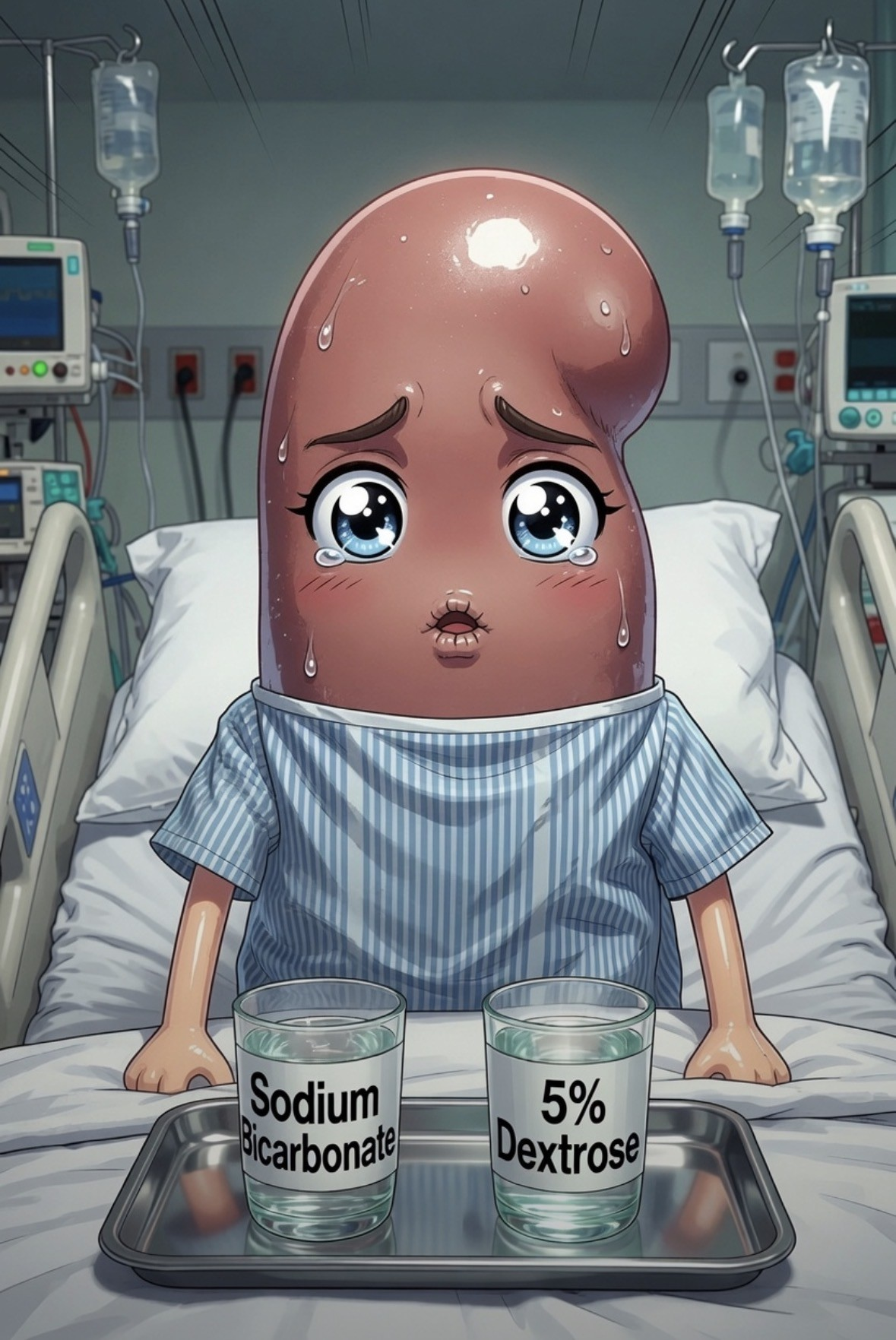
This week, we will discuss SODaBIC trial: with ICU acidosis driven by multiple overlapping mechanisms, is bicarbonate infusion supported by robust evidence, or does it persist mainly out of habit rather than physiology?
FIND-CKD extends finerenone beyond diabetic kidney disease, showing slower eGFR decline and sustained albuminuria reduction in non-diabetic CKD. While the benefits are modest and cardiovascular effects remain uncertain, the trial opens the door to broader use of nsMRAs and raises important questions about combination therapy with SGLT2 inhibitors.
With a healthy bump in participants post #ERAEDTA15, just compare the participants. 'Nuff said.
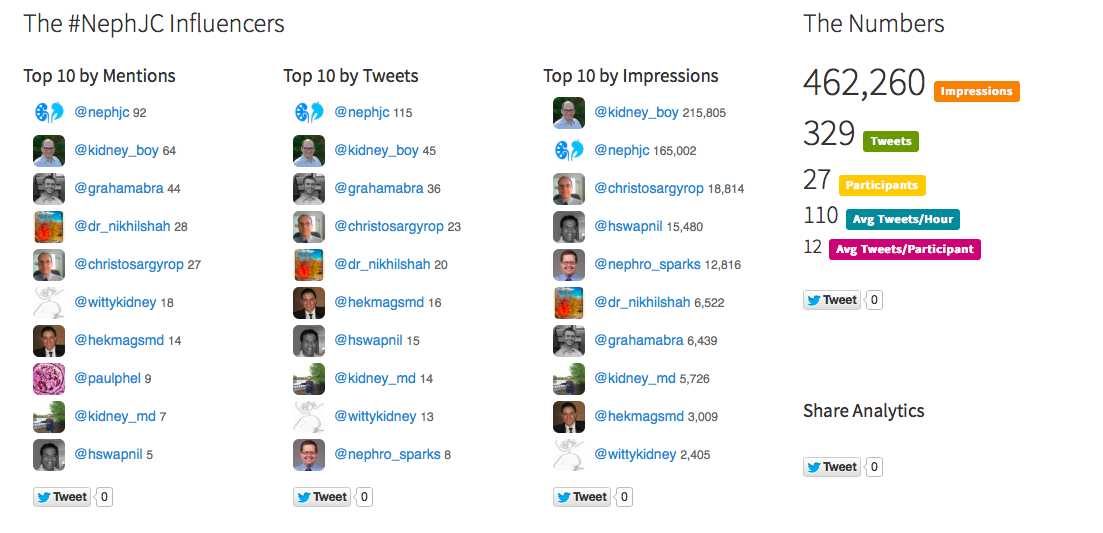
The American chat
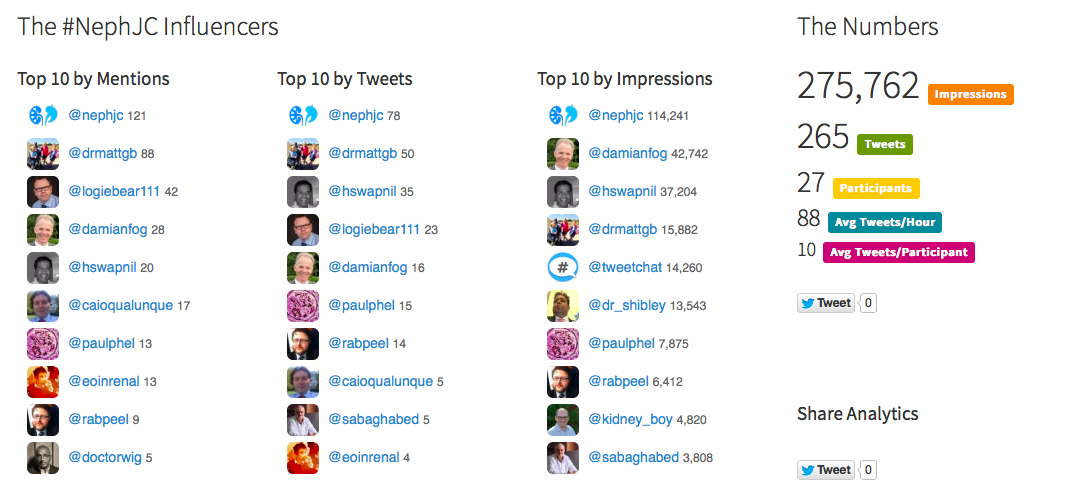
The GMT chat
As promised, the GMT chat storify is here, complete with the after party discussion on diuretics. Another superb curation by Hector!
Hector Madariaga - Nephrology Fellow from Syracuse and #NSMC intern - has now joined the #NephJC team. And you can see that why with the excellent job he has done with the storify of last week's chat. Watch this space for more contributions.
In case you were all wondering where the EU/African leg of the PD/CHF #NephJC chat disappeared, it will be held - albeit with a week's delay - on Wednesday June 3rd. It is all for a good reason. It has been quite busy for the Europeans this week - as you must have seen with all the furious tweeting from Charlie Tomson, Daniel McGuinness, David Arroyo, and many more including our very own Paul Phelan (who also wrote some excellent AJKD blog posts).

But, better late than never - and we hope many of you join us this week for the PD/CHF #nephjc chat.

Add this to the two articles by Alex Djuricich to flesh out your live-tweeting medical library.
You may have seen the evidence pyramid before, with animal studies and case reports at the bottom, and systematic reviews on the top.

Well, an interesting paper was published a few days ago, in the Journal of Medical Internet Research. Go ahead, click on that link and check it out.
It is a systematic review of all twitter-based journal clubs (and they seem to have captured all that were existing at that time). They have then examined the impact of these journals clubs using many different metrics. Interestingly, the one that immediately stands out is in table 2:

Table 2 from Roberts et al, http://www.jmir.org/2015/4/e103/
There's only one journal club with over a million impressions. Take a bow, all of you who have ever participated in a #NephJC chat!
The paper does make for interesting reading, apart from what we mention above. Some of the analyses agrees with our thoughts after the first dozen #nephJC chats.
If it wasn't from the pages of the New York Times I wouldn't believe it.

Please join us on #NephJC, Tuesday at 9PM EDT and Wednesday at 8PM GMT for a discussion of proper medical director behavior.
It was pretty well attended...

So was the GMT chat next day...

So our NSMC intern, Nikhil Shah not only did a super job of writing the sumary up for the BK virus #NephJC 22, he also has done a great job of curating the first chat into a storify.
The American chat (mostly by virtue of its longevity) still has more participants and tweets, but the GMT (EU/African) chat makes up by being fun and entertaining. Tom Oates, Paul Phelan, Francesco and their merry band of tweeters make for delightful reading. Jungle Juice, scud missiles and more. See some highlights below
@NephJC I never do EKG before starting quinolone, but always ask the patient: how long is your QTc? ;) #nephjc
— Fra Ian (@caioqualunque) March 4, 2015@ThePeanutKidney @NephJC Ideally when we use the untested jungle juice (cido,leflun,IVIg) we should do it as part of a study #nephjc
— Paul Phelan (@paulphel) March 4, 2015@swissnephro like the term PyVan 😄 pic.twitter.com/uA3wegSi1E
— John Booth (@ThePeanutKidney) March 4, 2015@NephJC nephrology's equivalent of a Scud missile - probably effective but lots of collateral damage #nephJC
— John Booth (@ThePeanutKidney) March 4, 2015
You might remember Perry Wilson, the young dapper nephrologist from Yale who presented his trial on AKI alerts at NephJC live a few months ago. He was tweeting as @nephrolalia - and has now renamed and rebranded himself as @methodsmanmd, which is quite apt given his recent blog posts and succinct and snappy videos up at MedPage Today.
More notably, the data he presented at #NephJC live has been published today - with some great additional analyses, in the Lancet. We sure know how to pick winners - so the next time we come calling, pick up the phone!
Dr. Faubel nailed the best comment about NephroCheck by reminding us while we pick apart the particulars of NephroCheck that we have some other dragons to slay:
@hswapnil @Nephro_Sparks @dr_nikhilshah btw, nephrocheck and urine eos cost about the same. urine eos useless. this much better. #nephjc
— sarah faubel (@doc_faubel) February 18, 2015
And then Edgar slides in with the appropriate #NephPearl (How does he do that so fast?)
@NephJC @doc_faubel Why I DO NOT order URINE EOSINOPHILS anymore #Nephpearls #NephJC http://t.co/NH9PdFK7fc pic.twitter.com/cbneNsoZPl
— Edgar V. Lerma (@edgarvlermamd) February 18, 2015
Last night we were off to a rollicking start with a great #NephJC chat - in great part due to the participation of Azra, Jay and Sarah! Joel took no time - burning the candle at both ends to do some storifys.
Here is the entire unedited archive with all the tweets from both chats:
The GMT chat today was also very intense - Storify will follow shortly!
In case you haven't signed up for our mailing list (really - why not? go there and do it now!) - We are going deep on the FDA approved NephroCheck™, a new test for the early diagnosis of AKI. This is not industry sponsored BS, just honest, crowd-sourced, EBM.
For this #NephJC we have three topics we want to discuss:
Topic Zero: How are you currently diagnosing AKI?

Topic 1: Evaluate their strategy for developing a novel test for AKI.
Three studies in 2 papers:
Discovery: the scientists tested 340 biomarkers and came up with a pair that performed best. N=522.
Sapphire: validated the biomarker from Discovery in a unique cohort. N=744.
Topaz: A separate study just to validate the results of Sapphire. N=420.
Is this a compelling story line? Is this a fair way to discover and validate a test? Do you agree with the conclusions?
Topic 2: Evaluating a test.
Topic 3: So what?
Tom Oates and his merry gang of GMT chatters shattered previous records for the Euro/Afro chat. Great work guys!


Not quite up to the pace of the western hemisphere, but gaining fast.
#NephJC analytics for tonights donor risk discussion: • 33 participants • 374 tweets http://t.co/9VMYNoacvN
— Nephrology Jrnl Club (@NephJC) February 4, 2015
In a related note, NephJC.com reached 4,000 page views in a month for the first time in January.

We had a great NephJC last night. We had a new contributor who was excellent, Eric Weinhandl of Minnesota.
those models for ESRD risk are like spinning plates. 31 events and HRs bounce around with every adjustment #nephjc
— Eric Weinhandl (@EWeinhandl) February 4, 2015
Dr. Weinhandl works with the new PEER Kidney Care Initiative. It looks like a cool project. Here is some press from Nephrology News and Issues.
RSS feed users
If you like subscribing to RSS feeds to get updates - we now make it easy to subscribe to our blog feed.
Click on this link and it will allow you to subscribe easily using your choice of reader.
If You Don't Know What RSS Stands for and Would Like to Know
RSS (Rich Site Summary - or really simple syndication as it is known more popularly) refers to a family of web formats that is used to publish information for frequently updated web sites, like blog posts, newspaper headlines and journals. Subscribing to a website RSS removes the need for the user to manually check the website for new content. In addition, by entering these 'feeds' into an aggregator or feed reader (Feedly is our current favourite - since Google decided to nix Google Reader), you will have all that content 'pushed' to you, notifying you of new posts. That's our secret to knowing the latest article published in Lancet. Look for this icon to find RSS feeds for your favourite website:

There are many advantages to using RSS feeds - you can get all the content you consume into one 'reader' i.e. news, medical journals, blogs etc. And, in addition, you can skim the headline, or the abstract - and decided if you want to click the link to read the full article in the original website. Enjoy!

The rheumatology crew that killed it during the Rituximab for ANCA vasculitis NephJC are striking out on there own with an ambitious plan for their own twitter journal club. They are kicking it off this coming Thursday with a GMT and EST at the exact same time as our NephJCs, 8GMT and 9EST. They are then doing a consolidation wrap up discussion the following day.
The first topic is one near and dear to all of our hearts, lupus nephritis. RCT of tacrolimus versus MMF for induction.
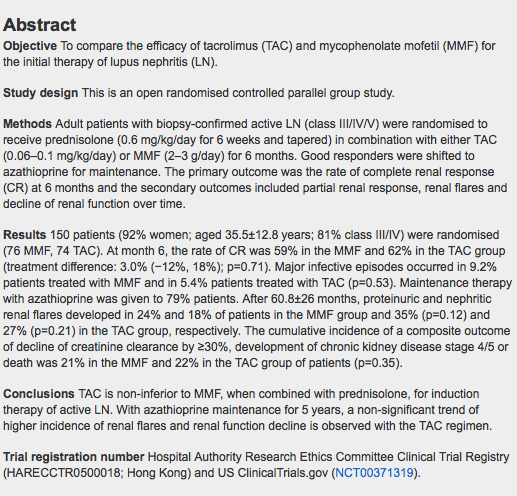
It would be great if some of our community could support the rheumatologists as they launch their journal club.

