



"Immune complex mediated" glomerulonephritis gets the Wash U YouTube treatment.
This week, we will discuss whether less is more when it comes to discontinuing dialysis in patients with AKI and a chance to recover.
Holy Mackerel! This week we will discuss fish oil use in maintenance hemodialysis patients. Could this be the one thing that bends the curve on CV mortality, or is it just a red herring?
This week, we will discuss the phase 3 ORIGIN3 trial of atacicept, an APRIL/BAFF inhibitor for use in IgAN.
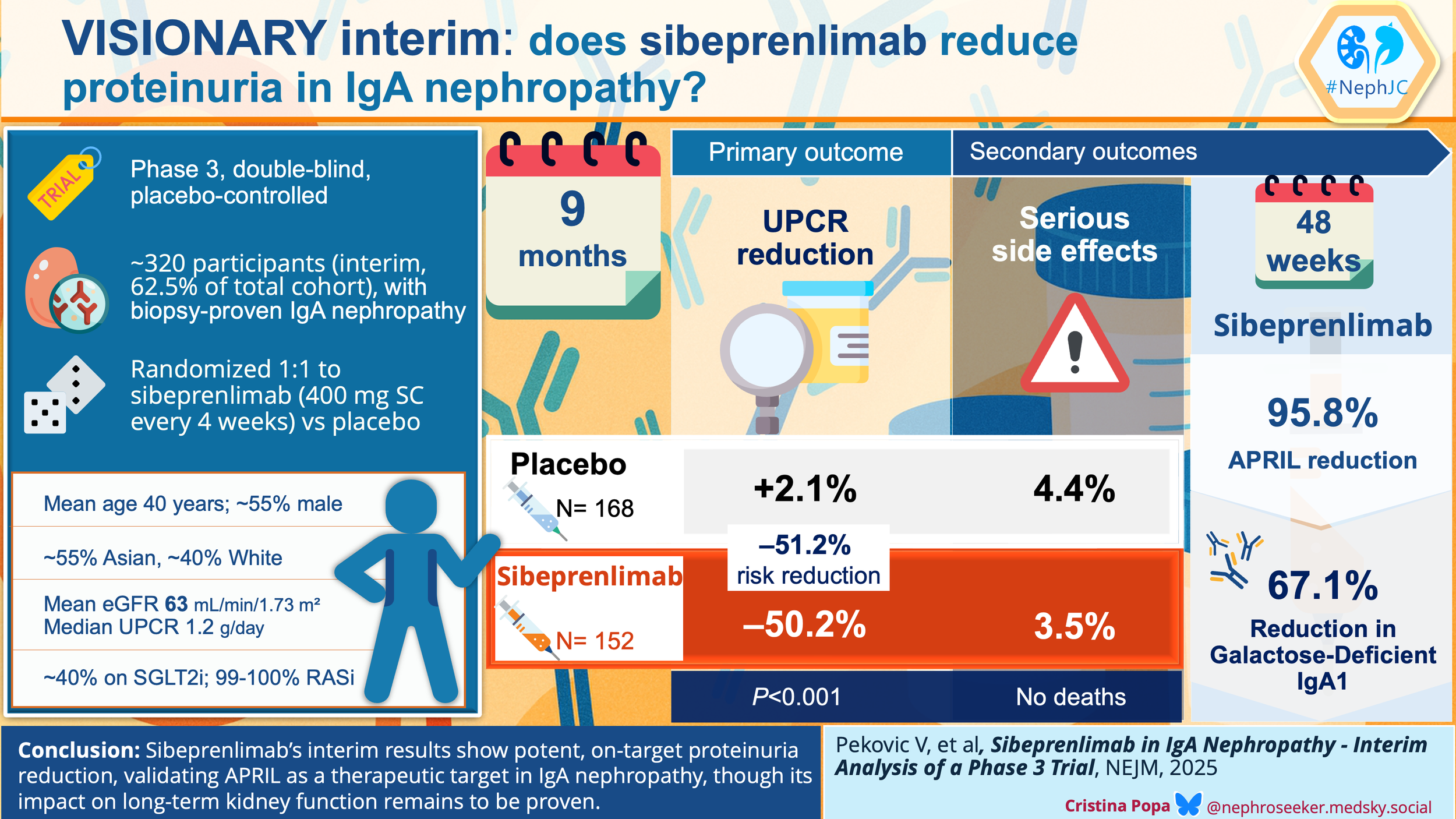
Day 3 of Kidney Week. Sibeprenlimab and Balcinrenone on NEJM and Lancet, plus a couple of other non-kidneywk studies.
Renal physiology and pathophysiology is widely regarded as one of the most challenging subjects in the pre-clinical studies of medical school. The challenging subject has been blamed for the downturn in interest in our fine specialty. To help combat this we have started an initiative where a medical students can post a question to Twitter and get an answers from practicing nephrologists and basic scientists. See the kick off post at PBFluids.
The way this works is, if a student has a question they post it to Twitter with the hashtag #AskRenal. We have a bot that scours Twitter for this hashtag and will retweet the question while tagging @NephJC. NephJC will amplify the question to its audience of nephrology nerds who will then provide answers tagging the initial questioner.

Everything is in place, we are just waiting to get some student questions.
Inorder to better promote this we would like to capture when different medical students teach renal physiology and renal pathophysiology. If you know the schedule of one or two medical schools, please enter the class timing on to this crowd sourced spreadsheet.
It's back. The original, slightly subversive, slightly funny, ASN Kidney Week Bingo board. Turn hobnobbing with the kidney elite into a competitive sport. Tweet out each of your squares with the hashtag #KidneyWkBingo. Let's make Nephrology Great Again!
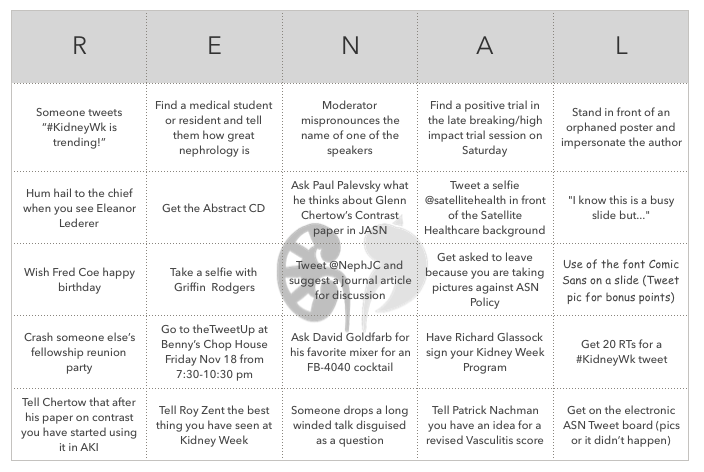
Click to download a PDF of the board
Check out the home page - great job by Peter Gallacher putting it together. See you all on April 26th or 27th. We hope to have an author online at the chat too. More soon!
A few months ago, we wrote about the nephro-twitterverse discovering twitter polls. Graham Abra and Thomas Hiemstra were early adopters, though response rates were ~ 20-40 at best then. But there are many more, with much better response rates. Check them out:
During #NephMadness, Krishna Penmatsa made a bunch of #PredictaPolls - check some notable ones:
Top Qualifier from Hypertension region at #NephMadness 2016 will be#PredictaPoll 📊
— Krishna Penmatsa (@krishnadoctor1) March 12, 2016
Top Qualifier from Pediatrics region at #NephMadness 2016 will be#PredictaPoll 📊
— Krishna Penmatsa (@krishnadoctor1) March 12, 2016
Top Qualifier from Palliative Care region at #NephMadness 2016 will be#PredictaPoll 📊
— Krishna Penmatsa (@krishnadoctor1) March 12, 2016
Graham, again, on IgA nephropathy and pregnancy
Young female w/ IgA nephropathy. Nml Cr. <500 mg/day proteinuria. Nml BP. Wants to get pregnant. You advise:
— Graham Abra, MD (@GrahamAbra) 19 December 2015
Tomas Rohal on tweeps preference of social networks
Really easy nephro poll (survey for short talk). Which social networks do you use communicating nephro stuff? Thx!
— Tomas Rohal (@calvapo) March 18, 2016
Matt on the deprescribing PPI question
Are you actively deprescribing PPIs in pts with no indication secondary to CKD association?
— Matt Sparks (@Nephro_Sparks) 16 April 2016
And the PPI article we discussed at #NephJC was actually decided on the basis of a twitter poll too!
Pick the next article NephJC article details at: https://t.co/hNluoTVqkg
— Nephrology Jrnl Club (@NephJC) 24 February 2016
What RRT modality would nephrons choose for themselves (sparked by a tweet from Scherly at #HDu)
Poll (only Nephrologists/fellows please). If *you* have ESRD, no living donor, Tx wait time > 5 years, would choose
— Swapnil Hiremath, MD (@hswapnil) April 18, 2016
Matt again on how nephrons refer to themselves
How do you refer to yourself to family and friends? (only nephrons please)
— Matt Sparks (@Nephro_Sparks) April 18, 2016
Joel (was he making fun of my #DreamRCT, #MAGIK?)
Does anybody really think supplementing Mg in ESRD would improve outcomes? https://t.co/fWOgS6QyRa
— Joel Topf, MD FACP (@kidney_boy) January 27, 2016
This was another great #NephJC. Notable for many firsts:
The transcripts and storifys are also already done - and up on the page, due to uber-fast curation from Hector.
Lastly, we have the pleasure of announcing the winners of the coveted #NEJMCup. There were many great tweets, so it took some time to sift through all the nominees. Here are the winning tweets:

T1: If faced the option of wait listing or incompatible living donor, I would be willing to take the risk #NephJC
— Kevin J. Fowler (@gratefull080504) April 13, 2016
@NephJC @calvapo #nephjc UK data also shows advantage but less impressive. Patient choice and expectation so important
— Sian Griffin (@toomuchaltitude) April 13, 2016
Congratulations, Kevin and Sian! Your #NEJMCups should be on the way soon, courtesy of the New England Journal of Medicine.
We are discussing an NEJM article next week (on that note check out the summary, written by Matt Graham-Brown). The hurdle? Its behind a subscriber-only wall - and this is an issue that has come up as a barrier for many of us not in academia or with a personal subscription to the Journal. However, the nice people at the Journal have kindly agreed to make it easily accessible for #NephJC readers - use the link on our summary page, and you will get the full text.
But there is more good news. Like what we have done in the past with JAMA, the best tweet of the night will get a prize. One for each chat.

The #NEJMCup!
Lastly, thanks to Lisa Rosenbaum for opening to doors to NEJM for us.
Back in fall 2015, we discussed one of the few positive trials in nephrology on #NephJC, on the use of therapeutic hypothermia for cooling deceased donors and the impact of subsequent graft function. To our pleasant surprise, a few weeks later, the lead author, Claus Niemann, replied in detail to our Pubmed Commons summary comment (see here).
A weeks ago, we noticed another comment on the same article, which pointed out that the record in clinicaltrials.gov had reported a different primary outcome, which indeed it did (primary outcome was terminal graft function in donor). We noted and tweeted out this comment, and the COMPARE group also replied.
Interesting comment on @PubMedCommons on hypothermia RCT in @nejm (#NephJC a while ago) https://t.co/gfXauxcVZH
— Swapnil Hiremath, MD (@hswapnil) February 23, 2016
(primary outcome switched)
@hswapnil @PubMedCommons @NEJM We hadn't, thanks. It's really concerning - this seems to be a systematic issue with certain journals.
— COMPare (@COMPare_Trials) February 24, 2016
But the story is not done yet. Today there is another comment on PubMedCommons, from Melissa Greenwald of the Health Resources and Services Administration, which funded the trial. From her review of documents, delayed graft function does seem to have been one of the primary outcomes, if not the main one. Read it and decide for yourself!
This week we bring two resources for both physicians and nurses caring for ESRD patients.
We present two brilliant essays by our newly minted interns of #NSMC (Nephrology Social Media Collective)
- Nikhil Shah
Thank you for all of you who have responded and filled out the #NephJC survey - over 300 respondents so far! We wanted to give a heads up to the rest of you - the survey will be closing soon. Wednesday 12 midnight Eastern is the deadline. We would love to hear from any of you who haven't had a chance to voice your opinion. So please go ahead and let us know what you think and how we can improve.
The #NephJC team has designed a survey - to get to know more about you and your opinions. It's a simple, short survey, that will not take more than a few minutes (we promise) to complete. We would really like you to complete all the questions, though the ones where we ask more about you are optional. The overall purpose of doing this survey is two-fold. Firstly, we would like to hear more about what you like, what you don't like and how we can improve what we are doing with #NephJC. The second purpose is to know a little bit about you - all of you, who are following us on twitter or on facebook, who tweet at the chats or who lurk, or who get our weekly mailer.
Needless to say, completing the survey is completely voluntary. None of your information will be divulged. We do have institutional review board approval (from the Ottawa Hospital Health Sciences Research Ethics Board) to conduct this survey.
Lastly, this survey is conducted with Google docs. This makes it simple and easy, but please answer to the best of your ability, truthfully, and complete it only once.
thanks!
The #NephJC team
A few months ago, we discussed this trial from Rajiv Agarwal and his team from Indiana, which found increased serious adverse vents with IV iron, in CKD patients. The latest issue of Kidney International now has some interesting correspondence, with two critical letters, and a substantive reply from Rajiv Agarwal.

Rajiv Agarwal
Among the criticism is one from Iain Macdougall and Simon Rogers, questioning the methodology - and why these results are different from the FIND-CKD trial (free PMC link), which did test a different IV iron formulation (iron carboxymaltose in FIND-CKD, iron sucrose in REVOKE), against a lower dose of oral iron. The reply from Dr Agarwal is worth reading in full, but this table highlights the details.

Table from Kidney International Vol 88, pg 1446-7
A few weeks ago, the folks at twitter announced they were rolling out Twitter polls. Previously, tweeps would use manually counting responses or the RT-if-you-agree Fav-if-you-don't approach. This is how the polls were supposed to work:
Coming soon! We're rolling out the ability for everyone to create polls on Twitter: https://t.co/pH5a8q9Ujz pic.twitter.com/ijAKEMUdf1
— Twitter (@twitter) October 21, 2015So what, you might say? A few users (notably @conradhackett from Pew research) played a lot with them, sample poll:
Would you rather spend the next week without TV or Twitter?
— Conrad Hackett (@conradhackett) October 30, 2015The ease of setting one up, and the option to just click and be done were some of the major selling points. But it wasn't clear if would be just a passing fad or something more. I used one at the #KidneyWk, but there were few responders
So @potasn said at #KidneyWk to end CKD staging. What's your take?
— Swapnil Hiremath, MD (@hswapnil) November 5, 2015Then Matt decided to poll the #nephjc followers after the suPAR chat
what do you think about suPAR predicting CKD #NephJC
— Nephrology Jrnl Club (@NephJC) November 25, 2015And Thomas Hiemstra decided to design his next #DreamRCT on therapy for Membranous nephropathy with a series of tweets:
.@hswapnil @NephJC eGFR=65, aPLA2R +, membranous on bx, 9g proteinuria after 6mths ACEi. Now, I would use:
— Thomas Hiemstra (@Thomas_Hiemstra) November 27, 2015.@hswapnil @NephJC Same scenario, GFR=65, I would randomise to Cyc vs Tacrolimus
— Thomas Hiemstra (@Thomas_Hiemstra) November 27, 2015Second scenario
.@hswapnil @NephJC eGFR=30, aPLA2R +, membranous on bx, 9g proteinuria after 6mths ACEi. Now, I would use:
— Thomas Hiemstra (@Thomas_Hiemstra) November 27, 2015.@hswapnil @NephJC Same scenario, GFR=30, I would randomise to Cyc vs Tacrolimus
— Thomas Hiemstra (@Thomas_Hiemstra) November 27, 2015And it wasn't long before Graham Abra re-ran an older question on the utility of urine eosinophils in allergic interstitial nephritis
Let's re-do this one with the slick new poll feature:
Do you order urine eos as part of your AIN workup?
— Graham Abra, MD (@GrahamAbra) November 27, 2015another one on the duration of steroids in SLE, in remission
In class III/IV lupus nephritis w/ clinical response to MMF+steroids how long is your maintenance rx?
— Graham Abra, MD (@GrahamAbra) November 27, 2015So we guess polls on twitter are here to say. Nephrology tweeps find it awesome (and I can say so with confidence, backed by facts, or shall we say, a poll?)
Nephro-twitter has suddenly caught on to Twitter polls tonight
— Swapnil Hiremath, MD (@hswapnil) November 27, 2015Swapnil Hiremath
As always, great job by Hector!
Both the chats were quite stimulating, we saw quite a number of new voices (whom we hope to see again!)
Hector did a great job, again, of storify-ing. Thanks again to Preeti Malani, Ed Livingston and the rest of the JAMA staff for their support. Look forward to the #JAMbag next time!
Maybe next #NephJC we can give away a @JAMA_current beach bag. But #JAMAbag doesn't have the ring of #JAMAcup @NephJC @kidney_boy @hswapnil
— Preeti Malani (@PreetiNMalani) August 13, 2015
RIPC = Remote Ischemic PreConditioning
We hope to see many of you in one of these chats. Thanks again to Preeti Malani, and the folks at JAMA for supporting us - both with providing a toll-free access to the article (at this link), and for providing some prizes - cool JAMA swag!

So for discussion, the topics will be
Part 2 continued to be epic - with first author Rafael Kramann joining in this time. Check out the storify from Hector below -
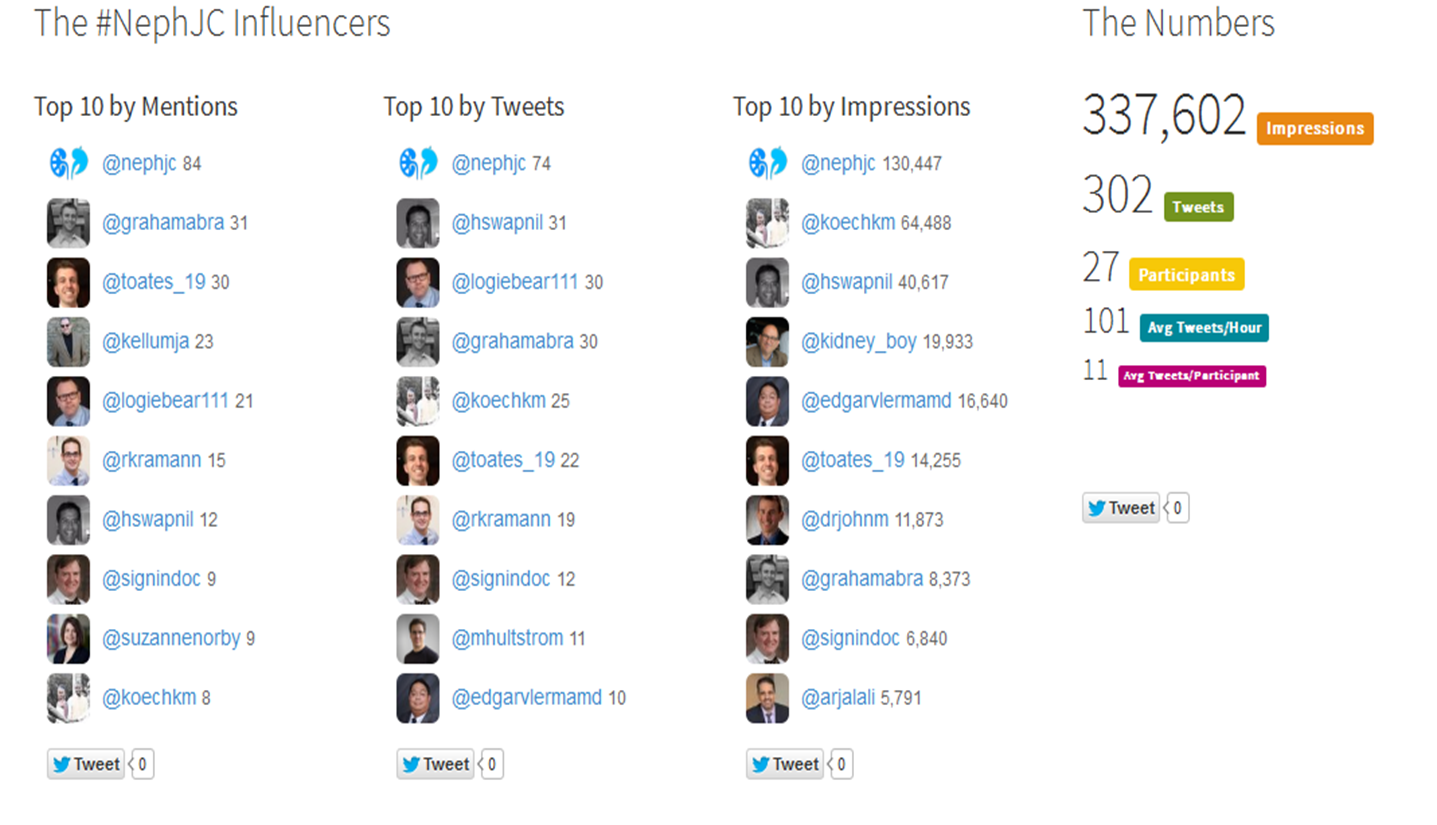
And the stats were equally impressive - overall picture captured by this tweet from Matt:
Here is the analysis of both #NephJC #Pericyte chats @hswapnil @kidney_boy i would say they were both #epic pic.twitter.com/D8Ul8J1Rft
— Matt Sparks (@Nephro_Sparks) July 30, 2015Not #parasites or ... #pedicure?
This was a fantastic chat last night, with great questions from Mal Parmar, Scott Brimble, Dylan Burger and others; clear and articulate answers from Ben Humphreys - and a link heavy tweeting from Matt Sparks. The transcript will read almost like a review article - or commentary.

Stay Tuned for the EU/African chat, occurring in just over 2 hours at 8 pm *BST* - with first author Rafael Kramann joinin in this time.

