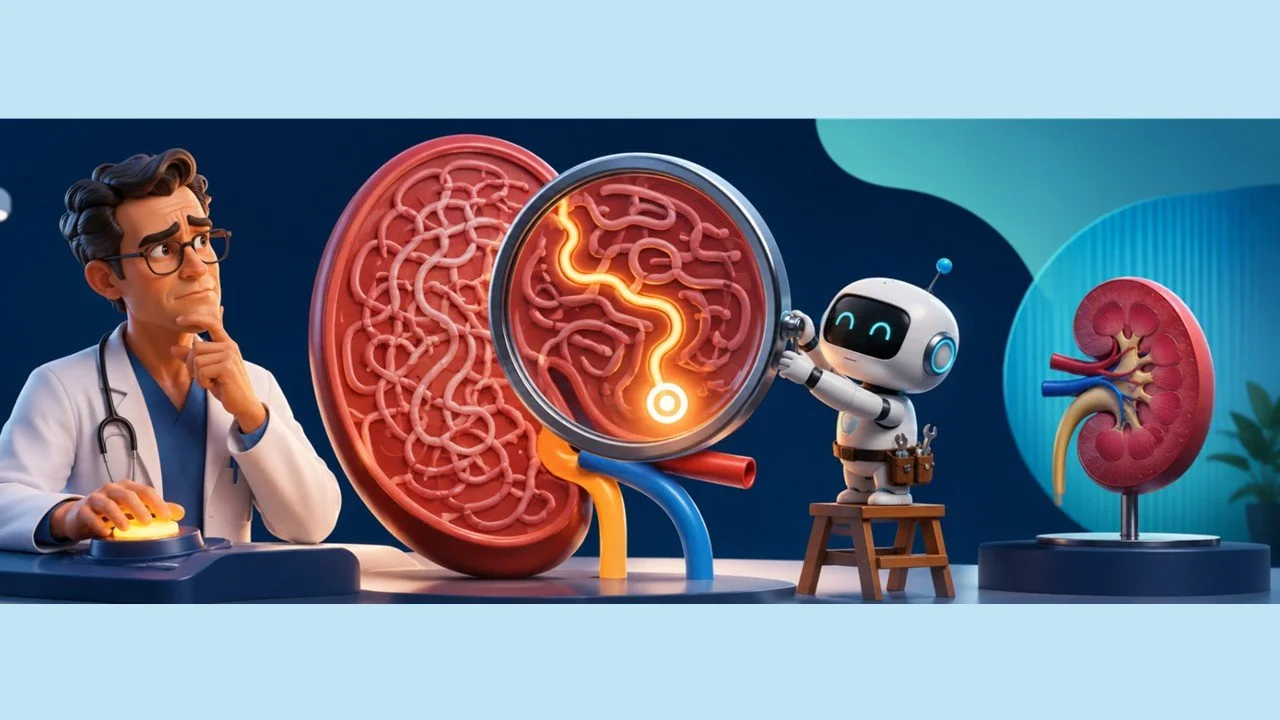
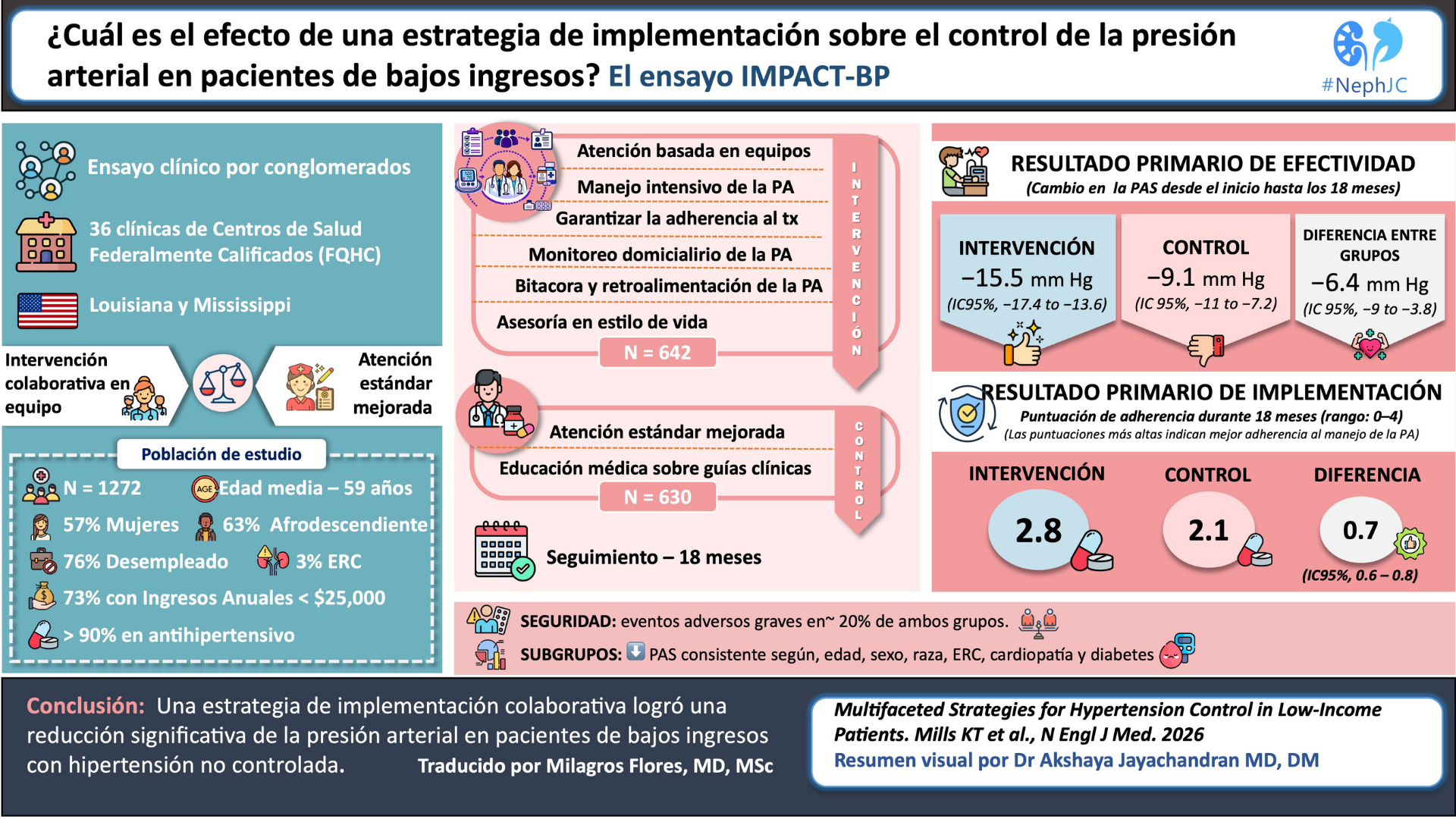
This week we will discuss whether a bundled, team-based hypertension intervention- featuring intensive BP targets, home monitoring, health coaching, and audit feedback- can overcome poverty, clinical inertia, and fragmented care to improve blood pressure control in low-income patients receiving care at federally qualified health centers.
IMPACTS-BP: The Visual Abstract
Can multifaceted strategies improve hypertension control in low-income patients?
Hypertension remains one of the leading cardiovascular risk factors worldwide. However, achieving adequate blood pressure control continues to be a major challenge, especially in low-income populations. The IMPACTS-BP trial has arrived, a study evaluating whether a multifaceted team-based strategy can improve blood pressure control and adherence to antihypertensive therapy.
Check out the VA by Dra Akshaya Jayachandran, and don’t forget to join the live discussion with @NephJC on X and Bluesky
El ensayo IMPACT-BP: El Resumen Visual
¿Puede el trabajo colaborativo mejorar el control de la hipertensión?
La hipertensión arterial continúa siendo uno de los principales factores de riesgo cardiovascular a nivel mundial. Sin embargo, lograr un adecuado control de la presión arterial sigue siendo un desafío, especialmente en poblaciones de bajos ingresos. Hoy aterriza el ensayo IMPACTS-BP, un estudio que evaluó si una estrategia multifacética basada en equipos puede mejorar el control y la adherencia al tratamiento antihipertensivo.
Revisa el resumen visual realizado por la Dra Akshaya Jayachandran y no olvides unirte en vivo con @NephJC en X y Bluesky
Can hydralazine trigger ANCA vasculitis?
A large registry cohort was essential to move beyond scattered case reports and finally quantify the true risk of hydralazine‑associated vasculitis. When rare events blur into background noise, only scale can clarify the signal. Can population‑level data sharpen the picture?
Check out Divya Bajpai VA
Advance-HTN: Return of the systolic order – Lorundrostat’s role in restoring balance
Underestimating primary aldosteronism?
Should we screen all individuals with hypertension for primary aldosteronism?
Undercover Aldosterone
BPROAD: Sprinting down the BP Road in Diabetes
NephJC Rewind: PATHWAY-2
The pressure is on! Unravelling the ESPRIT of Intensive vs Standard BP Control
This week, we will discuss the ongoing saga of blood pressure targets in patients with hypertension. This time its ESPRIT (Effects of Intensive Systolic Blood Pressure Lowering Treatment in Reducing Risk of Vascular Events) making a case for case for intensive BP control in most hypertensive individuals, including those with a history of diabetes and stroke.
The Balance of Giving: Understanding Risks for Living Kidney Donors
PRAECISely Predicting Preeclampsia
🤔 Does BP lowering matter for the kidneys after all?
Intensive BP Control in Patients with CKD and Risk for Adverse Outcomes (Ku, JASN 2023)
🤔 AT receptor action and dementia
Association of New Use of Antihypertensives That Stimulate vs Inhibit Type 2 and 4 Angiotensin II Receptors With Dementia Among Medicare Beneficiaries (Marcum, JAMA Open Network 2022)
🤔 Timing of BP medications, aka chronotherapy
Cardiovascular outcomes in adults with hypertension with evening versus morning dosing of usual antihypertensives in the UK (TIME study): a prospective, randomised, open-label, blinded-endpoint clinical trial (Mackenzie, The Lancet 2023)
🤔 Heterogeneity in BP response
TheHeterogeneity in Blood Pressure Response to 4 Antihypertensive Drugs: A randomized clinical trial (Sundstrom, JAMA 2023)
🤔 RASi + diuretics better than RASi + CCB in CKD?
A nationwide cohort study comparing the effectiveness of diuretics and calcium channel blockers on top of renin-angiotensin system inhibitors on chronic kidney disease progression and mortality (Faucon, Kidney International 2023)
🤔 Self managed BP control after pregnancy
Long-Term Blood Pressure Control After Hypertensive Pregnancy Following Physician-Optimized Self-Management: The POP-HT Randomized Clinical Trial (Kitt, JAMA 2023)
✏️ Salt reduction still lowers BP
Effect of Dietary Sodium on Blood Pressure: A Crossover Trial (Gupta, JAMA 2023)
We know reducing sodium intake lowers blood pressure (BP), but what is truly the effect in those with normal BP versus high BP? Those taking BP meds versus those who do not? In the Coronary Artery Risk Development in Young Adults (CARDIA)–SSBP trial (Gupta et al, JAMA 2023), the investigators enrolled 213 individuals either with normal BP or not, and either on BP meds with controlled or uncontrolled hypertension. They crossed over from the usual diet to low sodium (diet with 500 mg i.e. ~ 25 mmol sodium) and high sodium (with 2 bouillon packets, each containing 1100 mg of sodium added to the usual diet). The low sodium diet did result in lower BP in all subgroups, by about 5 - 6 mmHg SBP in the normotensive/controlled hypertension subgroups to about 9 - 190 mmHg SBP in the uncontrolled/untreated hypertension subgroups. Though the authors say these are not significantly different based on interaction p values, the subgroups are woefully underpowered to say that. Note that diet allocation was on alternate days, so this was not a randomized trial. Additionally - despite being provided food and daily phone calls, people on low sodium couldn’t stick to the provided saltless diet (24 hour urine sodium 1.7g rather than 0.5 g) and even the high sodium group couldn’t stomach the extra 2.2g bouillon (24 hour urine sodium went up from 4.6 to 5.5 rather than expected 6.8 g/day). So, an extremely low sodium diet does lower BP a bit, but it’s hard to achieve even if you are provided the food. Salt substitutes are so much more pragmatic!
Swapnil Hiremath
🤔 Does intensive BP Lowering worsen orthostatic hypotension?
Orthostatic Hypotension, Hypertension Treatment, and Cardiovascular Disease. An Individual Participant Meta-Analysis (Juraschek, JAMA 2023)