Majesty: El Resumen Visual

Recién llegado desde #ERA26, el estudio MAJESTY comparó obinutuzumab frente a tacrolimus y plantea importantes interrogantes sobre el futuro de las terapias anti-CD20 en la nefropatía membranosa primaria.

👑 ¿Será suficiente una depleción más profunda de células B para reclamar el trono?

📖 Revisa el más reciente resumen visual elaborado por la Dra Divya Bajpai

Nefrópatia no diabética: El Resumen Visual

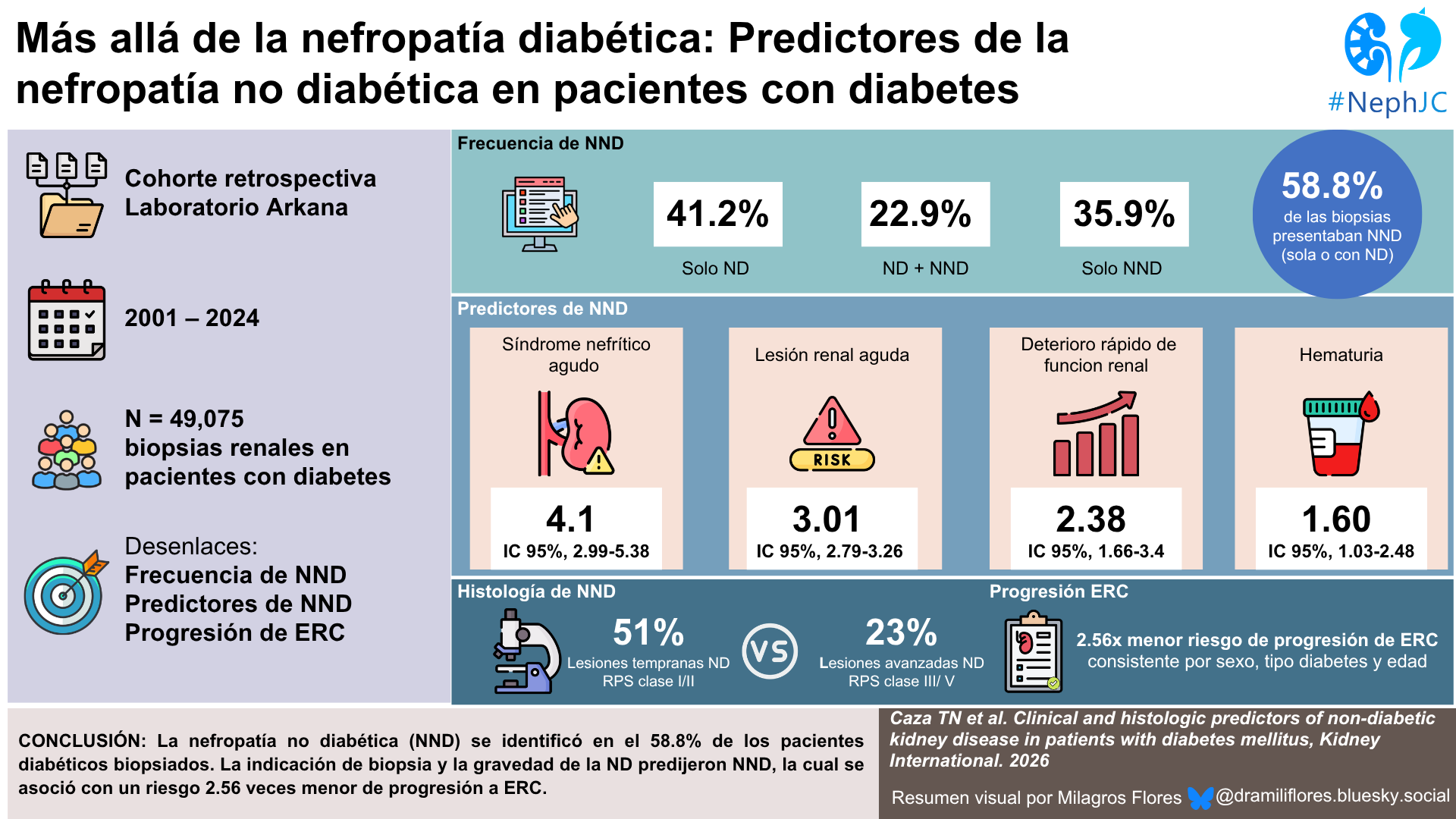
¿Hemos subestimado la frecuencia de la nefrópatía no diabética (NND) en pacientes diabeticos? Una cohorte basada en biopsias renales de 49,075 pacientes refuerza cuán heterogénea puede ser la NND y destaca las características clínicas más asociadas con la NND. ¿A quién debemos biopsiar? ¿Cuándo debemos sospecharla? ¿Cómo puede la histología cambiar el pronóstico?

Acompáñanos este martes en la discusión de #NephJC.

Nondiabetic Kidney Disease: The Visual Abstract

Have we been underestimating NDKD in patients with diabetes? A biopsy-based cohort of 49,075 patients reinforces just how heterogeneous kidney disease can be in DN and highlights the clinical features most strongly associated with NDKD. So, who should we biopsy? When should we suspect NDKD? And how can histology change prognosis?

Join us for this tuesday on the #NephJC discussion

Making an IMPACT on BP: Why pills alone won't win the war

Making an IMPACT on BP: Why pills alone won't win the war

This week we will discuss whether a bundled, team-based hypertension intervention- featuring intensive BP targets, home monitoring, health coaching, and audit feedback- can overcome poverty, clinical inertia, and fragmented care to improve blood pressure control in low-income patients receiving care at federally qualified health centers.

IMPACTS-BP: The Visual Abstract

Can multifaceted strategies improve hypertension control in low-income patients?

Hypertension remains one of the leading cardiovascular risk factors worldwide. However, achieving adequate blood pressure control continues to be a major challenge, especially in low-income populations. The IMPACTS-BP trial has arrived, a study evaluating whether a multifaceted team-based strategy can improve blood pressure control and adherence to antihypertensive therapy.

Check out the VA by Dra Akshaya Jayachandran, and don’t forget to join the live discussion with @NephJC on X and Bluesky

El ensayo IMPACT-BP: El Resumen Visual

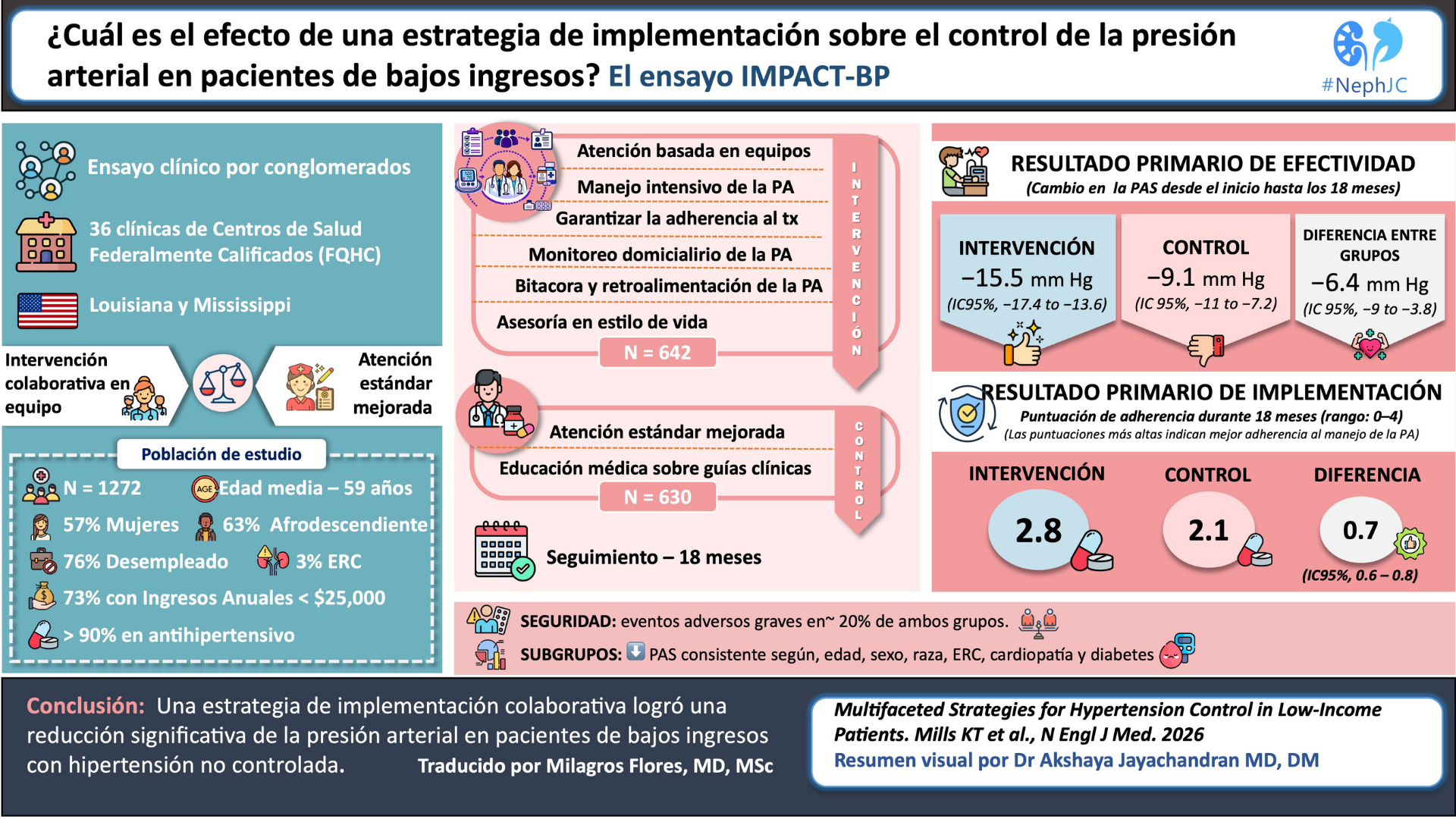
¿Puede el trabajo colaborativo mejorar el control de la hipertensión?

La hipertensión arterial continúa siendo uno de los principales factores de riesgo cardiovascular a nivel mundial. Sin embargo, lograr un adecuado control de la presión arterial sigue siendo un desafío, especialmente en poblaciones de bajos ingresos. Hoy aterriza el ensayo IMPACTS-BP, un estudio que evaluó si una estrategia multifacética basada en equipos puede mejorar el control y la adherencia al tratamiento antihipertensivo.

Revisa el resumen visual realizado por la Dra Akshaya Jayachandran y no olvides unirte en vivo con @NephJC en X y Bluesky

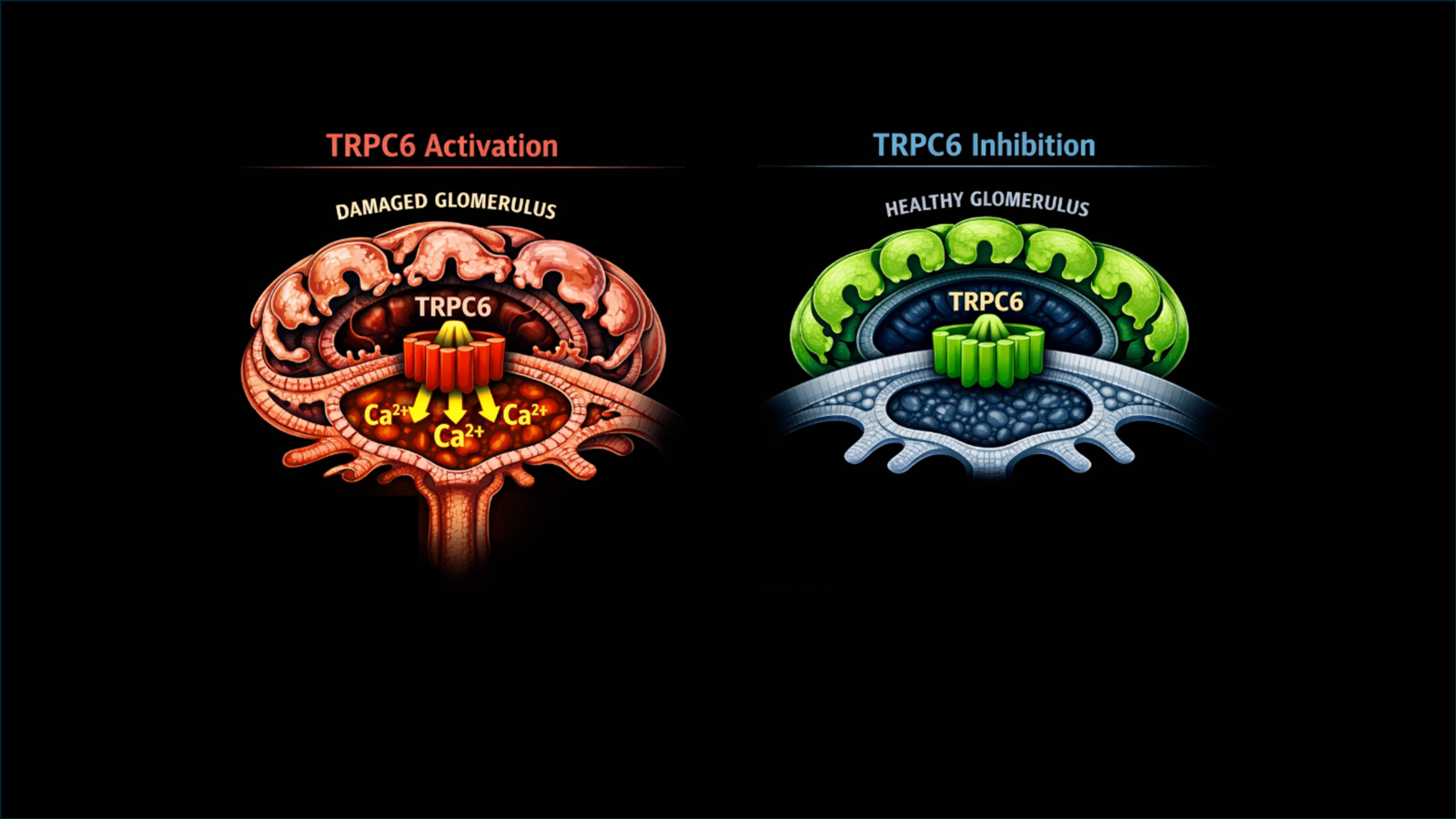
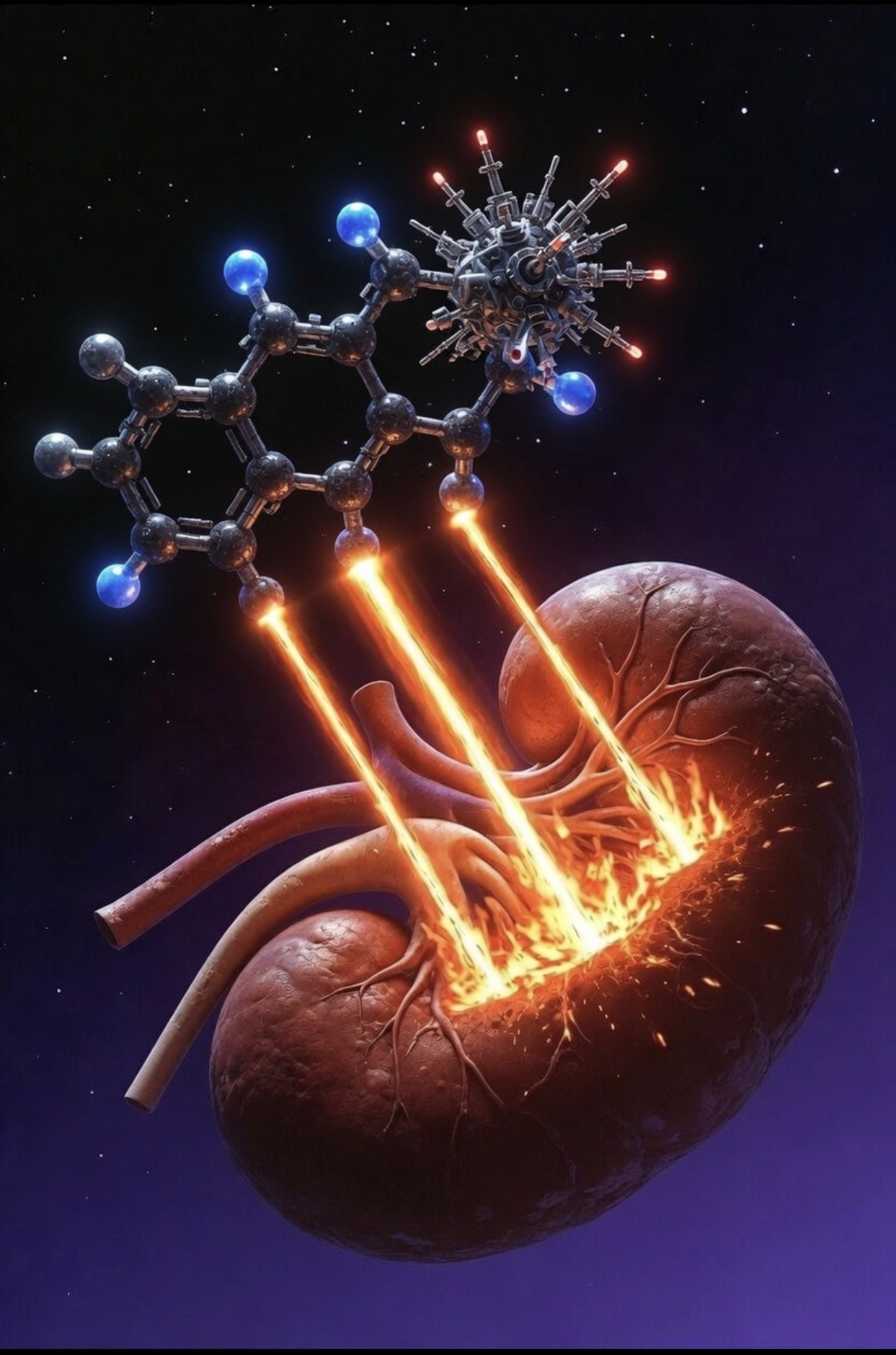
Is TRPC6 inhibition for FSGS a trick or a treat?

Is TRPC6 inhibition for FSGS a trick or a treat?

This week, we will discuss a phase 2 trial of the TRPC6 inhibitor BI 764198 in FSGS—an early signal for a podocyte-targeted therapy showing proteinuria reduction but set against small numbers, heterogeneity, and methodological trade-offs that frame this as direction-finding rather than definitive evidence.

Inhibidor de TRPC6: El Resumen Visual

Por primera vez, una terapia dirigida al podocito muestra eficacia clínica en GEFyS. Esta semana #NephJC revisa el ECA fase 2 de BI 764198, inhibidor oral de TRPC6, que redujo proteinuria, estabilizó el FGe y fue bien tolerado. ¿El inicio de una nueva era en GEFyS? Revisa el resumen visual por la Dra Divya Bajpai

TRPC6 inhibition: The Visual Abstract

For the first time, a podocyte-targeted therapy shows clinical efficacy in FSGS. This week #NephJC covers the phase 2 RCT of BI 764198, an oral TRPC6 inhibitor that lowered proteinuria, preserved eGFR, and was well tolerated. A new era in FSGS? Check out the visual abstract by Divya Bajpai

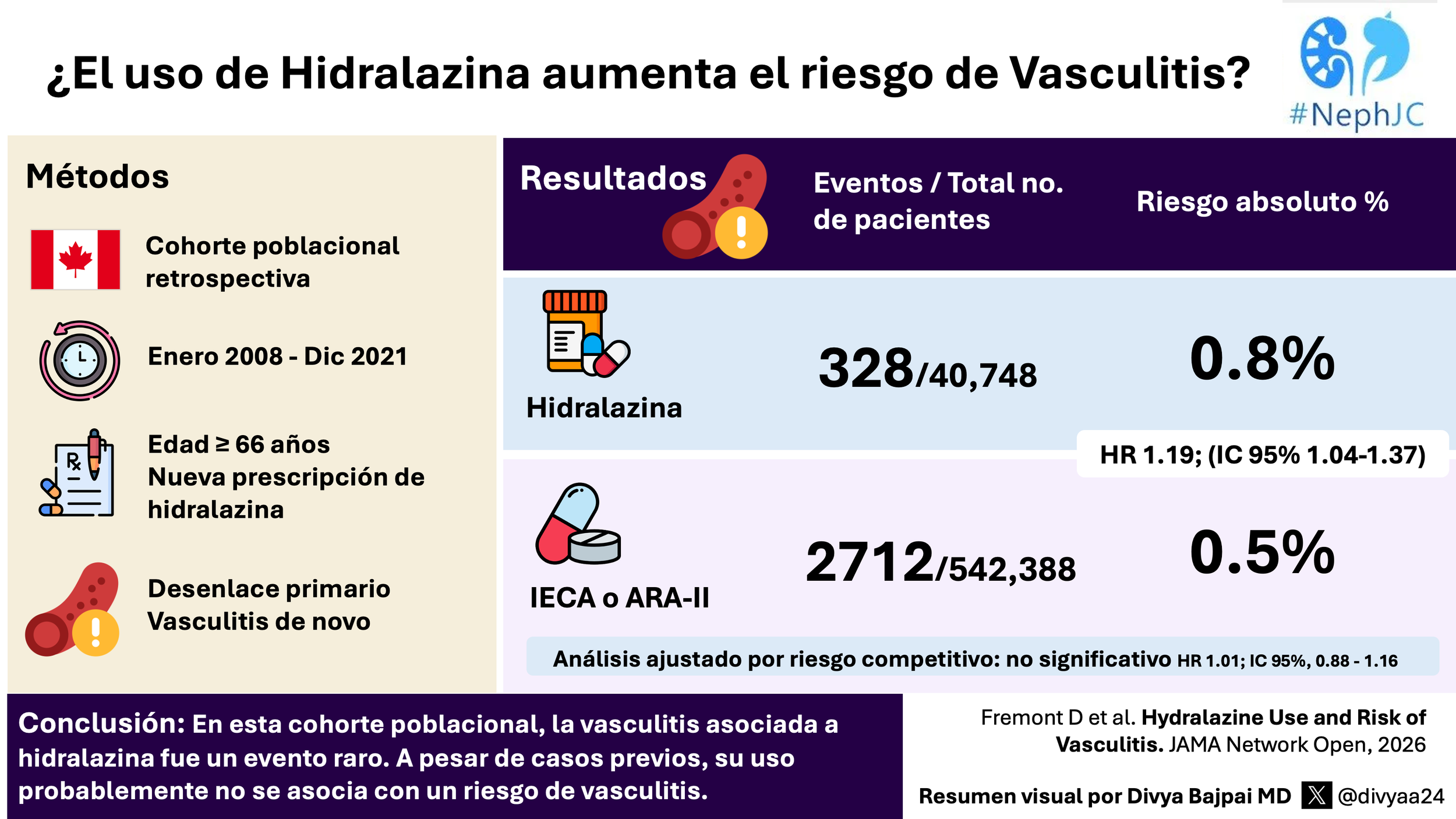
Why-dralazine?! Population risk of drug induced vasculitis

Why-dralazine?! Population risk of drug induced vasculitis

This week, we will discuss why a large registry cohort was needed to move past decades of scattered case reports and clarify the true risk of hydralazine‑associated vasculitis. When rare events hide in noise, only scale can reveal the signal. Can population‑level data finally bring this paradox into focus?

Can hydralazine trigger ANCA vasculitis?

A large registry cohort was essential to move beyond scattered case reports and finally quantify the true risk of hydralazine‑associated vasculitis. When rare events blur into background noise, only scale can clarify the signal. Can population‑level data sharpen the picture?

Check out Divya Bajpai VA

¿Puede la hidralazina desencadenar vasculitis ANCA? El resumen visual

Un gran registro poblacional era esencial para superar décadas de reportes aislados y cuantificar por fin el riesgo real de la vasculitis asociada a hidralazina. Cuando los eventos raros se confunden con el ruido de fondo, solo la escala permite distinguir la señal. ¿Puede la evidencia a nivel poblacional aclarar por fin este panorama?

Revisa el resumen visual por Divya Bajpai , traducir por Milagros Flores

Regarding the Situation with…Social Media in General

Regarding the Situation with…Twitter, Bluesky, Social Media

We at #NephJC pride ourselves on bringing you the best in nephrology publications and innovations without commercial bias. As we’ve stated during many a donation drive, we are beholden to none but our followers and readers.

Having said that, we’ve noticed a trend since the death of Twitter (yes, it will always be Twitter to the real FOAMed illuminati). The diaspora of NephTwitter were scattered throughout the nephro-universe of social media, never quite finding a new home. Perhaps the downfall of the Nephrologians can be a plot line for the next Mandalorian season?? Many left the social media space altogether because of the division, politicization and plain BS of some of the algorithms (I for one don’t need to see EVERYTHING Elon posts). However, we still believe there is a need for our unique style of nephrology education. Jon Stewart- yes, the comedian- recently likened social media to smoking: an addictive, attention seeking habit that is generally recognized as not healthy for most people and that is likely to be regulated for teen and self-regulate by adults. He believed the antidote was more long-form, nuanced edu-tainment. So, it light of the changing landscape, we are going to focus more on our blogs, VAs, and podcasts and less on live discussions on Bluesky.

NephJC is nothing if not nimble, and we have never been afraid of change.

So, given the low attendance at live chats (no judgement) we’re changing to a summary thread (a new 10 posts) with provocative questions to answer, at your leisure. We hope this keeps the discussions going without the need to be on social media for prolonged periods or at a specific hour and day. These threads will be posted at the familiar 9pm EST every other Tuesday. This shorter form will also allow us to post on multiple sites, and hopefully we will be easily accessible to you where you chat with other nephrophiles. Feel free to reply, chat, tag people in conversations whenever and wherever you see a #NephJC post. The team will be around, but we won’t be actively ‘moderating’ a one hour chat.

Sincerely,

NephJC Leadership


PS: As always we love to hear from our audience. If you have suggestions, or a better way to reach more people, we are all ears. Heck, if we hear enough complaints we might even bring back the chats!😉